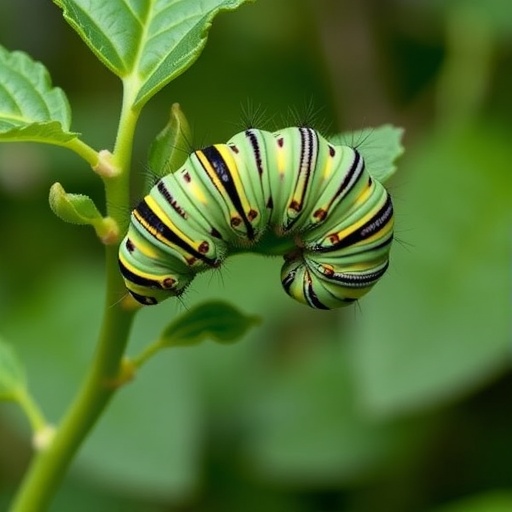
In the intricate world of plant defense mechanisms, recent research has unveiled an astonishing example of biochemical communication that transcends species boundaries. Bean plants, when attacked by caterpillars, do not simply passively endure the herbivory. Instead, they initiate a sophisticated defense strategy by emitting volatile organic compounds (VOCs) that act as chemical distress signals. These signals specifically recruit predatory wasps, natural enemies of the caterpillars, initiating a tritrophic interaction that effectively protects the plant from further damage.
At the core of this remarkable communication is a protein known as the inceptin receptor, or INR. This receptor plays a crucial role in sensing the presence of caterpillar herbivores. The receptor recognizes specific peptides—breakdown products derived from caterpillar digestion—that are perceived as elicitors by the plant. Upon detection, the INR initiates a cascade of intracellular signaling events that culminate in the production and release of VOCs capable of drawing predatory wasps to the site of infestation.
A groundbreaking study led by researchers at the University of Washington has shed new light on how the INR functions under natural conditions. Conducted in experimental fields in Oaxaca, Mexico—a region known for its rich biodiversity and traditional agricultural practices—the researchers cultivated bean plants harboring natural mutations that knocked out the INR gene function. These mutant plants, when subjected to caterpillar attack, failed to emit the usual defense-related VOCs. Consequently, they attracted significantly fewer predatory wasps compared to their wild-type counterparts with a functional INR gene.
This direct demonstration of the integral role of INR provides the first concrete genetic evidence linking plant immune receptors to the modulation of multitrophic interactions in the field. The implications extend far beyond basic plant biology; they underscore the power of a single protein in orchestrating complex ecological dynamics involving plants, herbivores, and predators. The recruitment of wasps as biological control agents is not only a fascinating natural phenomenon but also presents a potential avenue for sustainable pest management strategies in agriculture.
The emitted volatile compounds serve as chemical beacons in the environment. Wasps, which are highly sensitive to these chemical cues, navigate toward infested plants, seeking out caterpillars as prey. This recruitment of natural enemies signifies a critical evolutionary adaptation that benefits the plant by reducing herbivore pressure, minimizing leaf damage, and thereby preserving photosynthetic capacity and overall plant fitness. The research highlights that these VOCs do more than serve the individual plant; they likely confer protective benefits to neighboring plants, particularly in mixed cropping systems.
Indeed, the study points towards ecological ramifications for agricultural practices, especially in the context of companion planting. Beans often grow alongside crops like corn, a practice rooted in Indigenous agriculture referred to as the “Three Sisters.” This synergy is known for nutrient exchange and soil enhancement, but now, through mechanisms involving INR and VOC-mediated recruitment of predatory wasps, bean plants may also provide biotic protection to their companions. Such insights advocate for integration of ecological principles in crop management, encouraging the design of agroecosystems that harness natural defense networks.
The discovery of INR’s role opens up exciting prospects for molecular breeding and biotechnology. By enhancing or transferring INR-related pathways to other crop species, scientists may engineer plants that possess enhanced capabilities to recruit natural enemies of pests. This could reduce reliance on synthetic chemical insecticides, fostering environmentally friendly approaches that promote biodiversity and ecosystem health. Additionally, understanding the ligand-receptor interactions at the biochemical level offers a target for discovering synthetic analogs to artificially trigger plant defenses.
From a molecular perspective, the INR receptor belongs to the class of pattern recognition receptors (PRRs) that detect herbivore-associated molecular patterns (HAMPs). This involvement highlights parallels between plant immune responses to microbial pathogens and insect herbivory, expanding our comprehension of plant immunity beyond pathogen defense. The intricate signaling pathways downstream of INR activation may involve reactive oxygen species generation, activation of mitogen-activated protein kinase cascades, and ethylene biosynthesis, all contributing to the robust emission of VOCs.
Further research is poised to dissect how different predatory wasp species respond to the bouquet of volatiles deployed by bean plants. Such specificity in predator attraction could shape community structures and influence pest population dynamics. The identification of key volatile components and their biosynthetic genes remains an important frontier that will enable precise manipulation of plant volatile profiles for optimized pest control.
This integrative work also resonates with ecological theory on tritrophic interactions, whereby plants harness the natural enemies of their herbivores as an indirect defense. It vividly illustrates the complexity and sophistication of ecological relationships that sustain agricultural productivity. The study’s experimental design, combining genetics, field ecology, and chemical ecology, has set a benchmark for future interdisciplinary research aiming to decode the interplay between plants and their ecological partners.
Notably, the study emphasizes the context-dependency of plant defense responses. Environmental factors such as temperature, humidity, and the presence of other biotic agents modulate the effectiveness and expression of INR-mediated signaling. Thus, the ecological validity of these findings is strengthened by their observation under realistic field conditions, underscoring the relevance of this research for practical applications in crop protection worldwide.
In conclusion, the elucidation of how a single gene coding for the INR receptor governs the dynamic dialogue between bean plants, caterpillars, and wasps marks a transformative advance in plant science. It showcases nature’s ingenuity in crafting chemically mediated alliances that safeguard plant health and sustain agricultural ecosystems. As we deepen our understanding of such natural defense systems, there lies tremendous potential to innovate sustainable pest management solutions that align with ecological integrity and food security.
Subject of Research: Plant defense mechanisms mediated by the inceptin receptor (INR) linking caterpillar detection to recruitment of predatory wasps
Article Title: A plant immune receptor mediates tritrophic interactions by linking caterpillar detection to predator recruitment
News Publication Date: 27-May-2026
Web References:
https://www.science.org/doi/10.1126/sciadv.aec3229
https://www.washington.edu/news/2020/12/03/caterpillar-cowpea-defense/
References:
Behnken, B., Guayazán Palacios, N., Wu, D., Chaparro, A., Sheppard, B., & Steinbrenner, A. (2026). A plant immune receptor mediates tritrophic interactions by linking caterpillar detection to predator recruitment. Science Advances. DOI:10.1126/sciadv.aec3229
Image Credits: Brian Behnken/University of Washington
Keywords: Plant immunity, inceptin receptor, volatile organic compounds, tritrophic interaction, biological pest control, predatory wasps, herbivore-induced plant defense, companion planting, sustainable agriculture, pattern recognition receptor, molecular ecology, agroecosystem biodiversity
Tags: bean plants caterpillar detectioncaterpillar herbivore recognitionchemical signaling in plantsecological research in Oaxacainceptin receptor functionnatural plant pest controlPlant defense mechanismsplant immune response proteinsplant-insect biochemical communicationpredatory wasps recruitmenttritrophic interactions in agriculturevolatile organic compounds in plants