• HOME
  • NEWS
  • EXPLORE
    • CAREER
      • Companies
      • Jobs
    • EVENTS
    • iGEM
      • News
      • Team
    • PHOTOS
    • VIDEO
    • WIKI
  • BLOG
  • COMMUNITY
    • FACEBOOK
    • INSTAGRAM
    • TWITTER
Sunday, May 17, 2026
BIOENGINEER.ORG
No Result
View All Result
  • Login
  • HOME
  • NEWS
  • EXPLORE
    • CAREER
      • Companies
      • Jobs
        • Lecturer
        • PhD Studentship
        • Postdoc
        • Research Assistant
    • EVENTS
    • iGEM
      • News
      • Team
    • PHOTOS
    • VIDEO
    • WIKI
  • BLOG
  • COMMUNITY
    • FACEBOOK
    • INSTAGRAM
    • TWITTER
  • HOME
  • NEWS
  • EXPLORE
    • CAREER
      • Companies
      • Jobs
        • Lecturer
        • PhD Studentship
        • Postdoc
        • Research Assistant
    • EVENTS
    • iGEM
      • News
      • Team
    • PHOTOS
    • VIDEO
    • WIKI
  • BLOG
  • COMMUNITY
    • FACEBOOK
    • INSTAGRAM
    • TWITTER
No Result
View All Result
Bioengineer.org
No Result
View All Result
Home NEWS Science News Chemistry

‘Hot’ electrons in metallic nanostructures — non-thermal carriers or heating?

Bioengineer by Bioengineer
November 4, 2019
in Chemistry
Reading Time: 2 mins read
0
IMAGE
Share on FacebookShare on TwitterShare on LinkedinShare on RedditShare on Telegram

IMAGE

Credit: Yonatan Dubi & Yonatan Sivan


What happens to a piece of metal when you shine light on it? This question, which has been one of the driving forces of modern physics, gained renewed interest in recent years, with the advances in fabrication of small metallic nano-particles. When the piece of metal is very small, it turns out that it can couple extremely well to visible light. The study of fundamental and applicable aspects of this interaction is typically referred to as plasmonics.

Within the field of plasmonics – and considering metallic nanoparticles – two different answers emerged to the question posed above. The first, which relies on classical physics and is quite intuitive, is that the nanoparticle heats up. Indeed, the fact that illuminated nanoparticles serve of localized heat sources has found a wide variety of applications, from cancer treatment to water desalination. The second answer is gentler, and suggests that upon illumination, the electrons deviate from equilibrium and occupy a non-Fermi distribution, characterized by an excess of electrons at high energies, so-called “hot electrons”.

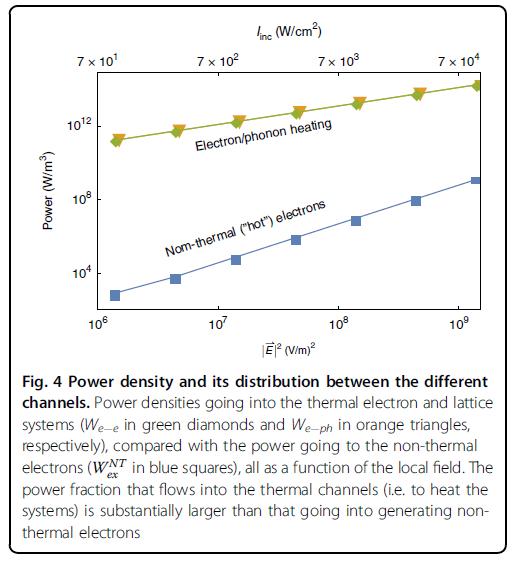
These two pictures, heating vs “hot electrons”, are typically presented as orthogonal, and theories either treat one or the other. In a recent work, conducted by the groups of Prof. Yonatan Sivan and Yonatan Dubi (both from Ben-Gurion University, Israel), these two pictures were merged into a single theoretical framework, which enabled them to fully evaluate both the electron distribution and the electron and lattice temperatures of an illuminated nanoparticle. Their research results were published in Light: Science and Applications.

The picture that emerges from their study is that indeed the two effects – heating and generation of “hot electrons” – are present. Yet, in contrary to many recent claims, heating is far more important, and uses most of the illumination power input. Only a tiny fraction (less than one millionth) of the power input is channeled towards generation of “hot electrons”, which is thus an extremely inefficient process.

Many experimental and theoretical studies have celebrated the promise of exploiting “Hot Electrons” to perform various functions, from photo-detection to photo-catalysis. The work of Sivan and Dubi allows for a realistic evaluation of energy harvesting efficiency using “hot” electrons, and provides the limits of this efficiency. Furthermore, it serves as an essential first step towards realistic calculations of the complete energy harvesting process in many systems, from plasmonic-enhanced photo-catalytic systems to solar cells.

###

Media Contact
Yonatan Dubi
[email protected]

Related Journal Article

http://dx.doi.org/10.1038/s41377-019-0199-x

Tags: Chemistry/Physics/Materials SciencesOptics
Share12Tweet8Share2ShareShareShare2

Related Posts

New Drexel Study Reveals Key to Keeping Students on Track in Physics Learning — Chemistry

New Drexel Study Reveals Key to Keeping Students on Track in Physics Learning

May 15, 2026
Reversible Glue Technology Powers Up with Electric Activation — Chemistry

Reversible Glue Technology Powers Up with Electric Activation

May 15, 2026

Sweet as Honey: Unveiling a New Heat Transport Regime in Ultrathin Semiconductors

May 15, 2026

High-Precision Boltzmann Luminescent Nanothermometry Achieved Through Predictive Rules

May 15, 2026
Please login to join discussion

POPULAR NEWS

  • Research Indicates Potential Connection Between Prenatal Medication Exposure and Elevated Autism Risk

    844 shares
    Share 338 Tweet 211
  • New Study Reveals Plants Can Detect the Sound of Rain

    730 shares
    Share 291 Tweet 182
  • Salmonella Haem Blocks Macrophages, Boosts Infection

    62 shares
    Share 25 Tweet 16
  • Breastmilk Balances E. coli and Beneficial Bacteria in Infant Gut Microbiomes

    58 shares
    Share 23 Tweet 15

About

We bring you the latest biotechnology news from best research centers and universities around the world. Check our website.

Follow us

Recent News

Detecting Illicit Bitcoin Transactions with Temporal Graph Learning

New Study Reveals the Massive Economic Impact of Tuberculosis

Age Discrimination Affects Healthcare Use in India

Subscribe to Blog via Email

Enter your email address to subscribe to this blog and receive notifications of new posts by email.

Join 82 other subscribers
  • Contact Us

Bioengineer.org © Copyright 2023 All Rights Reserved.

Welcome Back!

Login to your account below

Forgotten Password?

Retrieve your password

Please enter your username or email address to reset your password.

Log In
No Result
View All Result
  • Homepages
    • Home Page 1
    • Home Page 2
  • News
  • National
  • Business
  • Health
  • Lifestyle
  • Science

Bioengineer.org © Copyright 2023 All Rights Reserved.