For people living with anxiety, depression and exhaustion disorder, recovery often stalls despite years of medication and talk-based therapy. A new qualitative study from Sweden now offers one of the most detailed explanations yet of why a very different kind of treatment — spending structured time on a farm, in forests and with horses — can restart that stalled process. The research, published in the Scandinavian Journal of Occupational Therapy, followed twenty mental health service users through a 24-week nature-based intervention and built a grounded theory of what actually happens inside them as they recover. The answer, the researchers conclude, is not primarily cognitive or pharmaceutical. It is embodied: recovery is felt in the body first, then reflected upon, and finally carried home into everyday life.
The study was led by Marie Gudmundsson, a doctoral student and registered occupational therapist at Lund University, together with Anna Maria Pálsdóttir of the Swedish University of Agricultural Sciences, Daniel Sutton of Auckland University of Technology, and Ulrika Bejerholm and Elisabeth Argentzell of Lund University. Using Charmaz’s constructivist grounded theory approach, the team conducted in-depth, face-to-face interviews on site at a farm-based rehabilitation centre in southern Sweden, surrounded by deciduous and coniferous forest, brooks, valleys, ridges and pastures. The interviews were transcribed verbatim — including participants’ sighs, deep breaths, tears and laughter, which the researchers treated as embodied data — and analysed iteratively with NVIVO 14 until theoretical saturation was reached. The result is a core concept the authors call ‘a process of embodied recovery’, built from three interlocking concepts: experiencing interconnection, processing inner connection and feeling intra-connected.
The intervention itself was deliberately designed to work ‘body-up’ rather than ‘head-down’. Delivered in groups of about eight participants, the 24-week programme ran in two phases. In the first phase, participants attended the farm three days a week for three hours; in the second, two days a week with less staff support and more shared responsibility. Early activities emphasised self-rewarding occupational value — being guided to relax and unwind by a fire, near a brook, beneath a tree or while resting on horseback. Only gradually did participants take on work-like tasks such as mucking out pastures, cleaning water tubs or helping build fences. Every activity was presented as a suggestion, with participants free to join or not, a design feature that proved central to the recovery process. The programme drew on the Alnarp method of nature-based rehabilitation and on more than two decades of practice in equine-assisted therapy, and the therapy horses were trained and prepared according to international IAHAIO welfare guidelines.
The first concept, ‘experiencing interconnection’, describes how transactions between participants and their environment — nature, horses, other animals, peers and staff — initiated a recovery that had long been stalled. Participants repeatedly contrasted the low-demand, person-centred atmosphere of the farm with earlier experiences of mental health care that they perceived as stressful, demanding and impersonal. One participant, given the pseudonym Steve, described the relief of arriving without any formal introductions: ‘You kind of feel like you belong, you’re not standing out.’ Another, Lucy, speculated that if she had been referred to such a programme after her previous full-time sick leave, she might have returned to work three years earlier. The natural environment itself was described as a kind of co-worker and even a form of medicine; one participant said a guided forest walk felt ‘as if you inject a bit of the forest into your veins’.
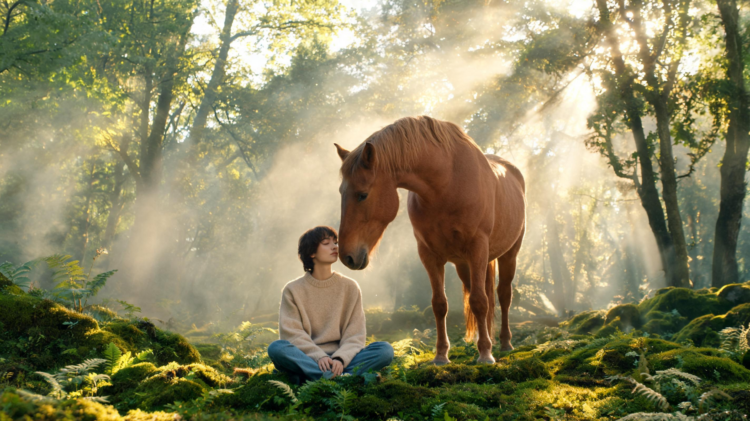
Interacting with horses emerged as one of the most valued and effective components of the entire intervention. Participants described lying on a horse’s back while the animal grazed, head resting against its flank, listening to it chew, and experiencing what one called ‘total peace’. Several said this gave them an entirely new reference point for what relaxation actually feels like. One participant realised she had been physically tense and stressed for years without knowing it, and that resting on the horse produced ‘a physiological shift in the body’ that ordinary rest did not. The researchers suggest that co-regulation with the horse’s calm nervous system may facilitate a depth of relaxation that talk-based strategies alone struggle to reach — a mechanism consistent with evidence that human-animal contact raises oxytocin levels and promotes attachment, and that nature exposure reduces sympathetic autonomic activity and even amygdala activity after a single walk.
The second concept, ‘processing inner connection’, describes how multisensory experiences opened a reflective process in which participants began to recognise their own needs and emotions again. Many described a sudden, unexpected change of emotional state — one participant’s therapist independently noticed that her ‘façades just disappeared along the way’. Others needed more time: one woman initially disliked the horses entirely, finding them smelly and shedding, and only after several sessions did resting on horseback begin to work for her. The multisensory dimension was striking. One participant described her perception shifting from a flat ‘2D painting’ into three dimensions the moment her sense of smell returned, recalling that ‘the first time I could actually smell something, I was happy’. Others reported slowly regaining access to a full palette of feelings — more sadness, but also more joy — after years of emotional shutdown, and developing an almost physical longing for the smells of the stable and the forest that revealed how much they had needed to be outdoors.
The third concept, ‘feeling intra-connected’, captures how participants integrated these new embodied experiences into a whole sense of self and carried them into daily life. Participants described empowerment through self-understanding — one said she finally understood her illness and what she could do to get well, as if ‘some sort of code has been cracked’. Others made concrete life changes: one began keeping a diary spontaneously, another planned to move to a house with a garden after realising that ‘gardening really calms me’, and another recreated the programme’s rhythms at home, lying down under blankets with her dog after walks in nature. Participants contrasted this with sick leave alone, which one said may have protected her from breaking down ‘but it didn’t make me feel better’. Childhood memories resurfaced in the forest, strengthening identity and family connections, and participants described learning to say no, set boundaries and make healthier choices throughout the day.
The researchers frame these findings through the lens of personal recovery — the subjective, individualised process of living a meaningful life despite persistent symptoms, as captured in the widely used CHIME framework of connectedness, hope, identity, meaning and empowerment. What the new study adds is a theoretical model showing how those elements can be reached through the body rather than the mind alone. Drawing on Merleau-Ponty’s phenomenology of perception and on occupational science, the authors argue that the intervention moved beyond the mind–body dualism that still dominates much of Western health care. Transactions with the environment grounded in each person’s earlier embodied experiences enabled trust and self-discovery; reflection on those experiences lowered participants’ guards and opened what one cited study calls ‘sensory channels’; and integration of the embodied self with the social and natural world produced belonging, hope and empowerment in daily life.
The clinical implications are significant. The participants, who had on average nearly ten years of psychiatric care behind them, reported solely positive experiences of the intervention — a finding the authors acknowledge may partly reflect relief and gratitude after years of treatments that offered little progress, and which they flag for further study. They argue that mental health services should complement medication and talk-based therapies with interventions offering safe, supportive, positive multisensory experiences, and that professional education should prepare staff to support recovery from a holistic, embodied perspective. The importance of duration also echoes earlier findings that longer nature-based rehabilitation, up to 24 weeks, supports more sustainable recovery and faster return to work than shorter programmes. The authors note that implementing longer, more complex interventions may require greater initial investment, depending on whether they add to or replace existing treatments.
The study also acknowledges its limitations: interviews were conducted on site in the natural environment, which may have coloured participants’ responses; the analysis was conducted after all interviews; and combining interviews with direct observation might have captured negative experiences more fully. Member-checking with two former participants, one of whom had not been interviewed, refined the final model and strengthened its realism. Even so, the researchers present their tentative model as a new conceptual depiction of how nature-based intervention can be experienced as an embodied journey towards recovery — one in which the body, the environment and meaningful occupation work together to re-open a path that medication and conversation alone had failed to clear. For a growing group of service users whose recovery has stalled in conventional care, the message is that healing may begin not with words, but with the smell of a stable, the sound of a horse chewing, and the felt sense of finally being safe enough to rest.
Subject of Research: Mental health service users’ embodied experiences of personal recovery during a nature-based intervention including equine-assisted therapy
Article Title: ‘An Embodied Journey Towards Recovery’: A Grounded Theory of Mental Health Service Users’ Experiences of a Nature-based Intervention
Article References: Gudmundsson, M., Pálsdóttir, A. M., Sutton, D., Bejerholm, U., & Argentzell, E. (2026). ‘An Embodied Journey Towards Recovery’: A Grounded Theory of Mental Health Service Users’ Experiences of a Nature-based Intervention. Scandinavian Journal of Occupational Therapy, 33(1), Article 3. https://doi.org/10.1007/s44474-026-00003-5
Image Credits: AI Generated
DOI: 10.1007/s44474-026-00003-5
Keywords: nature-based intervention, equine-assisted therapy, mental health recovery, embodiment, occupational therapy, grounded theory, sensory processing, anxiety, depression, exhaustion disorder, animal-assisted therapy, rehabilitation
Cite Scienmag News
APA
MLA
Chicago
Glenn Wilkins. (September 3, 2026). Horses, Forests and Healing: How Nature-Based Therapy Embodies Mental Health Recovery. Scienmag. https://scienmag.com/horses-forests-and-healing-how-nature-based-therapy-embodies-mental-health-recovery/
Glenn Wilkins. “Horses, Forests and Healing: How Nature-Based Therapy Embodies Mental Health Recovery.” Scienmag, 3 September 2026, https://scienmag.com/horses-forests-and-healing-how-nature-based-therapy-embodies-mental-health-recovery/. Accessed 3 September 2026.
Glenn Wilkins. “Horses, Forests and Healing: How Nature-Based Therapy Embodies Mental Health Recovery.” Scienmag. September 3, 2026. https://scienmag.com/horses-forests-and-healing-how-nature-based-therapy-embodies-mental-health-recovery/
Copy citation
Download RIS
Tags: animal-assisted therapyanxietyDepressionembodied healing in natureembodimentequine-assisted therapyequine-assisted therapy benefitsexhaustion disorderfarm-based mental health treatmentforest therapy for anxiety and depressiongrounded theorygrounded theory approach in therapy studiesholistic mental health recovery methodsmental health recoverymental health recovery through outdoor activitiesnature-based interventionnature-based therapyoccupational therapyoutdoor therapy for exhaustion disorderqualitative study on nature-based interventionsrehabilitationrole of natural environments in mental healthScandinavian mental health treatment researchsensory processing