• HOME
  • NEWS
  • EXPLORE
    • CAREER
      • Companies
      • Jobs
    • EVENTS
    • iGEM
      • News
      • Team
    • PHOTOS
    • VIDEO
    • WIKI
  • BLOG
  • COMMUNITY
    • FACEBOOK
    • INSTAGRAM
    • TWITTER
Wednesday, October 7, 2026
BIOENGINEER.ORG
No Result
View All Result
  • Login
  • HOME
  • NEWS
  • EXPLORE
    • CAREER
      • Companies
      • Jobs
        • Lecturer
        • PhD Studentship
        • Postdoc
        • Research Assistant
    • EVENTS
    • iGEM
      • News
      • Team
    • PHOTOS
    • VIDEO
    • WIKI
  • BLOG
  • COMMUNITY
    • FACEBOOK
    • INSTAGRAM
    • TWITTER
  • HOME
  • NEWS
  • EXPLORE
    • CAREER
      • Companies
      • Jobs
        • Lecturer
        • PhD Studentship
        • Postdoc
        • Research Assistant
    • EVENTS
    • iGEM
      • News
      • Team
    • PHOTOS
    • VIDEO
    • WIKI
  • BLOG
  • COMMUNITY
    • FACEBOOK
    • INSTAGRAM
    • TWITTER
No Result
View All Result
Bioengineer.org
No Result
View All Result
Home NEWS Science News Biology

Hormone involved in obesity is a risk factor for sepsis

Bioengineer by Bioengineer
June 22, 2020
in Biology
Reading Time: 2 mins read
0
IMAGE
Share on FacebookShare on TwitterShare on LinkedinShare on RedditShare on Telegram

IMAGE

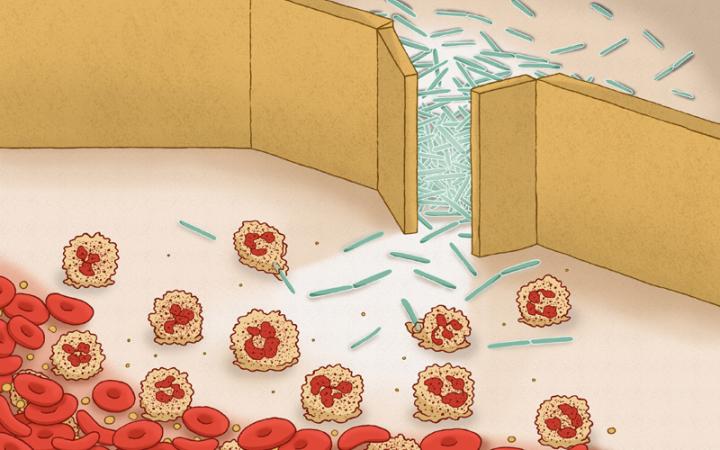
Credit: Joana Carvalho, IGC 2020

The work developed in collaboration with researchers from France, Germany and South Korea was recently published in the scientific journal PNAS – Proceedings of the National Academy of Sciences USA.

Sepsis is a potentially fatal illness, that derives from a deregulated response of the organism to an infection, leading to organ malfunction. A study recently published in the scientific journal The Lancet, estimated that in 2017 sepsis affected 49 million people and 11 million people worldwide have died. With the aim of expanding knowledge about this disease, Luis Moita’s team at IGC investigated whether the hormone known as GDF15 (growth and differentiation factor 15) could play a role in sepsis. This hormone has the specificity of being widely studied by several laboratories and pharmaceuticals as a treatment for obesity.

“We’ve discovered a critical effect of GDF15 on infection, which is relevant because this hormone increases in many common diseases, like obesity, pulmonary and cardiovascular diseases”, explains Luís Moita.

IGC researchers measured GDF15 levels in blood samples from patients with sepsis, under treatment in intensive care units, and compared these levels with the ones of healthy individuals and of patients diagnosed with appendicitis. Results have shown that sepsis patients had increased levels of GDF15 when compared with the other groups, and that the high levels of the hormone were correlated with mortality.

The research proceeded with the study in mice that didn’t had the GDF15 gene. The results obtained revealed that mice survived better to a bacterial abdominal infection that resembles sepsis in human patients, suggesting that the hormone plays a role in sepsis. Subsequently researchers studied what was causing the increased survival rate in mice that didn’t had GDF15. They noted that these mice were able to substantially recruit more white blood cells for the abdomen, specially neutrophils, better controlling locally the infection and preventing it from spreading rapidly to the rest of body.

“At a time when many pharmaceutical companies and groups are considering using GDF15 as a complementary therapy for obesity, it’s important to have in mind that this therapeutic strategy could increase the risk of severe infection, including sepsis”, Luís Moita warns.

Regarding the results of this research work, IGC researcher says that “they raise the possibility that the inhibition of GDF15’s action, perhaps using a blocking monoclonal antibody, could work as a new complementary therapy for sepsis, helping to control severe local infections and preventing it to become systemic and life-threatening”.

Finding new therapeutic strategies to fight sepsis is essential for saving lives.

###

Media Contact
Ana Morais
[email protected]

Original Source

https://gulbenkian.pt/ciencia/news/hormone-obesity-risk-factor-for-sepsis/

Related Journal Article

http://dx.doi.org/10.1073/pnas.1918508117

Tags: BiologyDiagnosticsInfectious/Emerging Diseases
Share12Tweet8Share2ShareShareShare2

Related Posts

Gut bacteria team up: how fiber's effects depend on microbial neighbors

Gut bacteria team up: how fiber’s effects depend on microbial neighbors

October 7, 2026
Lockdowns Weren't the Real Job Killer: Türkiye's Pandemic Labor Market Reexamined

Lockdowns Weren’t the Real Job Killer: Türkiye’s Pandemic Labor Market Reexamined

October 7, 2026

Sow’s Milk Shields the Newborn Uterus From Chemical Disruption, Gene Study Reveals

October 7, 2026

Nature’s Immune Boosters: How Natural Adjuvants Could Transform Cancer Therapy

October 7, 2026
Please login to join discussion

POPULAR NEWS

  • Alloys That Shrink Their Own Grains: New PIX Mechanism Refines Metals With Heat Alone

    Alloys That Shrink Their Own Grains: New PIX Mechanism Refines Metals With Heat Alone

    29 shares
    Share 12 Tweet 7
  • Endurance Exercise Reshapes the Liver in Males and Females Through Distinct Molecular Routes

    29 shares
    Share 12 Tweet 7
  • Single Transcription Factor PU.1 Rapidly Converts Fibroblasts into Macrophage-Lineage Cells

    29 shares
    Share 12 Tweet 7
  • New Scale Measures How Ready Nurse Educators Really Are for the AI Era

    29 shares
    Share 12 Tweet 7

About

We bring you the latest biotechnology news from best research centers and universities around the world. Check our website.

Follow us

Recent News

Alloys That Shrink Their Own Grains: New PIX Mechanism Refines Metals With Heat Alone

Endurance Exercise Reshapes the Liver in Males and Females Through Distinct Molecular Routes

Single Transcription Factor PU.1 Rapidly Converts Fibroblasts into Macrophage-Lineage Cells

Subscribe to Blog via Email

Success! An email was just sent to confirm your subscription. Please find the email now and click 'Confirm' to start subscribing.

Join 85 other subscribers
  • Contact Us

Bioengineer.org © Copyright 2023 All Rights Reserved.

Welcome Back!

Login to your account below

Forgotten Password?

Retrieve your password

Please enter your username or email address to reset your password.

Log In
No Result
View All Result
  • Homepages
    • Home Page 1
    • Home Page 2
  • News
  • National
  • Business
  • Health
  • Lifestyle
  • Science

Bioengineer.org © Copyright 2023 All Rights Reserved.