


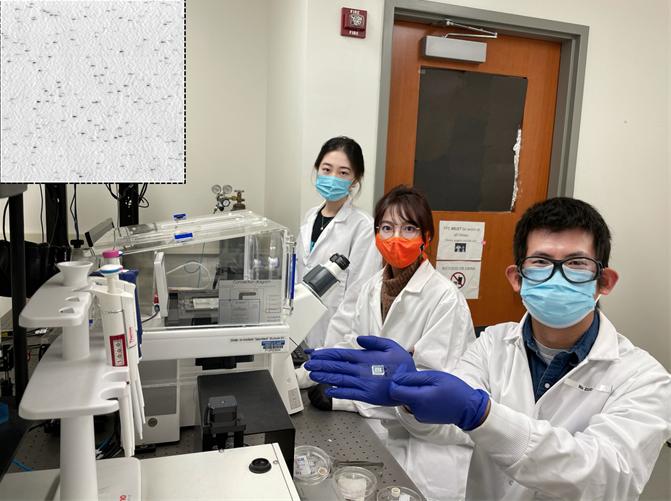
Credit: The Grainger College of Engineering
As the numbers of those infected with COVID-19 has continued to climb, the desperate need for a vaccine was apparent. Even now with the invention and administration of several COVID-19 vaccinations, the question remains: How effective are these vaccines? HMNTL students Congnyu Che, Weijing Wang, and Nantao Li, also members of the ECE Nanosensors Group, along with Postdoctoral Researcher Bin Zhao and Professor Brian Cunningham have recently been published in Talanta journal for the development of a cost efficient COVID-19 antibody test.
“Compared with other detection methods, our method is a simple, 15-minute sample-to-answer test,” says Zhao, a postdoctoral research associate and IGB Fellow. “It costs less than $2 per test and is used with a desktop detection system that is suitable for point-of-care situations like clinics and physician offices.”
When COVID-19 began developing into a global crisis in early 2020, this research group was already working on an NIH-funded project to develop a “flu chip” that would rapidly determine the most likely cause of a fever by measuring several proteins within a droplet of blood. They decided to pivot their efforts to detect COVID-19 antibodies instead.
“We made an important breakthrough at the end of May and our method started working,” says Congnyu Che, a BioE and Holonyak Lab graduate student. “After that, it took only a couple of months for us to complete all the experiments that measured detection limits, selectivity against other proteins, and the minimum time needed to get a result.”
Serological (detected by blood sample) antibody testing is an important diagnostic tool for combating the COVID-19 pandemic. Studies have shown that measurement of SARS-CoV-2 specific antibodies may be helpful for the diagnosis of suspected patients with negative RT-PCR results and for the identification of asymptomatic infections – a cause for concern as vaccinations may lessen or eliminate symptoms as well as prevent infection. Quantitative measurement of COVID-19 antibody titer is also vital for blood transfusion therapy, which has shown promising results for treating patients with severe symptoms.
“Quantitative assessment of COVID-19 antibody titer is especially important as clinicians and researchers more fully understand the patient-to-patient variability of immune response, in terms of the onset time for post-infection antibody production, and the post-recovery time that antibodies continue to be present,” says Weijing Wang, a BioE and Holonyak Lab graduate student. “As vaccines become available, it will be urgent for patients to know the extent to which their immune response has been stimulated.”
This highly sensitive, fast, and low-cost test demonstrates great potential for wide applications in diverse working environments. COVID antibody testing could become routine and simple as a variety of vaccines are deployed whose long-term protection is not yet fully known. The test is simple enough to be performed at schools, health clinics, pharmacies, and parts of the world where diagnostic laboratories are not available.
“Our developed method is not only rapid and simple, but also highly sensitive and quantitative. It also requires only a fingerstick quantity of blood (~ 4 μL),” says Nantao Li, an ECE and Holonyak Lab graduate student. “The method that we used to detect COVID-19 antibody can also be adapted to detect other molecules, such as antibodies to other viral pathogens, biomarkers for cardiac disease, and biomarkers for cancer.”
Members of the research group say that, as researchers in the field of disease diagnostics, their mission is to develop innovative analytical methods and tools to provide potentially effective solutions for global public health. They are eager to contribute their expertise to combat the COVID-19 pandemic.
“We are very glad we did it,” says Zhao. “Without any one of us, this group couldn’t have finished the work so quickly and efficiently. We all put forward many great ideas and were all very active during the experimental process.”
The team says they also want to encourage everyone to continue social distancing and mask wearing even as vaccines are distributed.
###
Media Contact
Lizzie Roehrs
[email protected]
Original Source
https:/
Related Journal Article
http://dx.



