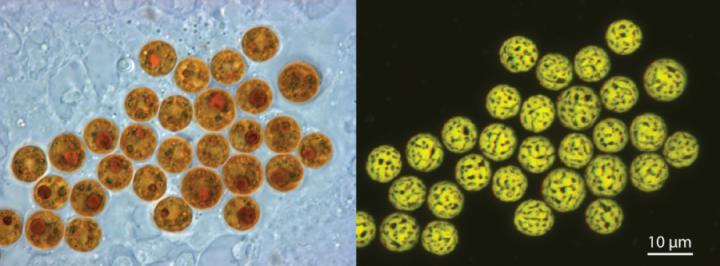
Credit: Allisonmlewis / CC BY-SA
Researchers from the School of Biological Sciences and Swire Institute of Marine Science at the University of Hong Kong are working to understand how the coral symbiosis may respond to global warming through changes in their microbiome, specifically their symbiotic algae. Using a newly developed method they revealed , which may be a determining factor in the sucthe metabolic function of algae changes in response to competition with other speciescess or failure of certain host-symbiont combinations.
The research, published in The ISME Journal, used single-celled algae (dinoflagellates) which were isolated from reef-building corals to understand how hotter ocean temperatures might influence their ability to compete against each other within their coral host. The work builds on decades of research which has honed in on certain types of algal species which confer heat resistance to their host. Why these heat-tolerant species are not more widespread has remained a mystery, until now.
“We know that the ability of corals to withstand warming oceans is related to their microbiome. You could say we are asking the same types of questions as a physician: Can we manipulate the host microbiome to improve coral health? Our paper demonstrates that the efficacy of probiotic treatments or assisted evolution might depend on how these microbes interact with each other” explains postdoctoral fellow Dr Shelby McIlroy who co-led the study with PhD student Jane Wong.
The experiments were conducted at two temperatures; a heated treatment to simulate a coral bleaching event and an unheated control. The researchers found that the heat-tolerant algae were poor competitors at both temperatures and adopted a “shelter-in-place” strategy by storing more fats and carbohydrates to persist through times of stress. At normal temperatures, the thermally sensitive species grew similarly whether the other species was present or not. However, with warming competition triggered a marked increase in resource consumption, essentially restricting the availability of growth resources to its competitors. What the researchers suggest is that thermally tolerant algae have failed to become more widespread because they are outcompeted in most scenarios and simply the “last-man standing” under conditions unsuitable for other species.
The researchers combined three established methods – Fluorescent In-Situ Hybridization (FISH), Flow Cytometry (Flow), and Stable Isotope Analysis (SIA) – to differentiate two species of algae from one another that were grown together in a mixed culture. After introducing isotopically labeled nutrients, the team allowed the cells to assimilate carbon and nitrogen prior to separating them for isotope analysis. In this way they could see if one species was obtaining more resources for growth and reproduction than the other – evidence of competition. They called the method FFS.
“FFS is an exciting marriage of established methods. We applied it to an interesting question related to corals, but it can be adapted for any microbial community – such as the human gut. In doing so we can begin to assign metabolic functions to certain bacteria which are known to be present and may express certain genes but whose actual function remains unknown.” said Dr David Baker, Associate Professor of School of Biological Sciences and Swire Institute of Marine Science who supervised the study.
###
This research was funded by the Research Grants Council Hong Kong General Research.
Media Contact
Cindy Chan
[email protected]
Original Source
https:/