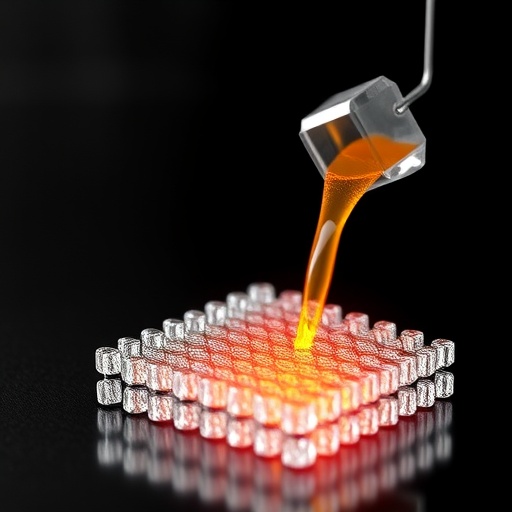
In a groundbreaking revelation that overturns a century of scientific consensus, researchers from the University of Hong Kong have demonstrated a significant piezoelectric effect in ultrathin polycrystalline diamond membranes. This discovery, spearheaded by Professor Zhiqin Chu and Professor Yuan Lin, challenges the long-held belief that diamond is inherently non-piezoelectric. Their work opens new frontiers in materials science, particularly in the functionalization and application of diamond in advanced microelectromechanical systems (MEMS) and energy harvesting technologies.
For over 100 years, diamonds have been categorized as non-piezoelectric due to their symmetrical crystalline structure, which was assumed to lack the inherent ability to generate electric charge under mechanical stress. Despite diamond’s exceptional mechanical robustness, ultra-high thermal conductivity, and large electronic bandgap, its role has been relegated primarily to that of a passive substrate in MEMS devices, supporting layers of genuinely piezoelectric materials. The intrinsic piezoelectric activity, or the ability to convert mechanical strain into an electrical signal, was considered absent in diamond, thereby limiting its utility in electromechanical applications.
The research overcomes this limitation by exploiting an innovative edge-exfoliation technique to fabricate polycrystalline diamond membranes that are not only ultrathin but also remarkably flexible. This mechanical pliability enables the otherwise rigid and brittle diamond to experience significant bending and deformation without fracture. When these membranes undergo controlled flexural strain, the team detected stable and reproducible voltage signals, a clear indication of piezoelectric behavior. This finding is unprecedented and points to previously untapped functionalities in diamond structures.
To rigorously rule out artefacts from environmental noise and other electrostatic effects such as triboelectricity, the experimental procedures included systematic mechanical cycling tests within carefully controlled environments. The results were consistently repeatable, affirming that the voltage signals arose from an intrinsic response within the diamond membrane rather than external interference. This level of scientific rigor strengthens the credibility of their claims and paves the way for new theoretical and practical explorations of diamond’s electromechanical properties.
At the atomic scale, first-principle computational modeling reveals that the piezoelectricity primarily originates at grain boundaries within the polycrystalline diamond. Unlike monocrystalline diamond, polycrystalline forms harbor asymmetries and defects at grain boundaries, which appear to accumulate charge polarization when mechanical stresses are applied. This localized charge imbalance generates an electric potential difference across the upper and lower surfaces of the membrane, effectively realizing a piezoelectric effect. It’s a profound insight that grain boundary engineering can unlock functionalities forbidden in perfect diamond lattices.
The implications of this discovery transcend fundamental materials science. Diamonds’ exceptional biocompatibility, chemical inertness, and mechanical durability make them ideal for medical and energy technologies. Piezoelectric diamond membranes could revolutionize implantable medical devices by providing self-sustaining power sources or highly sensitive deformation sensors capable of monitoring physiological signals in real-time without the need for external batteries. This represents a paradigm shift towards autonomous biomedical devices that harness body movement or biological forces for power generation.
Moreover, the exceptional thermal and mechanical properties of diamond membranes mean they could power next-generation energy harvesting systems with unprecedented stability and longevity. Devices built from piezoelectric diamond could operate reliably under harsh environmental conditions, opening applications in aerospace, industrial sensing, and remote infrastructure monitoring where durability and performance are paramount. This discovery heralds a new era of ultra-reliable micro-energy systems that utilize diamond’s robust nature alongside its newfound piezoelectric capabilities.
The research also introduces a compelling new avenue for material functionalization by manipulating microstructural features such as grain boundaries. This strategic structural engineering could be extended to other materials traditionally considered non-piezoelectric, potentially expanding the library of piezoelectric materials by harnessing microstructural asymmetries rather than relying solely on bulk crystal symmetry. It challenges conventional wisdom and may inspire a re-examination of other hard, inert materials that were previously overlooked for electromechanical applications.
Diamond’s integration into MEMS has typically focused on leveraging its mechanical and thermal attributes, but this discovery significantly broadens its application scope. The ability to generate electrical signals directly from a pure diamond membrane without additional piezoelectric layers simplifies device architecture, reduces fabrication complexity, and enhances device longevity. Future MEMS devices could be more compact, efficient, and resilient, with diamond serving as both substrate and active piezoelectric element.
Professor Zhiqin Chu’s team demonstrated a methodical blend of experimental precision and theoretical insight to validate this phenomenon. Their multidisciplinary approach combined advanced fabrication techniques with rigorous electrical characterization and comprehensive quantum mechanical modeling. Such integrative research exemplifies cutting-edge innovation at the intersection of physics, materials science, and engineering, setting a new benchmark for what is possible with carbon-based materials.
Looking ahead, this discovery invites intensified research into optimizing diamond membrane fabrication, tuning grain boundary characteristics, and tailoring their piezoelectric response. Scaling up production while maintaining membrane flexibility and piezoelectric efficiency will be key to commercial applications. The research community will also explore the integration of piezoelectric diamond membranes into complex device architectures, aiming to realize fully autonomous sensors, actuators, and energy harvesters with superior performance and durability.
The University of Hong Kong’s pioneering work fundamentally transforms our understanding of diamond’s properties and broadens the horizon for its practical applications. By uncovering an unexpected piezoelectric effect in a traditionally non-piezoelectric material, this research disrupts established paradigms and sparks a promising new chapter in advanced materials science and engineering.
Subject of Research: Not applicable
Article Title: Uncovering piezoelectric effect in polycrystalline diamond membranes
News Publication Date: 18-Mar-2026
Web References: http://dx.doi.org/10.1126/sciadv.aea8318
Image Credits: The University of Hong Kong
Keywords: Applied sciences and engineering, Engineering, Materials engineering, Mechanical engineering
Tags: advanced materials science breakthroughsdiamond mechanical propertiesdiamond piezoelectricity discoveryedge-exfoliation fabrication techniqueelectromechanical energy conversionenergy harvesting with diamondflexible diamond materialsmicroelectromechanical systems applicationspiezoelectric effect in diamond membranesPiezoelectric materials in MEMSultrathin polycrystalline diamond membranesUniversity of Hong Kong diamond research