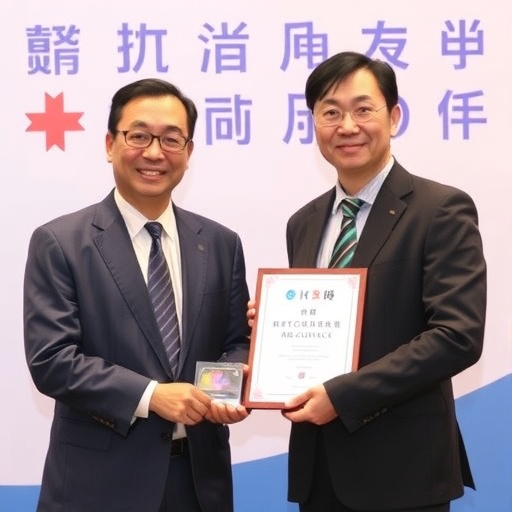
Professor YAO Wang, a luminary in the field of condensed matter physics at The University of Hong Kong (HKU), has been honored with a prestigious Certificate of Merit at the Fourth National Award for Excellence in Innovation. This accolade acknowledges his groundbreaking contributions to the emergent domain of valley optoelectronics in two-dimensional (2D) semiconductors, a frontier field that combines quantum mechanics with nanoscale materials science to revolutionize optoelectronic devices.
The National Award for Excellence in Innovation, presented triennially, seeks to identify and commend scientists whose work embodies innovation in fundamental research, pioneering exploration, technological breakthroughs, and impactful knowledge transfer. Professor Yao’s receipt of this award not only commemorates his individual scholarly achievements but also positions HKU at the forefront of global scientific inquiry in quantum materials. The ceremony, held on May 30 at the National Communication Center for Science and Technology in Beijing, underscored the strategic importance of his contributions to science and technology.
Valley optoelectronics, the core of Professor Yao’s work, exploits the quantum property termed the “valley degree of freedom” of electrons in 2D materials. Unlike charge or spin, the valley index is related to the momentum of electrons in distinct energy extrema within the electronic band structure. By harnessing this unique attribute, Professor Yao’s research advances the possibility of encoding information at the quantum level, paving the way for valley-based transistors, sensors, and novel quantum light sources that could outstrip conventional electronic devices in speed and energy efficiency.
Central to this research is the manipulation of 2D semiconductor materials such as transition metal dichalcogenides (TMDs), which exhibit strong spin-valley coupling due to broken inversion symmetry and pronounced spin-orbit interactions. Professor Yao’s investigations delve into how these properties can be tuned via external stimuli—like strain, electric fields, or optical pumping—to control valley polarization and coherence. This control is crucial for developing practical optoelectronic devices that leverage valley degrees of freedom under ambient conditions.
Professor Xiang Zhang, President and Vice-Chancellor of HKU, articulated the profound challenge and vision inherent in fundamental scientific research. He emphasized that Professor Yao exemplifies the intellectual resilience and courage necessary to navigate uncharted scientific territories. This national recognition not only honors Professor Yao’s ingenuity but also reinforces HKU’s pioneering role in advancing frontier science that underpins both national development and global technological transformation.
In his statement, Professor Yao expressed deep gratitude towards his research team, collaborators, and students whose dedication has been integral to achieving these scientific milestones. He conveyed a forward-looking commitment to expanding research in quantum materials, focusing on both elucidating basic scientific principles and fostering innovation technologies that could redefine the landscapes of electronics and photonics.
Professor Yao’s academic journey began at Peking University, where he obtained his Bachelor’s degree in 2001, followed by a PhD in Physics from the University of California, San Diego in 2006. Joining HKU in 2008, he has risen to the rank of Chair Professor in the Department of Physics. Throughout his career, his research has spanned diverse areas including condensed matter physics, quantum physics, and optics, with a distinctive emphasis on 2D materials and their heterostructures.
His research trajectory has been marked by international recognition, notably being named a Highly Cited Researcher by Clarivate annually since 2018, reflecting the significant impact of his work across the physics community. His accolades also include the Huang Kun Physics Award, the Nishina Asia Award, the OCPA Achievement in Asia Award, and prestigious fellowships and innovation awards that highlight his contributions to both fundamental science and applied physics.
Professor Yao’s exploration of valley pseudospin has opened promising pathways for next-generation valleytronic devices, which exploit quantum states beyond traditional electron charge and spin. By demonstrating how to generate, manipulate, and detect valley polarization optically and electrically, his research offers a revolutionary platform for integrated quantum technologies, potentially affecting quantum computing, secure communication, and ultra-sensitive detection.
The importance of valley optoelectronics derives from its promise to complement or even supersede existing paradigms in semiconductor technology, leveraging unique symmetry-breaking effects in atomically thin materials. These capabilities could transform conventional electronic architectures by introducing low-power, high-speed alternatives that internally utilize valley degrees of freedom to perform complex information processing tasks.
The multidisciplinary nature of Professor Yao’s research integrates physics, materials science, engineering, and optical technology, providing a fertile ground for cross-sector innovation. Collaborations with experimentalists and theoreticians worldwide have enhanced the understanding of valley physics phenomena and helped bridge the gap between fundamental discovery and device fabrication.
This award highlights the vital role of such basic research in fostering technological breakthroughs that resonate beyond academia. It accentuates the synergy between scientific curiosity and pragmatic innovation that drives progress in quantum materials science, inspiring the next generation of researchers to pursue bold inquiries into the unknown realms of quantum mechanics and nanotechnology.
Overall, Professor YAO Wang’s achievements continue to illuminate the path toward a new era of optoelectronic devices powered by quantum degrees of freedom. His pioneering work in valley optoelectronics not only enriches scientific knowledge but also bolsters the global quest for advanced, functional materials that will define the future of electronics, photonics, and quantum engineering.
Subject of Research: Valley optoelectronics in two-dimensional semiconductors and quantum materials
Article Title: HKU’s Professor YAO Wang Honored for Pioneering Contributions to Valley Optoelectronics
News Publication Date: 30 May 2024
Web References: https://www.scifac.hku.hk/press
Keywords
Valley optoelectronics, two-dimensional semiconductors, quantum materials, condensed matter physics, spin-valley coupling, transition metal dichalcogenides, quantum degree of freedom, valley polarization, HKU, innovation award, quantum devices, fundamental research
Tags: condensed matter physics innovationsfundamental research in quantum materialsHKU scientific innovation recognitionnanoscale optoelectronic devicesNational Innovation Excellence AwardsProfessor Yao Wang achievementsquantum materials at HKUquantum mechanics in 2D materialstechnological breakthroughs in optoelectronicstwo-dimensional semiconductor technologiesvalley degree of freedom in electronicsvalley optoelectronics research