

• HOME
  • NEWS
  • EXPLORE
    • CAREER
      • Companies
      • Jobs
    • EVENTS
    • iGEM
      • News
      • Team
    • PHOTOS
    • VIDEO
    • WIKI
  • BLOG
  • COMMUNITY
    • FACEBOOK
    • INSTAGRAM
    • TWITTER
Tuesday, August 11, 2026
BIOENGINEER.ORG
No Result
View All Result
  • Login
  • HOME
  • NEWS
  • EXPLORE
    • CAREER
      • Companies
      • Jobs
        • Lecturer
        • PhD Studentship
        • Postdoc
        • Research Assistant
    • EVENTS
    • iGEM
      • News
      • Team
    • PHOTOS
    • VIDEO
    • WIKI
  • BLOG
  • COMMUNITY
    • FACEBOOK
    • INSTAGRAM
    • TWITTER
  • HOME
  • NEWS
  • EXPLORE
    • CAREER
      • Companies
      • Jobs
        • Lecturer
        • PhD Studentship
        • Postdoc
        • Research Assistant
    • EVENTS
    • iGEM
      • News
      • Team
    • PHOTOS
    • VIDEO
    • WIKI
  • BLOG
  • COMMUNITY
    • FACEBOOK
    • INSTAGRAM
    • TWITTER
No Result
View All Result
Bioengineer.org
No Result
View All Result
Home NEWS Science News Biology

HKU fossil imaging helps push back feather origins by 70 million years

Bioengineer by Bioengineer
December 18, 2018
in Biology
Reading Time: 2 mins read
0
IMAGE
Share on FacebookShare on TwitterShare on LinkedinShare on RedditShare on Telegram

IMAGE

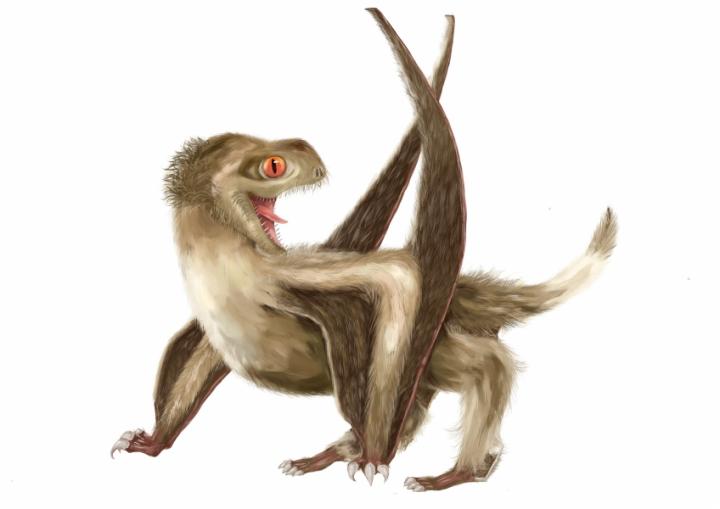
Credit: @Reconstruction by Yuan Zhang


In a new study published in the journal Nature Ecology & Evolution, an international team led by Professor Baoyu Jiang of Nanjing University and including Dr Michael Pittman of the Department of Earth Sciences, the University of Hong Kong, shows that pterosaurs had at least four types of feathers in common with their close relatives the dinosaurs, pushing back the origin of feathers by some 70 million years.

Pterosaurs and dinosaurs are closely related reptiles that lived from about 230 to 66 million years ago. Reptiles are generally known for their scales, but pterosaurs evolved a furry covering — often called ‘pycnofibres’ — that was presumed to be fundamentally different from the feathers of birds and other dinosaurs, until now. The new study shows that pterosaurs had at least four types of feathers: (1) simple filaments (‘hairs’), (2) bundles of filaments, (3) filaments with a tuft halfway down and (4) down feathers. These four feather types are known from two major dinosaur groups — the plant-eating ornithischians and the theropods, which include living birds.

Dr Pittman who leads the HKU’s Vertebrate Palaeontology Laboratory said: “These exceptional pterosaur specimens were imaged by myself and Tom Kaye of the Foundation for Scientific Advancement using Laser-Stimulated Fluorescence, a technique we co-developed. The LSF images vividly revealed the form of the wing membrane, demonstrating that its generally ginger-coloured feathers were preserved in place.”

Professor Mike Benton from the University of Bristol’s School of Earth Sciences added: “We ran some evolutionary analyses and they showed clearly that the pterosaur pycnofibres are feathers, just like those seen in modern birds and across various dinosaur groups.”

Despite careful searching, the team was unable to find any anatomical evidence that the four pycnofibre types identified were in any way different from the feathers of dinosaurs, including those of birds. Thus, they came to the conclusion that they must share an evolutionary origin with dinosaurs around 250 million years ago.

###

The paper:

‘Pterosaur integumentary structures with complex feather-like branching’ by Z. Yang, B. Jiang, M. McNamara, S. Kearns, M. Pittman, T. Kaye, P. Orr, X. Xu and M. Benton in Nature Ecology and Evolution

Link of journal article: https://go.nature.com/2UOwqzj

Media Contact
Benjamin Miu
[email protected]
852-391-74948

Original Source

https://www.hku.hk/press/news_detail_18876.html

Tags: Earth ScienceEvolutionPaleontology
Share12Tweet8Share2ShareShareShare2

Related Posts

Gene Family Reveals How Tropical Crops Adapt to Heat

Gene Family Reveals How Tropical Crops Adapt to Heat

August 11, 2026
Fungal Necrotizing Otitis Externa: Three Key Clinical Questions Answered

Fungal Necrotizing Otitis Externa: Three Key Clinical Questions Answered

August 11, 2026

Ophthalmic Foundation Models Advance: Technical Progress, Clinical Evidence, and Unanswered Questions

August 11, 2026

Dogs Distinguish Human Fear from Sadness, Study Finds

August 11, 2026
Please login to join discussion

POPULAR NEWS

  • Gene Family Reveals How Tropical Crops Adapt to Heat

    29 shares
    Share 12 Tweet 7
  • Fungal Necrotizing Otitis Externa: Three Key Clinical Questions Answered

    29 shares
    Share 12 Tweet 7
  • More Electrons, Fewer Interfaces: Halide Cathodes Raise All-Solid-State Battery Energy Density

    29 shares
    Share 12 Tweet 7
  • Recurrence-linked eccDNA patterns offer new prognostic insights for lung adenocarcinoma

    29 shares
    Share 12 Tweet 7

About

We bring you the latest biotechnology news from best research centers and universities around the world. Check our website.

Follow us

Recent News

Gene Family Reveals How Tropical Crops Adapt to Heat

Fungal Necrotizing Otitis Externa: Three Key Clinical Questions Answered

More Electrons, Fewer Interfaces: Halide Cathodes Raise All-Solid-State Battery Energy Density

Subscribe to Blog via Email

Enter your email address to subscribe to this blog and receive notifications of new posts by email.

Join 86 other subscribers
  • Contact Us

Bioengineer.org © Copyright 2023 All Rights Reserved.

Welcome Back!

Login to your account below

Forgotten Password?

Retrieve your password

Please enter your username or email address to reset your password.

Log In
No Result
View All Result
  • Homepages
    • Home Page 1
    • Home Page 2
  • News
  • National
  • Business
  • Health
  • Lifestyle
  • Science

Bioengineer.org © Copyright 2023 All Rights Reserved.

