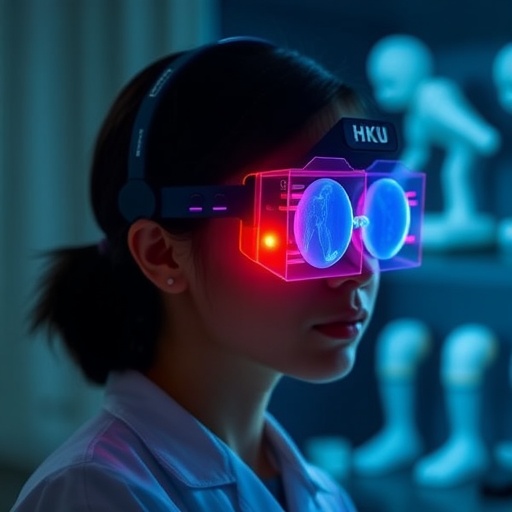
Cancer continues to cast a long shadow over global health, claiming millions of lives annually and imposing immense burdens on healthcare systems worldwide. In 2023 alone, the Hong Kong Cancer Registry documented nearly 38,000 new cancer cases alongside approximately 15,000 fatalities related to the disease, emphasizing the urgent need for more effective and accessible early detection methods. Early diagnosis remains the cornerstone for improving survival rates and quality of life for patients, yet many current detection modalities involve invasive, time-consuming, and often costly procedures that limit their widespread applicability. Addressing these challenges, a pioneering team at The University of Hong Kong (HKU) has engineered a breakthrough technology that promises to revolutionize cancer risk screening through a compact, AI-powered optical sensor capable of analyzing saliva — a non-invasive and rapidly obtainable biological sample.
The novel device developed by Professor Chi Ming Che, Zhou Guangzhao Professor in Natural Sciences and Chair Professor of Chemistry at HKU, in collaboration with Dr. Wei Liu, represents a paradigm shift in the approach to cancer diagnostics. Bridging synthetic chemistry with cutting-edge artificial intelligence, this portable instrument offers a rapid, straightforward, and user-friendly cancer risk assessment that eschews the need for tissue biopsies or complex laboratory infrastructure. This innovation was recently lauded with the prestigious Gold Medal and Congratulations of the Jury at the 51st International Exhibition of Inventions of Geneva (2026), underscoring its scientific significance and potential to transform public health monitoring on a global scale.
At the heart of this technological marvel lies a unique class of luminescent metal complexes synthesized under Professor Che’s guidance. These metal complexes possess an extraordinary affinity for damaged DNA sites — particularly mismatches — which often serve as molecular hallmarks of oncogenic processes. Unlike conventional dyes or probes, these complexes undergo pronounced changes in their photoluminescent properties upon binding to compromised DNA strands, generating an optical signal of remarkable sensitivity and specificity. This luminescence phenomenon is directly correlated with the extent of DNA damage, allowing for quantitative assessment of cancer-related molecular aberrations without cumbersome sample preparation or specialized labeling.
To capture and interpret these delicate optical signals, the research team developed a miniaturized, high-precision spectrometer engineered by Dr. Wei Liu. This spectrometer operates seamlessly within the handheld device, detecting fluctuations in emission spectra triggered by the DNA-bound luminescent probes. Crucially, the raw spectroscopic data is fed into an advanced artificial intelligence engine that executes sophisticated pattern recognition and machine learning algorithms. This AI component distills complex optical signatures into clinically actionable insights, enhancing both the accuracy and speed of cancer risk prediction. The marriage of molecular sensing with AI-powered analytics heralds a new era where diagnostic precision meets digital efficiency.
Designed with portability and accessibility in mind, the device empowers individuals to conduct self-administered cancer risk screenings using merely a saliva sample, circumventing the discomfort and risks associated with invasive tissue biopsies. The entire detection process unfolds within ten minutes, facilitated via an intuitive mobile application interface that guides users through sample collection, analysis, and interpretation of results. This democratization of cancer screening holds immense promise, particularly for high-risk populations such as individuals with familial cancer histories or patients under continuous post-treatment surveillance, who require frequent and hassle-free monitoring.
Professor Che emphasizes that while this groundbreaking tool is not intended to supplant established clinical diagnostic procedures, it serves as a potent auxiliary platform for rapid detection and longitudinal tracking. Preliminary clinical investigations involving patients diagnosed with breast cancer and nasopharyngeal carcinoma have yielded compelling evidence of the device’s capability to discriminate effectively between patients afflicted by malignancy and healthy individuals. These encouraging findings lay the groundwork for expansive validation efforts, as the HKU research team presently collaborates closely with oncologists from multiple hospitals to assess the technology’s efficacy across a diverse array of cancer types and patient cohorts.
Beyond its clinical applications, the technology exemplifies the power of interdisciplinary innovation — uniting the realms of synthetic chemistry, optical physics, and artificial intelligence into a harmonious diagnostic ecosystem. The luminescent metal complexes, a novel chemical entity crafted through meticulous molecular design, underscore the potential of chemical biology to yield tools that decipher complex biological phenomena at a molecular level. Meanwhile, AI’s capacity to parse multifaceted data patterns in real-time offers unprecedented advantages in translating these molecular events into reliable health indicators.
The societal implications of this development are profound. Cancer imposes staggering costs not only in lives lost but also in economic and social hardships. Early detection and continuous monitoring reduce these burdens by enabling timely interventions that improve prognoses and conserve healthcare resources. By delivering an easily deployable, low-cost, and scalable technology, this device could markedly enhance screening coverage, especially in underserved or resource-limited regions where traditional diagnostic infrastructure is scarce.
Moreover, the technology aligns with broader trends in personalized and precision medicine, where diagnostic tools tailor healthcare responses to individual molecular profiles. Its ability to detect subtle DNA damage signatures non-invasively dovetails with efforts to shift cancer care upstream — focusing on prevention, early interception, and personalized risk stratification. As the device integrates seamlessly with digital health platforms, it can potentially interface with telemedicine services, further extending its reach and impact.
In essence, this AI-integrated optical sensing device not only embodies a leap forward in cancer diagnostics but also illustrates a compelling blueprint for the next generation of biomedical innovations: compact, intelligent, and patient-centric technologies designed to empower individuals and enhance public health outcomes. The convergence of chemical ingenuity and artificial intelligence opens new vistas for detecting and understanding disease processes in ways previously unattainable, bringing us closer to a future where cancer detection is swift, safe, and universally accessible.
The University of Hong Kong and the Laboratory for Synthetic Chemistry and Chemical Biology Limited (LSCCB) continue to spearhead this ambitious initiative, striving to translate laboratory breakthroughs into tangible clinical benefits. Their ongoing collaborations with medical practitioners and commitment to rigorous validation promise to refine and optimize this technology for broader clinical deployment. With further development and integration, this innovative device could become an indispensable tool in the global fight against cancer, exemplifying how scientific excellence can be harnessed to achieve meaningful societal impact.
For inquiries related to this pioneering research, contact the Office of Vice-President and Pro-Vice-Chancellor (Research) at The University of Hong Kong, or Ms. Esther YIU via telephone or email.
Subject of Research: Development of a portable AI-enabled optical sensing device for rapid, non-invasive cancer risk detection using saliva samples.
Article Title: AI-Powered Optical Device Enables Rapid, Non-Invasive Cancer Risk Screening via Saliva Analysis
News Publication Date: Not specified
Web References: Not specified
References: Not specified
Image Credits: The University of Hong Kong
Keywords: Cancer detection, non-invasive diagnostics, optical sensing, luminescent metal complexes, artificial intelligence, saliva-based screening, biosensors, molecular diagnostics, digital health, early cancer screening
Tags: AI-powered medical sensorsartificial intelligence in healthcarecancer detection without biopsiesearly cancer diagnosis technologyHKU cancer research breakthroughinnovative cancer diagnostic toolsnon-invasive cancer detectionportable AI optical sensorrapid cancer risk assessmentsaliva-based cancer screeningsynthetic chemistry in diagnosticsuser-friendly cancer screening device