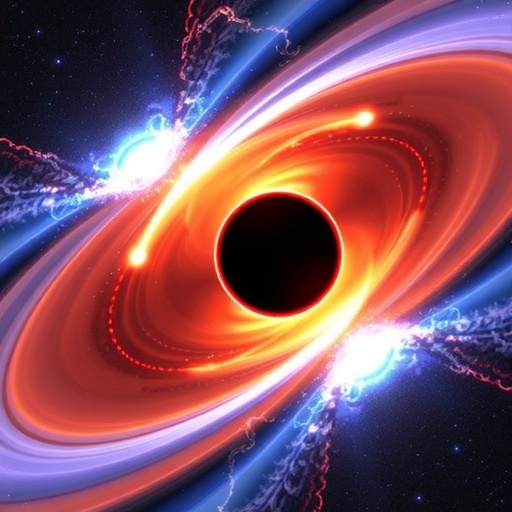
On July 2, 2025, the Einstein Probe (EP), a pioneering space telescope led by China, recorded an extraordinary high-energy cosmic phenomenon that is reshaping our understanding of extreme astrophysical events. The probe detected an exceptionally bright and rapidly fluctuating X-ray source during its routine all-sky survey, an observation that immediately defied the characteristics of conventional cosmic sources. This unique event instantly activated an international network of observatories that commenced a multi-wavelength observational campaign to further scrutinize the transient signal and its cosmic origin.
The Einstein Probe mission, operated by the Chinese Academy of Sciences, stands out with its innovative approach comprising two complementary X-ray instruments that enable a wide-field sensitive scan alongside detailed follow-up measurements. Its Wide-field X-ray Telescope (WXT) utilizes advanced lobster-eye micro-pore optics technology, delivering a broad field of view with unparalleled sensitivity in the soft X-ray band. This instrument’s initial detection of the transient source, designated EP250702a (also known as GRB 250702B), was soon corroborated by NASA’s Fermi Gamma-ray Space Telescope, which observed a corresponding series of gamma-ray bursts in the same sky region.
What sets this event apart is the atypical temporal sequence of emissions; the EP’s WXT had already recorded persistent X-ray emission from the object nearly a day before the gamma-ray bursts were detected by Fermi. This early X-ray activity is rare among known cosmic explosions, suggesting a novel underlying physical mechanism. Approximately 15 hours after the initial signal, the source displayed a dramatic outburst, generating extreme X-ray flares peaking at a luminosity around 3 × 10⁴⁹ erg s⁻¹. Such luminosity ranks this event among the brightest transient cosmic outbursts ever witnessed in the observable universe, indicative of a tremendously energetic astrophysical process.
Precise localization by the WXT enabled rapid follow-up by major ground- and space-based telescopes around the globe. The host galaxy of the transient was identified at considerable distance, with the explosive event occurring in its peripheral regions rather than near the galactic nucleus. Over the following 20 days, the Einstein Probe’s Follow-up X-ray Telescope (FXT) meticulously tracked the source’s luminosity decay, revealing a steep brightness decline by over five orders of magnitude. Simultaneously, the spectral properties of the source’s X-ray emission evolved from a hard, higher-energy state to a softer spectrum, reflecting complex changes in the emission mechanism or environment.
A comprehensive synthesis of data spanning the electromagnetic spectrum led to the conclusion that this enigmatic transient could not be fully reconciled with conventional models of gamma-ray bursts or known stellar explosions. Instead, astrophysicists converged on an extraordinary scenario: the tidal disruption of a white dwarf star by an intermediate-mass black hole. This model posits that the gravitational forces exerted by an intermediate black hole—one with a mass between that of stellar-mass and supermassive black holes—can rip apart a white dwarf, causing rapid accretion of stellar debris and launching relativistic jets.
Research teams from The University of Hong Kong played a pivotal role in elucidating this interpretation. Led by Professor Lixin Dai from the Department of Physics and the Hong Kong Institute of Astronomy and Astrophysics (HKIAA), the HKU team provided rigorous theoretical modeling that demonstrated the white dwarf–intermediate-mass black hole disruption scenario as most consistent with the observed rapid light curve evolution and astonishing energy release. Such insight was bolstered by simulations conducted by Dr. Jinhong Chen, who used high-resolution numerical models to replicate the dynamics of tidal disruption, jet formation, and resulting electromagnetic emissions.
Professor Bing Zhang, Director of HKIAA, highlighted the significance of the collaboration in positioning Hong Kong as a vital node for international astronomical research. The team’s active involvement in every phase, from data analysis to theoretical prediction, underscored the region’s capability to contribute meaningfully to forefront discoveries in transient astrophysics. This milestone event underscores the scientific dividends of global partnerships and open data sharing, assembling expertise from institutions across Asia, Europe, and North America.
At a mission level, the Einstein Probe exemplifies how advanced space-borne instrumentation can identify unexpected cosmic events and catalyze rapid community response. Principal Scientist Professor Weimin Yuan from the National Astronomical Observatories of China noted that the detection of EP250702a validates the probe’s strategic mission objectives—to uncover and study the Universe’s most volatile and energetic phenomena, casting light on mechanisms hitherto inaccessible with prior observatories.
Should this interpretation be conclusively confirmed through ongoing and future observations, the event represents the inaugural direct observation of a compact object feeding episode involving an intermediate-mass black hole and a white dwarf star. This revelation fills a critical gap in our understanding of black hole demographics by providing evidence for the elusive intermediate-mass category, a long-hypothesized but sparsely observed black hole population believed to bridge the mass scale between stellar remnants and the supermassive black holes anchoring galaxy centers.
The discovery also opens promising new avenues for multi-messenger astrophysics. By combining electromagnetic signatures with potential gravitational wave counterparts from such tidal disruption events, astronomers can gain unparalleled insights into the life cycles of compact stars, black hole growth pathways, and the physics of relativistic jet formation. These connections have far-reaching implications not only for astrophysics but also for fundamental physics under extreme gravitational fields.
This breakthrough is a testament to the strength of coordinated, multinational scientific endeavors involving more than 40 institutions worldwide. The co-authored paper, published prominently in Science Bulletin, credits a broad coalition of scholars and facilities, exemplifying how large-scale collaboration and open science initiatives accelerate the pace of transformative discovery. The endeavor unites researchers from The University of Hong Kong, the National Astronomical Observatories of China, Anhui Normal University, Sun Yat-sen University, the University of Science and Technology of China, and other major centers of excellence.
The Einstein Probe project, while China-led, benefits significantly from its international partnerships—including the European Space Agency, Germany’s Max Planck Institute for Extraterrestrial Physics, and France’s CNES—all contributing expertise, instrumentation, and data analysis capabilities. Such global synergy has been pivotal in decoding the complex signals emanating from EP250702a and will continue to be instrumental in unveiling new cosmic mysteries.
This landmark event not only propels forward our comprehension of black hole physics and stellar endstates, but it also highlights how the next generation of space observatories can push the boundaries of our observable universe. The Einstein Probe’s exceptional ability to capture transient phenomena with unprecedented sensitivity is opening new frontiers, allowing scientists to witness and analyze cosmic cataclysms as never before.
Subject of Research: Not applicable
Article Title: A fast powerful X-ray transient from possible tidal disruption of a white dwarf
News Publication Date: 8-Jan-2026
References: http://dx.doi.org/10.1016/j.scib.2025.12.050
Image Credits: Einstein Probe Science Center, National Astronomical Observatories, CAS / Sci Visual
Keywords
Space sciences, Astronomy, Planetary science, Space exploration, Space research, Space technology
Tags: advanced X-ray instrumentsEinstein Probe black hole detectionGRB 250702B gamma-ray burstshigh-energy cosmic phenomenaHKU astrophysics researchinternational network of observatorieslobster-eye micro-pore optics technologymulti-wavelength observational campaignsoft X-ray band sensitivitytransient cosmic events analysiswhite dwarf devouring black holeX-ray source observation