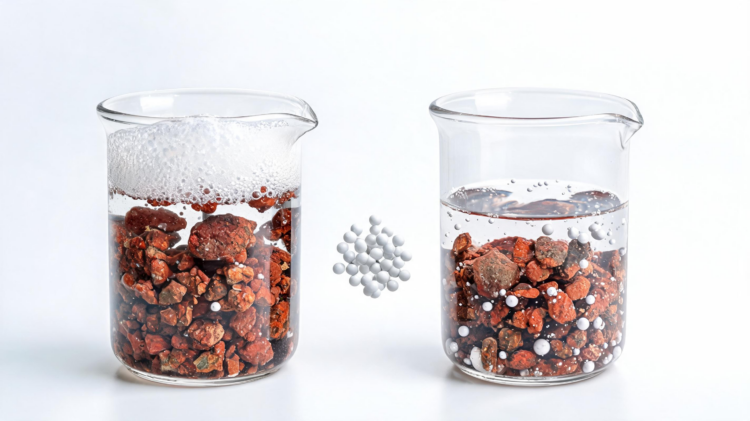
Copper has become the metal that the modern world cannot live without, and the pressure on mining companies to squeeze more of it out of progressively poorer ores has never been greater. Wind turbines, solar panels and electric vehicles all depend on the red metal, yet the high-grade sulfide deposits that historically supplied industry are steadily depleting. As a result, attention is shifting toward low-grade oxidized copper ores and even old flotation tailings, materials that are notoriously difficult to process. Now, researchers in Iran report a nanotechnology-based strategy that could make this difficult chemistry considerably more efficient, showing that tiny particles of alpha aluminum oxide can slash the amount of chemical collector required in the flotation of oxidized copper ores by as much as half while maintaining, and in some respects improving, separation performance.
The study, conducted by a team from the University of Kashan and the Iranian Research Organization for Science and Technology, tackles a problem that has long frustrated mineral processors. Flotation is the workhorse of modern ore beneficiation: finely ground ore is mixed with water and reagents, air bubbles are sparged through the pulp, and hydrophobic mineral particles attach to the bubbles and rise into a froth that is skimmed off as concentrate. The technique works brilliantly for sulfide copper minerals such as chalcocite and chalcopyrite, but oxidized copper minerals like malachite and chrysocolla are a different story entirely. Their surfaces are hydrophilic and become even more water-loving when hydrated in aqueous pulps, which prevents conventional xanthate collectors from adsorbing effectively. In industrial practice, operators typically first apply sodium hydrosulfide to disrupt this hydrated layer and enable xanthate attachment, adding cost and complexity to the flowsheet.
The challenges do not end there. Fine particles, often produced by the fine grinding needed to liberate valuable minerals from low-grade ores, exhibit slower flotation kinetics, demand higher collector dosages and suffer from heterogeneous entrapment alongside gangue minerals, reducing selectivity. Carbonate and silicate gangue, unstable surface charges and the notorious difficulty of floating particles smaller than ten micrometers all conspire to depress recoveries and inflate reagent bills. Conventional collectors bring their own baggage: xanthates, the most widely used collectors in industrial flotation, can decompose into hazardous by-products such as carbon disulfide, even though well-controlled operations with proper dosing manage the risk profile effectively. These economic and environmental pressures have driven a global search for greener collectors, from bio-surfactants derived from renewable resources to mixed thiol systems and, increasingly, engineered nanomaterials.
The Iranian team focused on alpha-phase aluminum oxide, the thermodynamically stable corundum form of alumina, whose nanoparticles combine high hardness, chemical stability and a large specific surface area. Because the alpha phase resists both acidic and alkaline conditions, the particles survive the demanding chemistry of a flotation pulp with limited undesired reactivity. Their small size, typically between one and one hundred nanometers, and their abundant surface hydroxyl groups allow them to bind to mineral surfaces through hydrogen bonding and electrostatic forces, acting as tiny bridges between hydrophilic oxidized copper particles and air bubbles. Nanorods of the material can also promote selective aggregation of ultrafine particles, increasing their effective size and improving their floatability, a phenomenon that could transform the economics of processing finely disseminated oxide ores.
The researchers began with a real ore sample from a copper mine in Qazvin Province, Iran, analyzing it petrologically and by X-ray diffraction. The sample contained 0.88 percent copper, hosted mainly in malachite associated with iron hydroxides, limonite, goethite and hematite, with quartz making up 38 percent of the gangue. Microscopy revealed malachite grains locked within iron hydroxide matrices, remnants of pyrite replaced by supergene alteration, and a single chalcopyrite grain undergoing replacement by chalcocite, confirming the mixed oxide-sulfide character of the feed. Liberation analysis indicated that the ore required grinding to approximately 45 micrometers for adequate mineral release, with a d80 of around 100 micrometers, achieved through staged grinding to avoid over-grinding and excessive slimes generation.
With the ore characterized, the team optimized a conventional flotation recipe in two-liter laboratory cells. Using potassium amyl xanthate as the primary collector, supported by sodium isopropyl xanthate and potassium hydroxamate as auxiliary collectors, sodium sulfide as an activator, sodium silicate as a dispersant and methyl isobutyl carbinol as a frother, they established optimal conditions at a pH near 10, a pulp temperature around 30 degrees Celsius and an impeller speed of roughly 1000 revolutions per minute. The collectors were added in three rougher stages to maximize capture while managing froth stability. Under these baseline conditions, the process achieved approximately 72 percent copper recovery with a concentrate grade near 15 percent, leaving tailings at roughly 0.2 percent copper, a solid benchmark for such a refractory feed.
The nanoparticles themselves were produced by high-energy planetary milling, a scalable top-down method favored for its simplicity and product purity. Commercial alpha-alumina powder of about 100 micrometers was milled at around 750 revolutions per minute for 15 to 20 hours with a ball-to-powder ratio of roughly 15:1 to 20:1, with stearic acid added as a dispersant to limit agglomeration. The resulting nanorods, between roughly 6 and 50 nanometers in size and about 99.96 percent pure, were then introduced into the flotation circuit alongside the chemical reagents at dosages of 150 to 300 grams per ton.
The decisive experiment came when the researchers halved the total chemical collector dosage, from 300 grams per ton to 150, compensating with the alumina nanoparticles. Remarkably, the process continued to deliver acceptable recovery while the concentrate grade improved relative to the baseline, demonstrating that the nanomaterial can partially substitute for the xanthate-based reagent scheme. The optimal nanomaterial-assisted formulation, run at pH 10.5 with 30-degree-Celsius pulp, yielded a concentrate grade of around 15 percent with recovery near 68 percent. In other words, a 50 percent reduction in chemical collector consumption was achieved with only a moderate trade-off in recovery, a compelling proposition for operations where reagent costs and environmental compliance dominate the economics.
The mechanism, the authors argue, lies in the nanoparticles’ extraordinary surface chemistry. Their high specific surface area permits strong attachment to oxidized copper mineral surfaces, modifying wettability and strengthening particle-bubble adhesion. When coated with hydrophobic surfactants, alumina nanoparticles can raise the water contact angle on mineral surfaces, effectively lending hydrophobicity to particles that would otherwise refuse to float. Flotation theory supports this behavior: maximum flotation rates occur when particle zeta potentials are close to zero, and surface-active nanoparticles can help steer the pulp toward that condition. The nanorods’ ability to aggregate slimes through selective coagulation further reduces the penalties imposed by ultrafine particles, one of the most stubborn problems in oxide flotation.
The researchers are careful to frame these results as preliminary. Laboratory-scale demonstrations, however encouraging, must be followed by systematic optimization of nanoparticle concentration and flotation parameters, mechanistic validation of the particle-mineral interactions, and rigorous statistical testing before industrial applicability can be claimed. Questions about the recyclability of the nanomaterials, their long-term behavior in plant water circuits and their ultimate environmental footprint remain open. Still, if the approach validates at larger scales, the implications are significant: lower operational costs, reduced chemical inventories, diminished release of xanthate decomposition products, and a more sustainable route to unlocking the vast global inventory of oxidized copper ores and tailings. As the energy transition accelerates demand for copper, even modest improvements in how the metal is liberated from stubborn ores could translate into enormous environmental and economic dividends.
Beyond the immediate process economics, the findings sit within a broader shift in how mineral processors think about reagent design. Traditional collectors act as dissolved molecular species, whereas nanoparticles function as discrete solid interfaces dispersed throughout the pulp, each one carrying a large reservoir of surface sites. This distinction matters because the performance of a flotation reagent is ultimately governed by interfacial area per unit mass, and few conventional chemicals can match the specific surface area that nanoscale particles provide at modest dosages.
The choice of the alpha phase of alumina is also significant from a manufacturing standpoint. Unlike metastable transition aluminas, the alpha phase is the thermodynamic endpoint of the alumina family, meaning particles produced by high-energy milling retain their structure under the mechanical and chemical stresses of repeated processing. Mechanochemical synthesis routes of this kind, with ball-to-powder ratios typically between 10:1 and 20:1 and rotational speeds of 300 to 500 revolutions per minute, are already practiced at industrial scale, which matters for any technology hoping to move beyond the laboratory.
The work also complements parallel efforts elsewhere in the flotation literature. Polystyrene-based polymer nanoparticles have shown promise in chalcopyrite flotation by boosting hydrophobicity and buffering the deleterious effects of clay minerals such as montmorillonite and kaolinite, while tailored xanthate formulations have lifted malachite recovery at Chinese processing plants. Alumina nanoparticles, by contrast, remain comparatively underexplored in copper systems, which is precisely why the present results, though preliminary, help define a research gap.
For operators of tailings reprocessing circuits, where feed grades can fall below half a percent copper, even partial substitution of xanthate chemistry could meaningfully alter project viability. The authors’ call for mechanistic validation and statistical rigor is therefore well placed: the next stage of this work will determine whether nanoparticle-assisted flotation becomes a plant-scale reality or remains a laboratory curiosity.
Subject of Research: Use of alpha-Al2O3 nanoparticles to enhance oxidized copper ore flotation and reduce chemical collector consumption
Article Title: Enhancement of oxidized copper flotation process using α-Al₂O₃ nanoparticles and reduction of chemical collector consumption
Article References: Bagherpour, Z., Nourmohamadi, H., Javadi, A., & Bozorgi, H. (2026). Enhancement of oxidized copper flotation process using α-Al₂O₃ nanoparticles and reduction of chemical collector consumption. Discover Chemistry, 3(1), Article 509. https://doi.org/10.1007/s44371-026-00958-1
Image Credits: AI Generated
DOI: 10.1007/s44371-026-00958-1
Keywords: alpha-alumina nanoparticles, oxidized copper flotation, copper recovery, froth flotation, mineral processing, xanthate collectors, malachite, nanotechnology, collector dosage reduction, planetary ball milling, sustainable mining, concentrate grade
Cite Scienmag News
APA
MLA
Chicago
Bethany Barker. (September 10, 2026). Alumina Nanoparticles Cut Collector Use in Oxidized Copper Flotation. Scienmag. https://scienmag.com/alumina-nanoparticles-cut-collector-use-in-oxidized-copper-flotation/
Bethany Barker. “Alumina Nanoparticles Cut Collector Use in Oxidized Copper Flotation.” Scienmag, 10 September 2026, https://scienmag.com/alumina-nanoparticles-cut-collector-use-in-oxidized-copper-flotation/. Accessed 10 September 2026.
Bethany Barker. “Alumina Nanoparticles Cut Collector Use in Oxidized Copper Flotation.” Scienmag. September 10, 2026. https://scienmag.com/alumina-nanoparticles-cut-collector-use-in-oxidized-copper-flotation/
Copy citation
Download RIS
Tags: alpha-alumina nanoparticlesAlumina nanoparticles in mineral flotationcollector dosage reductionconcentrate gradecopper recoveryenvironmentally friendly flotation methodsflotation efficiency improvementflotation of low-grade copper oresflotation tailings reprocessingfroth flotationmalachitemineral processingmineral separation from oxidized copper depositsnanomaterials in mineral extractionnanotechnologynanotechnology in mineral beneficiationoxidized copper flotationoxidized copper ore processingplanetary ball millingreduction of chemical collectors in flotationsustainable mineral processing techniquessustainable mininguse of alpha aluminum oxide nanoparticlesxanthate collectors