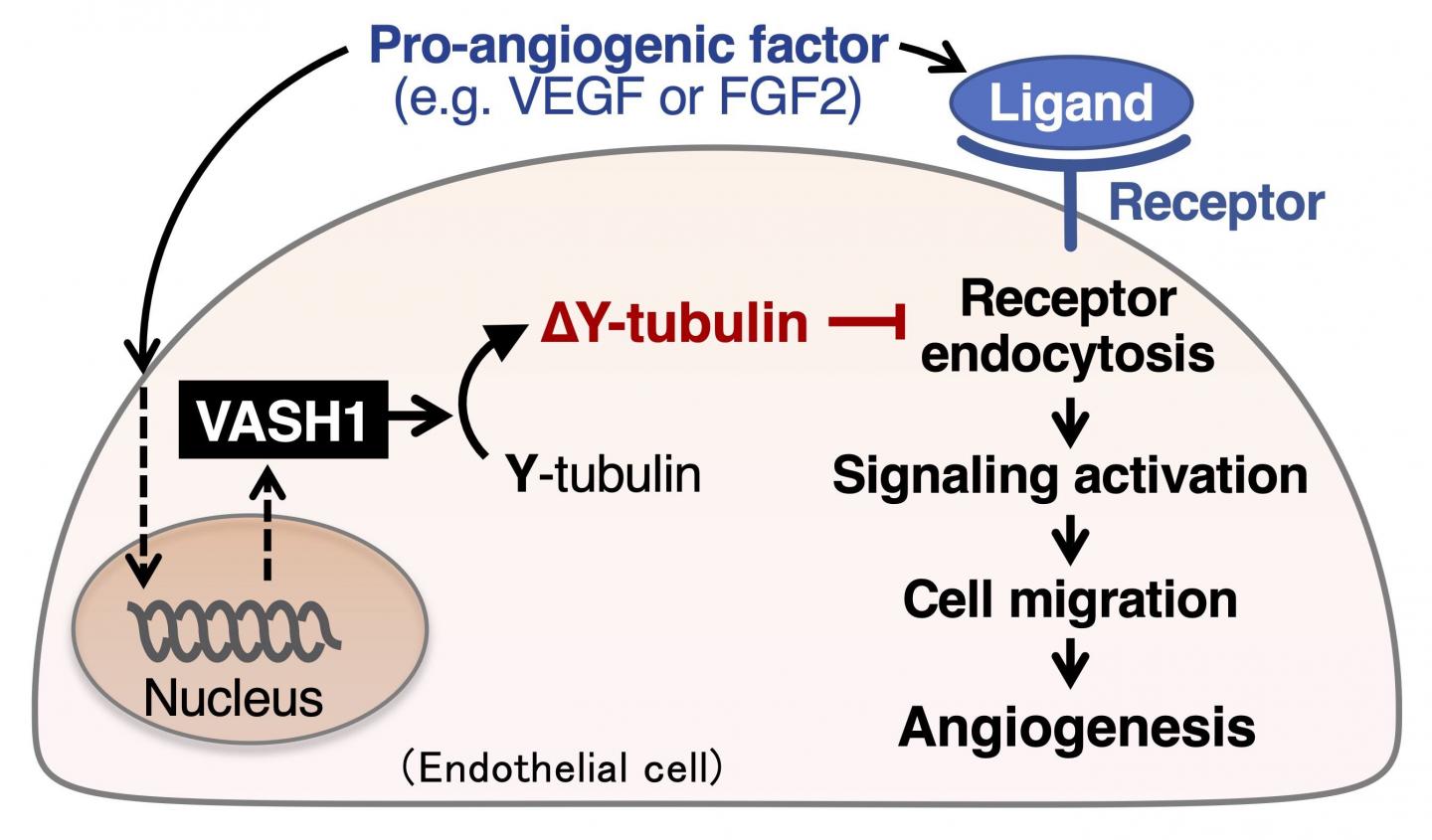
Credit: Department of Biochemistry,TMDU
Researchers from Tokyo Medical and Dental University (TMDU) identify a novel role for a protein, vasohibin-1, in preventing cancer cells from spreading
Tokyo, Japan – Cancer often becomes more difficult to treat and has a poorer prognosis when it spreads throughout the body. This process, called metastasis, is promoted by various cellular events not only become uncontrolled via mutations in cancerous cells, but also by the effects from many types of cells surrounding cancer. One such event is tumor angiogenesis – the abnormal development of new blood vessels in near solid cancers, causing cancer gets worth. Now, researchers at Tokyo Medical and Dental University (TMDU) have recently discovered an unique inhibitory function of a protein that may help suppress the formation of these tumor vessels in cancer tumors.
In a report published in Angiogenesis, a group of researchers from TMDU elucidated the mechanism by which the protein vasohibin-1, also known as VASH1, can block the vasucular-composing cells from receiving signals and messages from surrounding cancer cells or cancer microenvironment to generate new vessels, thus may reducing potential metastasis. It was previously unknown how VASH1 achieves block of creating new vessel leading to the anti-cancer outcome.
In earlier studies, this group showed that VASH1 can reduce the movement activity of endothelial cells – the cells that form blood vessels. They also examined how VASH1 affects microtubules, which are cellular tubelike structures that sometimes serve as a set of molecular railroad tracks on which different components can travel around the cell. Because of the signal received molecules are also transported on microtubules, alterations to microtubule condition can modulate certain signals from being brought into the cell from its outside environment and change the cell’s behavior. Building on their previous findings, the researchers at TMDU further investigated the ability of VASH1 to influence endothelial cells, microtubules, and the suppression of angiogenesis.
“Angiogenesis is an extremely important process that allows tumor cells to obtain oxygen and nutrients from blood flow to promote tumor growth,” says lead author of the study Miho Kobayashi. “We knew that VASH1 can inhibit this process by affecting endothelial cells, but it was not clear how exactly this protein was able to do so.”
To address their questions, the researchers looked for a specific change to microtubule condition, called detyrosination, and examined how VASH1 affects the transport of important signal-received molecules into the cell along microtubules. They ascertained the particular role of VASH1 in these processes by repeating their experiments with a VASH1 mutant or a VASH1 specific inhibitor that cannot change the microtubules.
“We found that VASH1 could mediate detyrosination of microtubules in vascular,” describes Yasufumi Sato from Tohoku University, research collaborator. “This function of the protein is ultimately how it can block angiogenesis.”
This condition change prevents certain external signals from being brought into the cell and travel along the microtubules.
“Specific outside messages enter the cell and induce changes that cause it to accelerate angiogenesis,” says Kobayashi. “Yet, VASH1 activity acts like a roadblock that stops them from reaching their destination.”
With a greater understanding of angiogenesis make increase ideas of how to suppress cancer growth and spread. This study provides vital knowledge that will support the development of new strategies for the treatment of cancer.
###
The article, “Tubulin carboxypeptidase activity of vasohibin-1 inhibits angiogenesis by interfering with endocytosis and trafficking of pro-angiogenic factor receptors,” was published in Angiogenesis at DOI: 10.1007/s10456-020-09754-6
Media Contact
Miho KOBAYASHI
[email protected]
Original Source
http://www.
Related Journal Article
http://dx.