• HOME
  • NEWS
  • EXPLORE
    • CAREER
      • Companies
      • Jobs
    • EVENTS
    • iGEM
      • News
      • Team
    • PHOTOS
    • VIDEO
    • WIKI
  • BLOG
  • COMMUNITY
    • FACEBOOK
    • INSTAGRAM
    • TWITTER
Sunday, May 10, 2026
BIOENGINEER.ORG
No Result
View All Result
  • Login
  • HOME
  • NEWS
  • EXPLORE
    • CAREER
      • Companies
      • Jobs
        • Lecturer
        • PhD Studentship
        • Postdoc
        • Research Assistant
    • EVENTS
    • iGEM
      • News
      • Team
    • PHOTOS
    • VIDEO
    • WIKI
  • BLOG
  • COMMUNITY
    • FACEBOOK
    • INSTAGRAM
    • TWITTER
  • HOME
  • NEWS
  • EXPLORE
    • CAREER
      • Companies
      • Jobs
        • Lecturer
        • PhD Studentship
        • Postdoc
        • Research Assistant
    • EVENTS
    • iGEM
      • News
      • Team
    • PHOTOS
    • VIDEO
    • WIKI
  • BLOG
  • COMMUNITY
    • FACEBOOK
    • INSTAGRAM
    • TWITTER
No Result
View All Result
Bioengineer.org
No Result
View All Result
Home NEWS Science News Chemistry

Highly stable amyloid protein aggregates may help plant seeds last longer

Bioengineer by Bioengineer
July 23, 2020
in Chemistry
Reading Time: 3 mins read
0
IMAGE
Share on FacebookShare on TwitterShare on LinkedinShare on RedditShare on Telegram

IMAGE

Credit: Dr. Pavel Zykin

Highly stable polymeric “amyloid” proteins, best known for their role in Alzheimer’s disease, have been mostly studied in animals. But a new study on the garden pea publishing July 23, 2020 in the open-access journal PLOS Biology, by Anton Nizhnikov of All-Russia Research Institute for Agricultural Microbiology (ARRIAM) and colleagues, shows that they also occur in plants, and they may be an important adaptation for prolonging seed viability.

Amyloid is a type of protein conformation in which adjacent sheets of amino acids are bound together to form aggregates that are highly resistant to degradation. In animals, amyloids play roles in hormone storage and long-term memory formation, among other activities, but are best known from Alzheimer’s disease, which is characterized by the formation of plaques of amyloid aggregates in the brain.

Direct evidence that plants form amyloids has been limited, but recent biochemical experiments have hinted at it, and a recent bioinformatic study led by Nizhnikov turned up a group of seed storage proteins with amino acid sequences that suggested they might be able to form amyloids.

In the new study, working in the garden pea, the researchers extracted the seed storage proteins, including one called vicilin, and analyzed both the full-length protein and two its domains called cupins that are rich in predicted amyloidogenic regions. When the genes were engineered into bacteria, all three proteins formed amyloid fibrils resistant to strong detergents; they also bound amyloid-specific dyes, and displayed unique spectral properties, all indicative of bona fide amyloid structure.

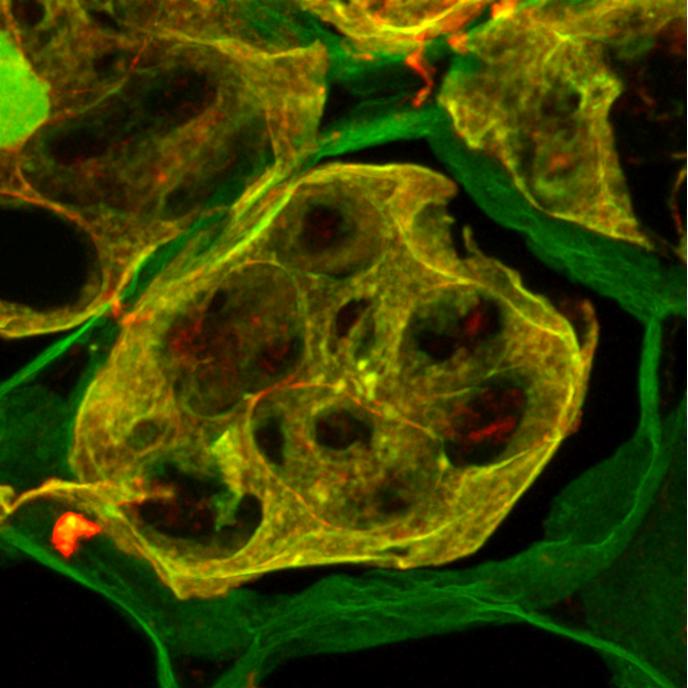
In vivo, in the pea seed, the authors used an amyloid-specific dye and an antibody to vicilin to show that the two co-localized–where there was vicilin, there was amyloid-specific dye. Vicilin amyloid aggregates built up in the storage vacuoles during seed maturation, and then rapidly disassembled during germination, suggesting their role is as a nutrient reservoir. They also found that vicilin amyloids survived intact in canned peas, resisted treatment with protein-digesting gastrointestinal enzymes, and were toxic to yeast and mammalian cells.

“Amyloids are highly stable protein structures that resist different treatments and can, in several cases, persist in the external environment for decades,” Nizhnikov said. “Amyloid formation seems to be reasonable as evolutionary adaptation to provide for the long-term survival of plant seeds.”

###

Peer reviewed; Experimental study; Plants

In your coverage please use this URL to provide access to the freely available article in PLOS Biology: https://journals.plos.org/plosbiology/article?id=10.1371/journal.pbio.3000564

Citation: Antonets KS, Belousov MV, Sulatskaya AI, Belousova ME, Kosolapova AO, Sulatsky MI, et al. (2020) Accumulation of storage proteins in plant seeds is mediated by amyloid formation. PLoS Biol 18(7): e3000564. https://doi.org/10.1371/journal.pbio.3000564

Funding: This work (study of amyloid formation by Vicilin and its domains in vivo and in vitro) was supported by the Russian Science Foundation, grant 17-16-01100. Part of this work performed by A.I. Sulatskaya (analysis of polymorphism of protein aggregates under various conditions) was awarded by RF President Fellowship SP-841.2018.4. The funders had no role in study design, data collection and analysis, decision to publish, or preparation of the manuscript.

Competing Interests: The authors have declared that no competing interests exist.

Media Contact
Anton A. Nizhnikov
[email protected]

Related Journal Article

http://dx.doi.org/10.1371/journal.pbio.3000564

Tags: AgricultureBiochemistryBiologyCell BiologyFood/Food ScienceMolecular BiologyPlant Sciences
Share12Tweet8Share2ShareShareShare2

Related Posts

Miniature Sensor Uses Light to Detect Touch — Chemistry

Miniature Sensor Uses Light to Detect Touch

May 8, 2026
Iron Minerals Determine Whether Dissolved Organic Matter Fuels Microbes or Becomes Long-Term Carbon Storage — Chemistry

Iron Minerals Determine Whether Dissolved Organic Matter Fuels Microbes or Becomes Long-Term Carbon Storage

May 8, 2026

Kate Evans Appointed Associate Lab Director for Biological and Environmental Systems Science at ORNL

May 8, 2026

Advancing Multiscale Modeling and Overcoming Operational Challenges in Autothermal COâ‚‚-to-Methanol Reactors

May 8, 2026
Please login to join discussion

POPULAR NEWS

  • Research Indicates Potential Connection Between Prenatal Medication Exposure and Elevated Autism Risk

    839 shares
    Share 336 Tweet 210
  • New Study Reveals Plants Can Detect the Sound of Rain

    727 shares
    Share 290 Tweet 181
  • Scientists Investigate Possible Connection Between COVID-19 and Increased Lung Cancer Risk

    68 shares
    Share 27 Tweet 17
  • Salmonella Haem Blocks Macrophages, Boosts Infection

    61 shares
    Share 24 Tweet 15

About

BIOENGINEER.ORG

We bring you the latest biotechnology news from best research centers and universities around the world. Check our website.

Follow us

Recent News

Taking 8,500 Steps Daily May Aid Long-Term Weight Management, Study Finds

Group Exercise Boosts Cognition, Fitness in Dementia

Estrogen Deficiency Triggers Bone EVs Causing Cell Aging

Subscribe to Blog via Email

Enter your email address to subscribe to this blog and receive notifications of new posts by email.

Join 82 other subscribers
  • Contact Us

Bioengineer.org © Copyright 2023 All Rights Reserved.

Welcome Back!

Login to your account below

Forgotten Password?

Retrieve your password

Please enter your username or email address to reset your password.

Log In
No Result
View All Result
  • Homepages
    • Home Page 1
    • Home Page 2
  • News
  • National
  • Business
  • Health
  • Lifestyle
  • Science

Bioengineer.org © Copyright 2023 All Rights Reserved.