• HOME
  • NEWS
  • EXPLORE
    • CAREER
      • Companies
      • Jobs
    • EVENTS
    • iGEM
      • News
      • Team
    • PHOTOS
    • VIDEO
    • WIKI
  • BLOG
  • COMMUNITY
    • FACEBOOK
    • INSTAGRAM
    • TWITTER
Thursday, June 25, 2026
BIOENGINEER.ORG
No Result
View All Result
  • Login
  • HOME
  • NEWS
  • EXPLORE
    • CAREER
      • Companies
      • Jobs
        • Lecturer
        • PhD Studentship
        • Postdoc
        • Research Assistant
    • EVENTS
    • iGEM
      • News
      • Team
    • PHOTOS
    • VIDEO
    • WIKI
  • BLOG
  • COMMUNITY
    • FACEBOOK
    • INSTAGRAM
    • TWITTER
  • HOME
  • NEWS
  • EXPLORE
    • CAREER
      • Companies
      • Jobs
        • Lecturer
        • PhD Studentship
        • Postdoc
        • Research Assistant
    • EVENTS
    • iGEM
      • News
      • Team
    • PHOTOS
    • VIDEO
    • WIKI
  • BLOG
  • COMMUNITY
    • FACEBOOK
    • INSTAGRAM
    • TWITTER
No Result
View All Result
Bioengineer.org
No Result
View All Result
Home NEWS Science News Health

High-tech printing may help eliminate painful shots

Bioengineer by Bioengineer
February 4, 2020
in Health
Reading Time: 2 mins read
0
IMAGE
Share on FacebookShare on TwitterShare on LinkedinShare on RedditShare on Telegram

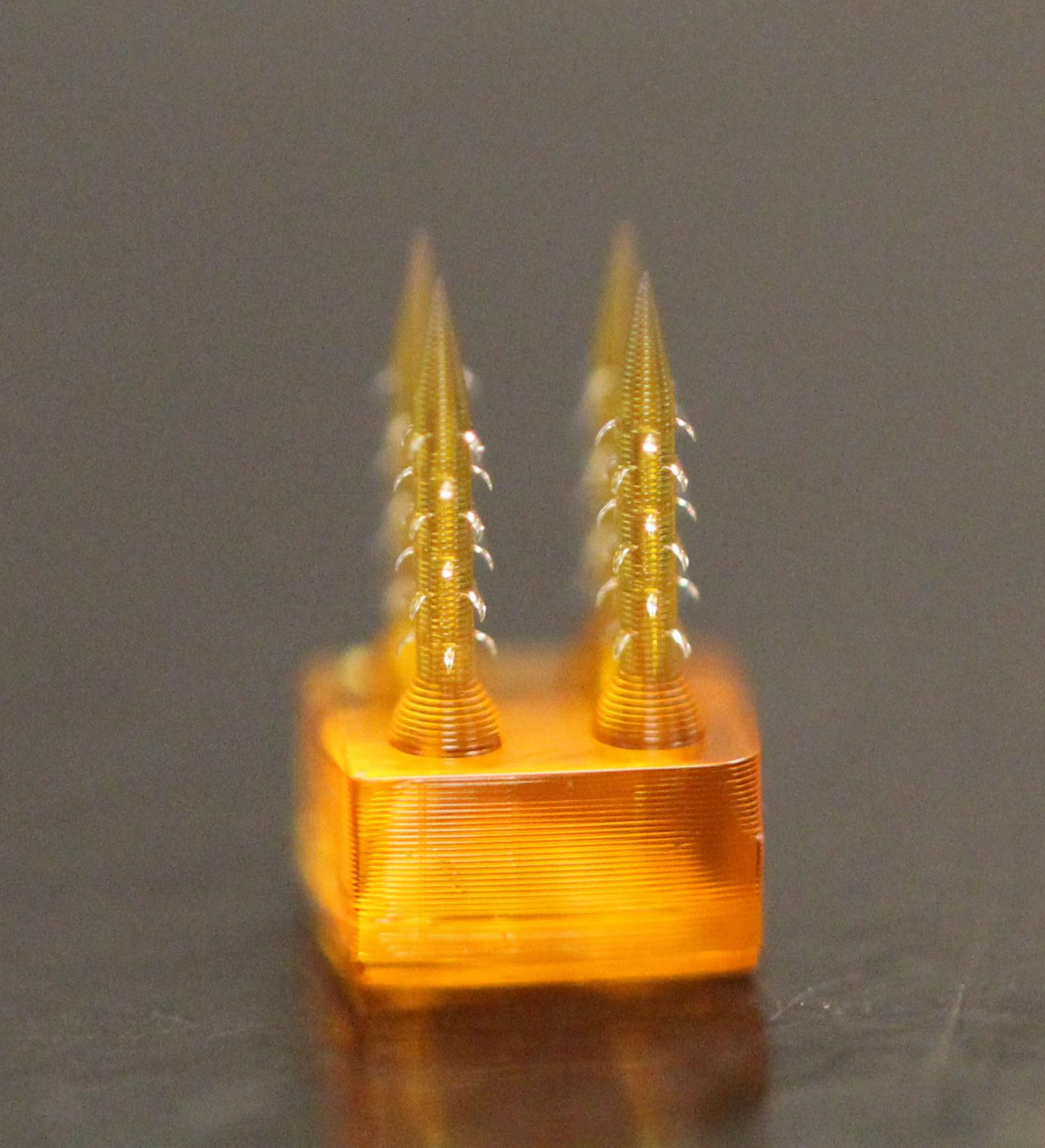
4D printing creates tiny needles inspired by parasites that could replace hypodermic needles
IMAGE

Credit: Riddish Morde


Painful hypodermic needles may not be needed in the future to give shots, inject drugs and get blood samples.

With 4D printing, Rutgers engineers have created tiny needles that mimic parasites that attach to tissues and could replace hypodermic needles, according to a study in the journal Advanced Functional Materials.

While 3D printing builds objects layer by layer, 4D goes further with smart materials that are programmed to change shape after printing. Time is the fourth dimension that allows materials to morph into new shapes.

“We think our 4D-printed microneedle array will allow for more robust and sustained use of minimally invasive, pain-free and easy-to-use microneedles for delivering drugs, healing wounds, biosensing and other soft tissue applications,” said senior author Howon Lee, an assistant professor in the Department of Mechanical and Aerospace Engineering in the School of Engineering at Rutgers University-New Brunswick.

This YouTube video by Riddish Morde shows microneedles applied to chicken muscle tissue.

Hypodermic needles are widely used in hospitals and labs to extract blood and inject drugs, causing pain, scarring skin and posing an infection risk. People with diabetes often take blood samples multiple times a day with needles to monitor blood sugar levels.

Microneedles (miniaturized needles) are gaining attention because they are short, thin and minimally invasive, reduce pain and the risk of infection and are easy-to-use. But their weak adhesion to tissues is a major challenge for controlled drug delivery over the long run or for biosensing, which involves using a device to detect DNA, enzymes, antibodies and other health indicators.

In nature, some insects and other organisms have developed microscopic features that adhere to tissue, such as the microhooks of parasites, barbed stingers of honeybees and scaled quills of porcupines. Inspired by these examples, Rutgers engineers developed a microneedle that interlocks with tissue when inserted, enhancing adhesion. They combined a micro 3D-printing technique and a 4D-printing approach to create backward-facing barbs on a microneedle.

Using chicken muscle tissue as a model, the researchers showed that tissue adhesion with their microneedle is 18 times stronger than with a barbless microneedle. Their creation outperforms previously reported examples, resulting in more stable and robust drug delivery, collection of bio-fluids and biosensing, the study says.

###

The study’s three co-lead authors include Daehoon Han, a former Rutgers doctoral student who is now a postdoc at the University of Minnesota, Riddish S. Morde, a former Rutgers master’s student, and a researcher at the University of Pisa in Italy. Rutgers doctoral student Chen Yang and researchers at the University of Pisa contributed to the study, which was funded by the New Jersey Health Foundation and Italian Ministry of Education, University and Research.

Media Contact
Todd Bates
[email protected]
848-932-0550

Original Source

https://news.rutgers.edu/high-tech-printing-may-help-eliminate-painful-shots/20200130#.XjMzSWhKi70

Related Journal Article

http://dx.doi.org/10.1002/adfm.201909197

Tags: Biomedical/Environmental/Chemical EngineeringDiabetesDiagnosticsHealth ProfessionalsMechanical EngineeringMedicine/HealthPublic Health
Share12Tweet8Share2ShareShareShare2

Related Posts

Tracking Lanthanide-Labeled Microplastics in Plants

June 25, 2026

Neural Design Enables Zero-Shot Drug-Binding Proteins

June 25, 2026

Genomic Insights into Human Skin Fungi Diversity

June 25, 2026

Chiral Laser Gyroscopes Surpass Lock-In Limit

June 25, 2026
Please login to join discussion

POPULAR NEWS

  • Saying Goodbye to PGY-6: Pediatric Fellowship Realities

    103 shares
    Share 41 Tweet 26
  • Multi-Hospital Study Reveals Long Covid Burden Is Twice as High as Current Estimates

    92 shares
    Share 36 Tweet 23
  • Detection of EDCs in Breast Milk and Infant Urine Up to Six Months Highlights Early Exposure Risks

    77 shares
    Share 31 Tweet 19
  • New Drug Candidate Developed at McMaster Shows Potential for Treating Brain Cancer

    58 shares
    Share 23 Tweet 15

About

We bring you the latest biotechnology news from best research centers and universities around the world. Check our website.

Follow us

Recent News

Tracking Lanthanide-Labeled Microplastics in Plants

POSTECH Researchers Slash Cost of Reconstituted Cell-Free Systems by 95%

AI and Physics Collaborate to Design Advanced Hydrogen Storage Materials

Subscribe to Blog via Email

Enter your email address to subscribe to this blog and receive notifications of new posts by email.

Join 82 other subscribers
  • Contact Us

Bioengineer.org © Copyright 2023 All Rights Reserved.

Welcome Back!

Login to your account below

Forgotten Password?

Retrieve your password

Please enter your username or email address to reset your password.

Log In
No Result
View All Result
  • Homepages
    • Home Page 1
    • Home Page 2
  • News
  • National
  • Business
  • Health
  • Lifestyle
  • Science

Bioengineer.org © Copyright 2023 All Rights Reserved.