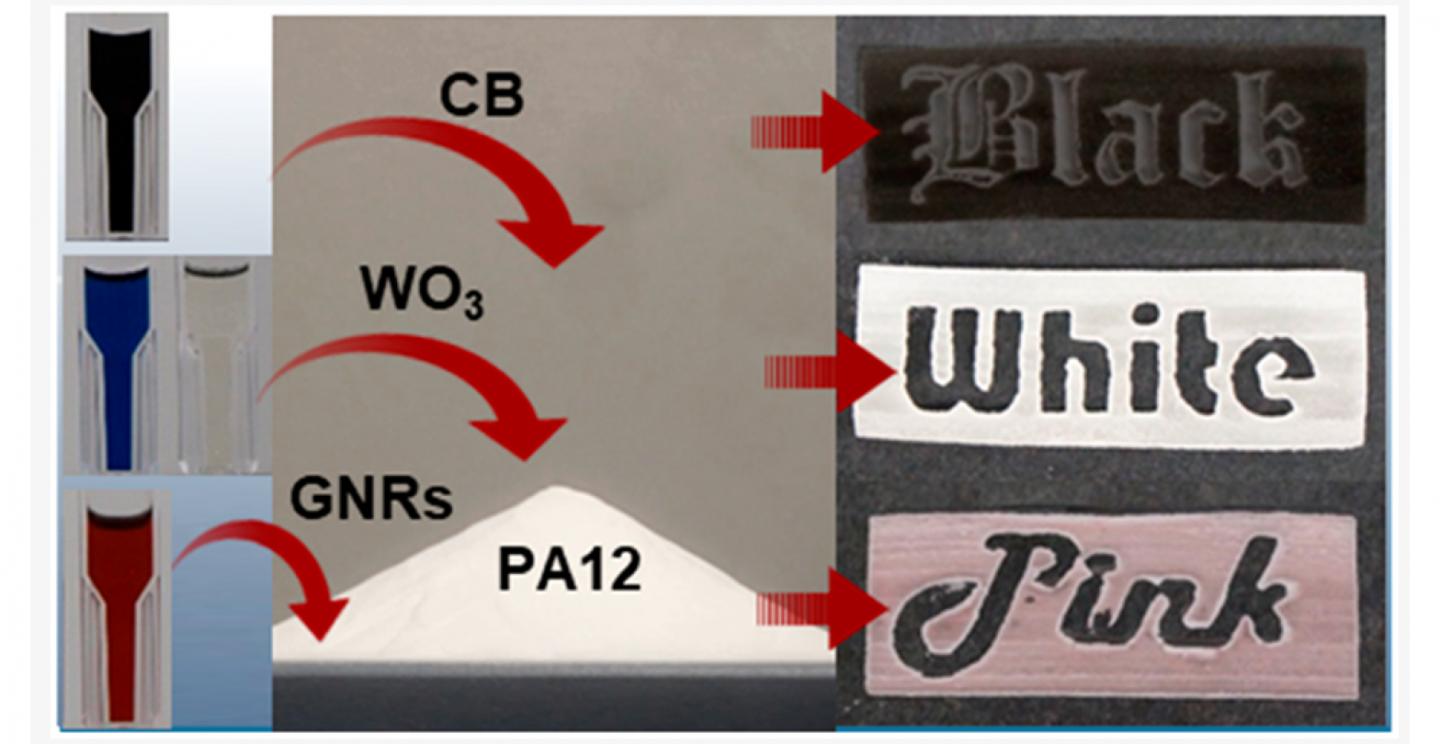
Credit: ICFO
Selective powder sintering for 3D printing has recently become an increasingly affordable solution for manufacturing made-to-order elements of almost any shape or geometry. This technique involves heating a bed of powder (such as polyamide, PA12) to just below its melting point, using an IR light source to selectively melt a cross section of the powder, then adding more powder and repeating to form a 3D object. To reduce costs and increase printing speed, a photothermal sensitizer is often added to the powders. Typically carbon-based, with a strong broadband absorption, adding these sensitizers to the polymer powders increases the conversion of incident light to heat, which means greater print speeds. However, carbon-based sensitizers can only produce black or gray objects. To create white or colorful prints, visibly transparent equivalents are needed.
A study conducted a few years ago by a team of researchers at ICFO, first authored by Alexander Powell and led by ICREA Professors at ICFO Gerasimos Konstantatos, and Romain Quidant, reported on a solution for overcoming color restrictions in this method using plasmonic nanoparticles. The researchers designed gold nanoparticles coated with silica as a photothermal sensitizer to allow a rapid sintering of polymer powders into 3D objects by having these nanoparticles strongly absorb in the near-infrared, while only minimally interacting with visible light. At resonance, these composites showed greatly improved light-to-heat conversion compared with equivalent composites and could be sintered using low-power light sources. While these particles showed to be very efficient for the rapid fabrication of colored 3D objects, they proved to have certain limitations when trying to print 3D objects in pure white color or multicolor with high color fidelity across a large hue range affecting the quality of the coloration of prints in high concentrations.
Thus, in a recent study published in NanoLetters, the ICFO researchers Alexander Powell, Alexandros Stavrinadis, and Sotirios Christodoulou, led by ICREA Professors at ICFO Gerasimos Konstantatos, and Romain Quidant, have now reported on the use a new sensitizer that has proven to easy overcome these problems.
In their study, the team of researchers has reported on using nanoparticles made of tungsten oxide (WO3) as the photothermal sensitizers for polymer powders. These nanoparticles comprise low cost elements, which make them easy and cheap to fabricate. They are colorless at high concentrations and have a strong absorption in the near infrared region, proving their capability of turning light into heat at a fast rate, and thus enabling them as fast fusing agents. In addition, they can be efficiently turned on or off with electricity or ultraviolet radiation. Even more, they are stable at very high temperatures and demonstrate a heating-to-color change rate superior when compared to other available sensitizers. Finally, when mixed with other color inks, these nanoparticles have been able to reproduce the same shades of color as the original powders, maintaining the color purity of the pristine samples.
The results of the study open a new pathway for the use of plasmonic nanoparticles that can be used to produce high color quality 3D-multicolor objects for advanced manufacturing processes.
###
LINKS
Link to the paper: https:/
Link to the research group led by ICREA Prof. at ICFO Gerasimos Konstantatos: https:/
Link to the research group led by ICREA Prof. at ICFO Romain Quidant: https:/
Media Contact
Alina Hirschmann
[email protected]