• HOME
  • NEWS
  • EXPLORE
    • CAREER
      • Companies
      • Jobs
    • EVENTS
    • iGEM
      • News
      • Team
    • PHOTOS
    • VIDEO
    • WIKI
  • BLOG
  • COMMUNITY
    • FACEBOOK
    • INSTAGRAM
    • TWITTER
Monday, May 11, 2026
BIOENGINEER.ORG
No Result
View All Result
  • Login
  • HOME
  • NEWS
  • EXPLORE
    • CAREER
      • Companies
      • Jobs
        • Lecturer
        • PhD Studentship
        • Postdoc
        • Research Assistant
    • EVENTS
    • iGEM
      • News
      • Team
    • PHOTOS
    • VIDEO
    • WIKI
  • BLOG
  • COMMUNITY
    • FACEBOOK
    • INSTAGRAM
    • TWITTER
  • HOME
  • NEWS
  • EXPLORE
    • CAREER
      • Companies
      • Jobs
        • Lecturer
        • PhD Studentship
        • Postdoc
        • Research Assistant
    • EVENTS
    • iGEM
      • News
      • Team
    • PHOTOS
    • VIDEO
    • WIKI
  • BLOG
  • COMMUNITY
    • FACEBOOK
    • INSTAGRAM
    • TWITTER
No Result
View All Result
Bioengineer.org
No Result
View All Result
Home NEWS Science News Chemistry

High-capacity electrodes by valence engineering developed for desalination

Bioengineer by Bioengineer
September 6, 2025
in Chemistry
Reading Time: 2 mins read
0
IMAGE
Share on FacebookShare on TwitterShare on LinkedinShare on RedditShare on Telegram

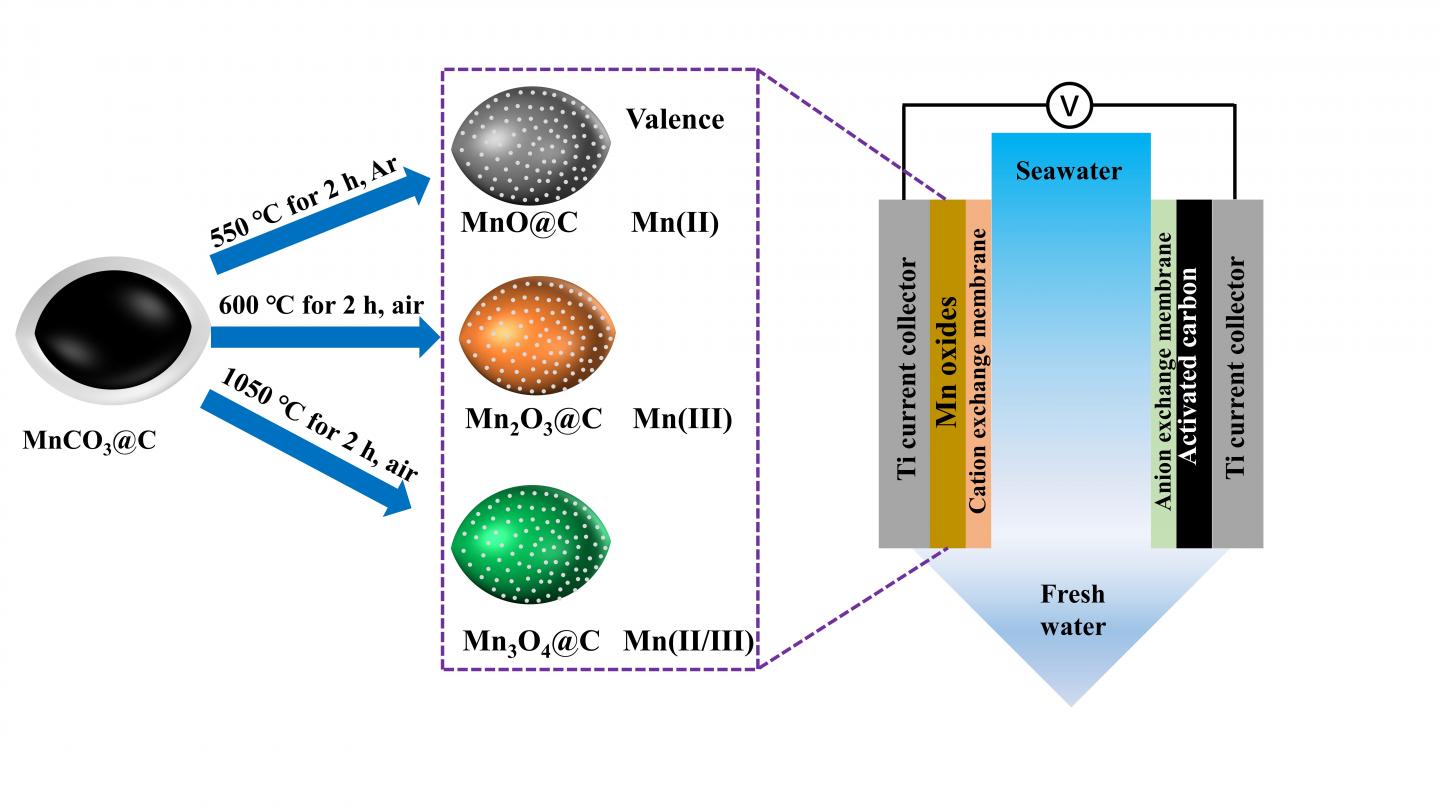
Recently, the researchers from Institute of Solid State Physics, Hefei Institutes of Physical Science (HFIPS) of the Chinese Academy of Sciences, by using valence engineering, developed three manganese oxides as electrodes with different Mn valences for high-performance capacitive desalination.

Reverse osmosis and thermal distillation are widely used to treat salt water with high salt concentration, but they have disadvantages including high energy consumption and high cost.

As an alternative method, capacitive deionization (CDI) technology can remove charged ions from desalt water through electrosorption or pseudocapacitive reaction. However, there are few reports on manganese oxides with lower valence of Mn, compared with the number of reports on MnO2. Hence, whether there is a difference in desalination performance in such different valence states of Mn and the internal reasons are worth exploring.

In this study, because of the high-capacity characteristic of the Faradic electrode, the researchers prepared three different manganese oxide carbon compositions with different valence states of Mn by calcining MnCO3@C precursor under different atmospheres and temperatures, and they combined them with commercial activated carbon electrode to assemble an asymmetric CDI unit. All as-prepared manganese oxides maintained the spindle-like morphology of the precursor.

The results showed that manganese oxides with divalent, trivalent and divalent/trivalent all displayed high salt adsorption capacity and corresponding high salt adsorption rates in 500 mg L-1 NaCl solution, surpassing other advanced carbon materials. Among them, MnO@C indicated the best electrosorption performance and Mn3O4@C has the worst.

The density functional theory (DFT) calculation results proved that the valence state of manganese during Na+ absorption could bring distinct discrepancy in the spatial structure and absorption capacity. Therefore, the researchers concluded that in terms of capacity and stability, the manganese oxides with divalent (MnO@C) was more suitable than trivalent (Mn2O3@C) and divalent/trivalent (Mn3O4@C) manganese oxides for CDI desalination.

The valence engineering provides a novel way for preparing high-performance pseudocapacitive materials for capacitive desalination.

###

Media Contact
ZHAO Weiwei
[email protected]

Original Source

http://english.hf.cas.cn/new/news/rn/202105/t20210527_271244.html

Related Journal Article

http://dx.doi.org/10.1007/s12274-021-3467-z

Tags: Chemistry/Physics/Materials SciencesParticle Physics
Share12Tweet8Share2ShareShareShare2

Related Posts

Humans and Zebra Finches Share Similar Speech Learning Techniques #ASA190 — Chemistry

Humans and Zebra Finches Share Similar Speech Learning Techniques #ASA190

May 11, 2026
Unveiling Dark Matter Through Molecular Insights — Chemistry

Unveiling Dark Matter Through Molecular Insights

May 11, 2026

From Touch to Sight: A Bioinspired Multisensory Framework Endows Robots with Human-Like Perception

May 11, 2026

Announcing the 2026 Carbon Future Young Investigator Award Winners

May 11, 2026
Please login to join discussion

POPULAR NEWS

  • Research Indicates Potential Connection Between Prenatal Medication Exposure and Elevated Autism Risk

    841 shares
    Share 336 Tweet 210
  • New Study Reveals Plants Can Detect the Sound of Rain

    728 shares
    Share 290 Tweet 182
  • Salmonella Haem Blocks Macrophages, Boosts Infection

    62 shares
    Share 25 Tweet 16
  • Breastmilk Balances E. coli and Beneficial Bacteria in Infant Gut Microbiomes

    57 shares
    Share 23 Tweet 14

About

We bring you the latest biotechnology news from best research centers and universities around the world. Check our website.

Follow us

Recent News

Humans and Zebra Finches Share Similar Speech Learning Techniques #ASA190

New Study Uncovers How Fungal Parasites Attack Strawberries and Raspberries

City of Hope Researchers to Present Groundbreaking Immunotherapy and Precision Medicine Advances Across Multiple Cancer Types at ASCO 2026

Subscribe to Blog via Email

Enter your email address to subscribe to this blog and receive notifications of new posts by email.

Join 82 other subscribers
  • Contact Us

Bioengineer.org © Copyright 2023 All Rights Reserved.

Welcome Back!

Login to your account below

Forgotten Password?

Retrieve your password

Please enter your username or email address to reset your password.

Log In
No Result
View All Result
  • Homepages
    • Home Page 1
    • Home Page 2
  • News
  • National
  • Business
  • Health
  • Lifestyle
  • Science

Bioengineer.org © Copyright 2023 All Rights Reserved.