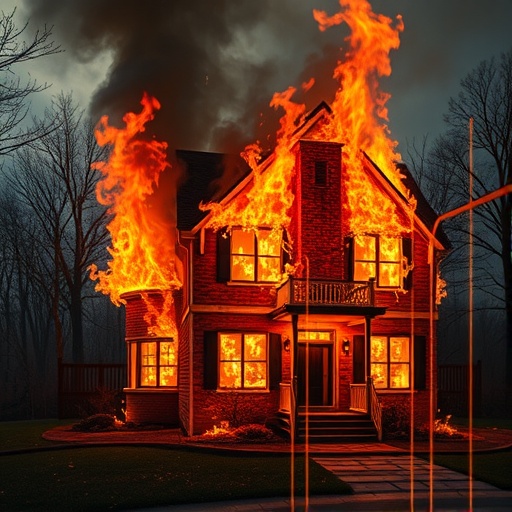
A University of Waterloo research team is using artificial intelligence, data science and advanced mathematics to reveal how fires evolve inside modern homes—an effort that could transform emergency evacuation systems and improve the way firefighters respond to rapidly changing conditions.
The project addresses a growing problem in fire safety research. Houses built today are often more airtight and energy efficient than older homes, while furniture commonly contains synthetic foams, fabrics and polymers. These materials can burn differently from traditional wood and natural fibers, producing distinct mixtures of heat, smoke and toxic gases. When ventilation is limited, the chemistry of a fire can shift dramatically, making conditions dangerous faster than conventional models may predict.
To study these changes, researchers carried out 15 controlled fires inside a burn house on the University of Waterloo campus. The experimental structure was equipped with as many as 175 sensors, which continuously recorded temperature, airflow, humidity, burning rate and concentrations of multiple gases. Together, the instruments created an exceptionally detailed picture of the environment as each fire developed, from its initial growth through increasingly oxygen-starved stages.
The scale of the measurements presented its own scientific challenge. A single group of sensors positioned in one location, sampling four times per second, could generate millions of individual data points. That information represented only a small portion of the observations collected throughout the building and across the full set of experiments. Traditional approaches that examine one variable at a time would struggle to capture the relationships linking ventilation, heat transfer, combustion and gas production.
The Waterloo team therefore developed a framework that combines mathematical analysis, statistical modeling and machine-learning artificial intelligence. Rather than treating each sensor reading as an isolated measurement, the system searches for patterns connecting many variables at once. It can identify how changes in temperature or airflow correspond with shifts in combustion, and it can reveal hidden transitions that may be difficult to recognize while looking at individual measurements.
One of the most important transitions occurs when a fire begins to under-ventilate. In that state, the fire is no longer receiving enough oxygen to sustain the same combustion process. The resulting change is not simply a reduction in flames. Oxygen-starved combustion can alter the chemical composition and quantity of gases released, increasing the risk from toxic smoke even when visible fire appears to be weakening. Detecting this transition could provide critical information about when a room or building is becoming especially hazardous.
The researchers hope the system will eventually support smart fire-safety technologies capable of anticipating how a fire will spread and how conditions will change from room to room. Such systems could combine real-time sensor data with predictive models to estimate where heat, smoke and toxic gases are likely to move. Emergency evacuation guidance could then be adapted to changing conditions, helping occupants and responders avoid routes that may become dangerous within minutes.
“The goal is to deepen our understanding so we can predict fire behaviour and the gases it releases,” said Dr. Joshua Pulsipher, a chemical engineering professor at Waterloo. The team’s broader objective is to develop smart systems that can model what a fire is likely to do rather than merely describe what has already happened.
Dr. Beth Weckman, a professor of mechanical and mechatronics engineering, said the research could help create systems that anticipate fire behavior and guide people toward safer exits. Dr. Vinny Gupta, also a professor of mechanical and mechatronics engineering, described the project’s purpose as extracting fundamental insights from experimental data to understand how an underlying fire evolves. The researchers plan to apply the framework to more complex scenarios in future studies, with potential implications for building codes, firefighter training, emergency planning and evacuation design. Their study, “A framework for high-dimensional fire sensor data analysis,” was published in Fire Safety Journal.
Subject of Research:
Artificial intelligence, sensor data analysis and mathematical modeling of fire behavior in modern homes.
Article Title:
A framework for high-dimensional fire sensor data analysis
Web References:
https://www.sciencedirect.com/science/article/pii/S0379711226001062
https://uwaterloo.ca/fire-research-and-safety/
https://uwaterloo.ca/chemical-engineering/profile/jpulsiph
https://uwaterloo.ca/fire-research-and-safety/profiles/elizabeth-weckman
https://uwaterloo.ca/mechanical-mechatronics-engineering/profile/v98gupta
References:
Pulsipher, J., Weckman, B., Gupta, V., et al. “A framework for high-dimensional fire sensor data analysis.” Fire Safety Journal.
Image Credits:
University of Waterloo
Keywords
Artificial intelligence, fire safety, fire behavior, machine learning, combustion, sensor data, toxic smoke, evacuation systems, chemical engineering, mechanical engineering, modern homes
Tags: advanced fire behavior analysisAI-based fire safety modelscontrolled fire experiments with sensor networksdata-driven fire risk assessmentevacuation system improvementsfire spread predictionfirefighter response optimizationimpact of airtight modern homes on fire developmentmodern house fire dynamicsreal-time fire monitoring sensorssynthetic materials and fire chemistrytoxic gas emissions in house fires