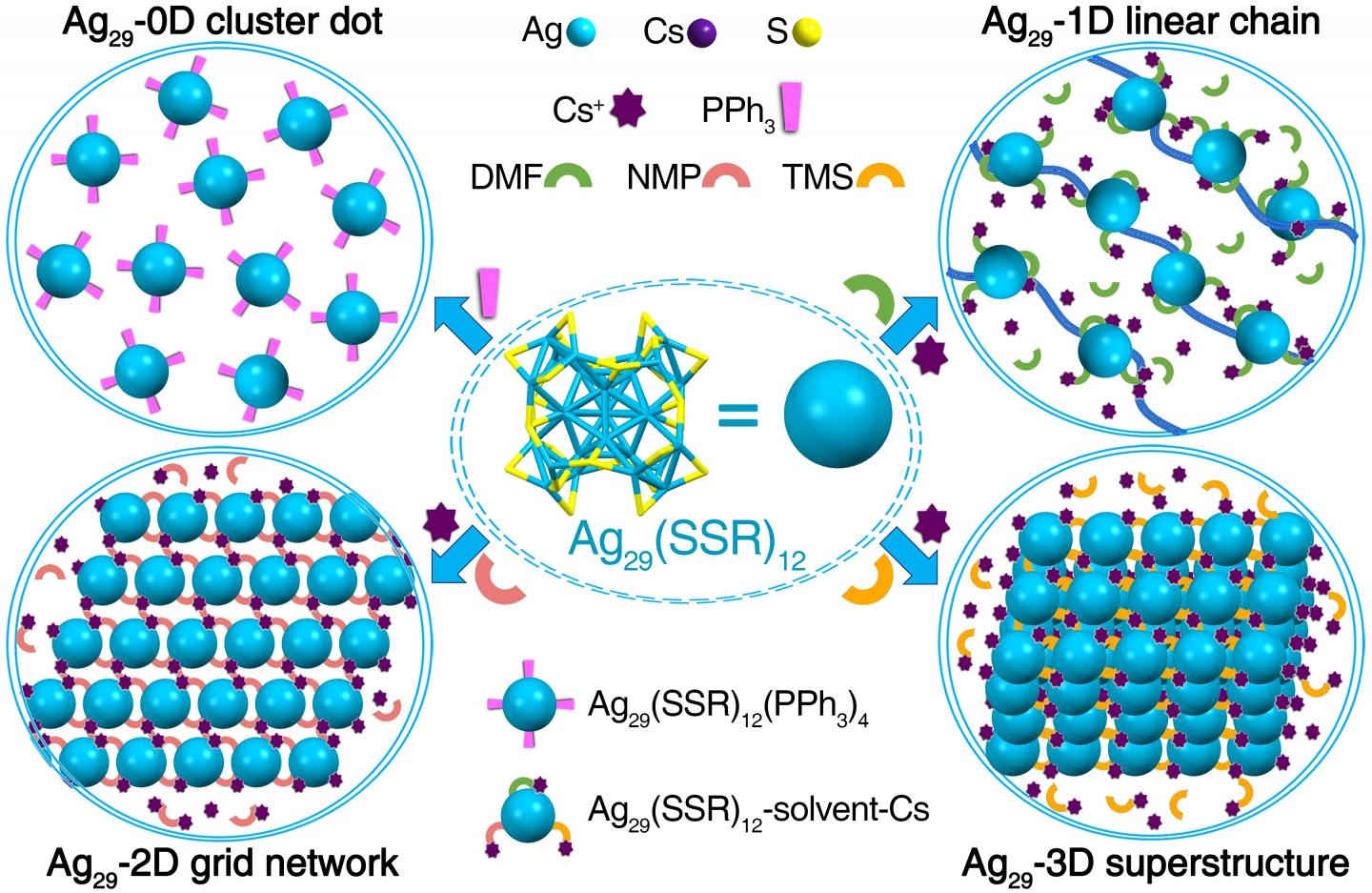
Credit: ©Science China Press
Metal nanoclusters have been served as an emerging class of modular nanomaterials owing to their atomically precise structures, fascinating properties, and potential applications. The subject of cluster-based supramolecular assembly represents one of the most dynamic areas and has emerged recently as a new “growth point” in the nanocluster science. Such assemblies originate in different types of inter-cluster interactions such as chemical bonding, hydrogen bonding, electrostatic, van der Waals, π* * * π and C-H* * * π interactions. On one hand, these cluster-based aggregates typically display enhanced performance (e.g., stability and fluorescence) relative to their constituent cluster building blocks owing to the synergy from the cluster-linker-cluster assembly system. On the other hand, the precise structures of nanoclusters allow for the atomic-level understanding of inter-cluster interaction modes, and such knowledge further guides us to controllably constitute hierarchically assembled cluster-based nanomaterials. However, up to the present, the controllable assembly of cluster nano-building blocks in different arrays remains challenging.
In a new paper published in the National Science Review, scientists at the Anhui University (China) and Nanjing University (China) reported the hierarchical self-assembly of atomically precise nanoclusters. On the basis of the Ag29(SSR)12 cluster nano-building framework (where SSR is 1,3-benzene dithiol), Professor Manzhou Zhu and his coworkers selectively constructed the cluster-based 1D linear chains, 2D grid networks, 3D superstructures in the presence of different solvent-conjoined Cs+ cations. Crystal structures of these cluster-based assemblies have been successfully determined. Besides, the hierarchical self-assembly of these Ag29(SSR)12 nano-building blocks has not only been observed in their crystalline state, but also in their amorphous state, with the help of the aberration-corrected HAADF-STEM (high angle annular dark field scanning transmission electron microscope).
“Such Ag29-based assemblies manifest distinguishable optical absorptions and emissions in both solutions and crystallized films; such differences originate from their different surface structures and crystalline packing modes,” they state, “Furthermore, the surface areas of these cluster-based assemblies are evaluated, the maximum value of which occurs when the cluster nano-building blocks are assembled into 2D arrays. The 2D-array assembly endows the best gas storage capability of these cluster-based frameworks.”
“This work presents an exciting example of the hierarchical assembly of atomically precise nanoclusters by simply controlling the adsorbed molecules on the cluster surface,” they add, “and we believe that this work will shed light on more future works touching upon the supramolecular chemistry of metal nanoclusters.”
###
This work was supported by National Natural Science Foundation of China (U1532141, 21631001, 21871001 and 21803001), the Ministry of Education, the Education Department of Anhui Province (KJ2017A010), and 211 Project of Anhui University.
See the article:
Xiao Wei, Xi Kang, Zewen Zuo, Fengqi Song, Shuxin Wang and Manzhou Zhu
Hierarchical structural complexity in atomically precise nanocluster frameworks
Natl Sci Rev, 2020; DOI: 10.1093/nsr/nwaa077
a target=”_blank” href=”https://doi.org/10.1093/nsr/nwaa077″>https:/
The National Science Review is the first comprehensive scholarly journal released in English in China that is aimed at linking the country’s rapidly advancing community of scientists with the global frontiers of science and technology. The journal also aims to shine a worldwide spotlight on scientific research advances across China.
Media Contact
Manzhou Zhu
[email protected]
Related Journal Article
http://dx.