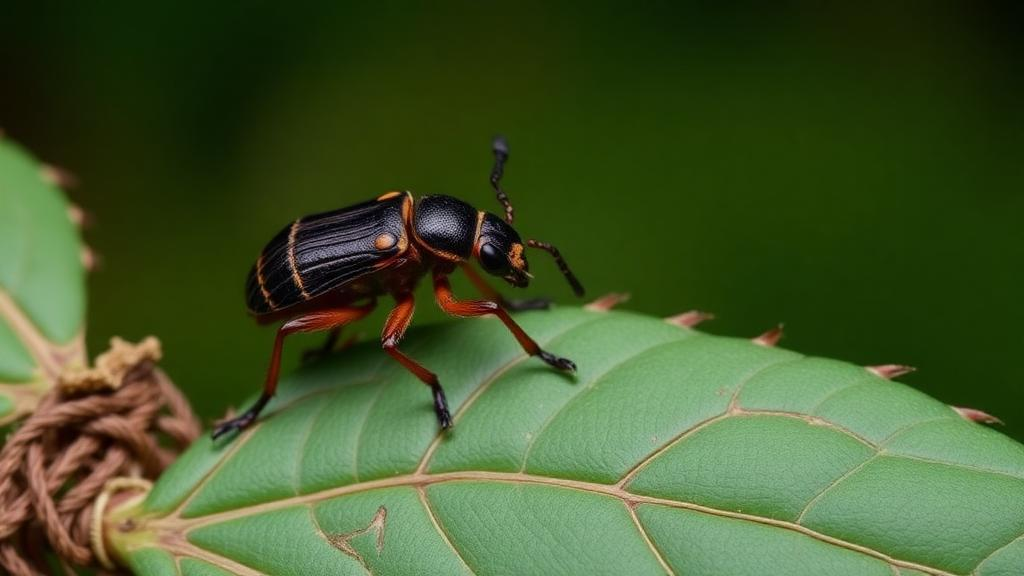
In the mountain ranges of northern Portugal, a small weevil has been quietly living out its life on a plant nobody expected. Donus proximus (Capiomont, 1876), a little-known member of the subfamily Hyperinae, has now been documented feeding and developing on the umbellate heather Erica umbellata, a member of the heather family Ericaceae. Until now, no Ericaceae species had ever been recorded as a host plant for any member of Hyperinae, making this discovery a genuine first for the group and a reminder of how much basic biology remains unknown even for European insects.
The findings stem from a field excursion in early June 2023 through the Serra do Marão, Serra do Alvão, Serra do Barroso and Serra do Gerês, mountain chains in northern Portugal where the species occurs alongside populations in northwest Spain. In small remnants of the original oak forest, consisting of Quercus pyrenaica, Q. cerris, Erica species and various broom shrubs, the researcher found both larvae and adult beetles of Donus proximus. A targeted search then revealed Erica umbellata as the host plant, with the insects concentrated on forest clearings and edges, usually near rock formations or paths.
The larvae themselves are striking. They carry a high-contrast pattern of five pale longitudinal stripes on a green body colour, an arrangement that camouflages them superbly among the branches of their host plant. Like other Hyperinae, the larvae feed externally on the plant, a lifestyle that makes them relatively easy to observe in the field during early summer and that has repeatedly proven useful for uncovering host-plant associations in this subfamily.
Rearing the larvae on Erica umbellata in the laboratory proceeded without difficulty. Within one week, the first larvae began spinning a reddish-brown silken net cocoon, a characteristic structure for the group. Pupation followed within three to four days, and by 19 June, fourteen to eighteen days after pupation, all adult beetles had emerged. This successful rearing confirmed the host-plant association beyond doubt, since the larvae had been collected in the field and completed their development on the suspected host.
Beyond the biological novelty, the study settles a taxonomic question that has lingered for decades. Capiomont described the species in 1876 as Hypera proxima on the basis of a single male specimen, noting that it was the only individual he could examine. He compared the new species with Donus montivagus, which he had described from the Sierra Nevada in southern Spain. The type locality of Donus proximus lies in the Serra do Gerês in northern Portugal, where L. von Heyden captured the specimen.
The holotype itself survives in the collection of Lucas von Heyden at the Senckenberg German Entomological Institute in Müncheberg, and photographs of the type allowed its identity to be verified without difficulty. Additional comparison material from the collection Georg Frey at the Natural History Museum Basel, including specimens from Asturias and León in Spain and from Sabrosa and S. Martinho in Portugal, together with topotypic animals from the Serra do Gerês and specimens of the synonym Donus barrosi, made it possible to examine the species thoroughly.
The conclusion was unambiguous: Donus proximus does not belong to the genus Brachypera, as had been proposed in 2008, but to the genus Donus. The oval shape of the elytra without a humeral bulge, the comparatively short and broad abdominal segments, the strongly rounded pronotum and the long, cylindrical rostrum all match the characteristic features of Donus. The new combination Donus proximus comb. nov. is therefore introduced. One larval character was not checked: the number of teeth on the larval mandibles, which should be three in Donus, four in Brachypera and only two in Hypera. This trait has so far been examined in only six of the more than forty species of Brachypera and should be verified in future studies.
The habitat records are equally significant. All sites lay on clearings or at the edges of near-natural oak forest, mostly close to rock formations or paths. The study characterises this environment for the first time for the species and highlights how restricted it has become. Much of today’s forest cover in northern Portugal consists of plantations of Aleppo pine, Eucalyptus, Thuja or Acacia, all foreign to the original ecosystem, and the natural oak woods have been severely reduced.
That pressure is not merely historical. Slash-and-burn clearing, unusually frequent forest fires and afforestation with non-native tree species continue to threaten the remaining oak forests, and the same threats apply directly to Donus proximus. Earlier records from near the coast, such as those of the synonym barrosi from the coastal locality of San Martinho, almost certainly no longer persist, given how degraded those habitats have become. The remaining forests in the northern sierras are therefore the last refuges for this weevil in Portugal.
The study also underscores how incomplete our knowledge of weevil host associations remains. A 2005 compilation gathered fifteen different plant families known to support Hyperinae development, and Ericaceae were not among them. Because no comprehensive revision of all Donus species exists, and the most recent summarising works date back to the nineteenth and early twentieth centuries, with only partial modern revisions available, adjustments of this kind are not surprising. The combination of field observation, successful rearing and type verification shows how classical methods can still resolve both the identity and the ecology of an obscure species in a single effort.
Subject of Research: Biology, host-plant association and taxonomic identity of the weevil Donus proximus in northern Portugal
Article Title: Zu Biologie und Identität von Donus proximus (Capiomont, 1876) comb. nov. ( Coleoptera , Curculionidae , Hyperinae )
Article References: Germann, C. (2023). Zu Biologie und Identität von Donus proximus (Capiomont, 1876) comb. nov. (Coleoptera, Curculionidae, Hyperinae). Alpine Entomology, 7, 213-217. https://doi.org/10.3897/alpento.7.109422
Image Credits: AI Generated
Keywords: Donus proximus, Curculionidae, Hyperinae, Erica umbellata, Ericaceae, taxonomy, comb. nov, northern Portugal, oak forests, larval rearing, Serra do Gerês, habitat loss
News Source: Gavin Prescott. (October 18, 2026). Hidden Weevil of Portugal’s Oak Forests Revealed With First Ericaceae Host Record for Hyperinae. Scienmag.