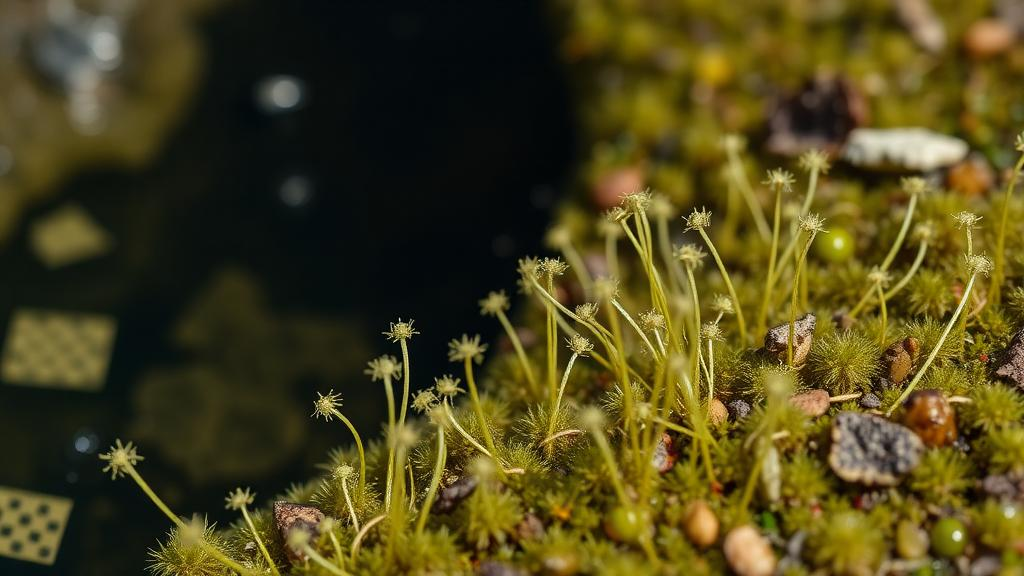
In a discovery that has electrified freshwater botanists across Central Europe, researchers have re-discovered the delicate stonewort Nitella gracilis in Slovakia, more than 45 years after the last confirmed record of the species in the country. The find, published in the Biodiversity Data Journal, came during a systematic survey of charophytes conducted between 2021 and 2025, in which roughly 200 prospective aquatic habitats were visited and searched both visually and with a grapnel from the shore and from boats. The species had been classed as Regionally Extinct on the Slovak Red List, so the confirmation of living populations at two localities represents one of the most striking botanical re-discoveries in the region in recent years.
Stoneworts, or charophytes, are macroscopic green algae whose branched, whorled thalli resemble miniature aquatic plants, and they are widely distributed across European freshwaters. The genus Nitella, established by C. Agardh in 1824, is distinguished from other charalean genera by ecorticate and mostly non-encrusted thalli, the absence of stipulodes, and segmented branchlets composed of more or less equal-sized unicellular segments. The terminal segments of the branchlets, known as dactyls, may be one-celled or composed of two or more cells, and this feature, together with oospore wall ornamentation, is central to identifying species within the genus. Thirteen species of Nitella are known from Europe, and slightly more than half have been recorded in Slovakia, where all of them are rare and poorly known.
A recent critical review of Slovak charophytes examined 252 herbarium specimens of the family Characeae and identified seven species of Nitella represented by only 20 records. Of these, just eight date from the twenty-first century, with the most recent from 2002. Nitella mucronata and Nitella syncarpa are classed as Endangered in Slovakia, while the remaining five species, including Nitella gracilis, were classed as Regionally Extinct. The re-discovery therefore brings the total number of Slovak records to five and provides the first confirmed evidence of the species in the country in more than four and a half decades.
Nitella gracilis is a cosmopolitan species, widely but thinly distributed across Europe, with its occurrence concentrated in the western and central parts of the continent and thinning towards the south, north and east. Its conservation status in the countries surrounding Slovakia reflects this precarious position: it is Critically Endangered in Poland, Vulnerable in Ukraine with eight localities, five confirmed since 2000, Endangered in Austria with nine known localities, and Highly Endangered in the Czech Republic, where only four of 18 localities have been confirmed in recent years. Notably, eight occurrences were recorded in Central Burgenland in Austria in 2022 and 2023, the first Austrian records since 1970, suggesting that the species may have been overlooked in small, transient waterbodies across much of its range.
The first new Slovak locality lies in the Krupinská planina Mountains, near the road to Čabraď Castle, where Nitella gracilis grew in a water-filled pool in a clearing within mixed deciduous forest dominated by oak-hornbeam and beech stands. The pool was 10 to 20 centimetres deep, approximately 20 square metres in area, with muddy, yellow-white water at 26.3 degrees Celsius, pH 7.41 and conductivity of 135 microsiemens per centimetre. Four clumps of the stonewort were found in the central part of the puddle, together with the conjugate alga Spirogyra sp., Lemna minor and Alisma plantago-aquatica, as well as several hygrophilous species such as Glyceria notata, Juncus effusus and Veronica beccabunga.
The second locality, on Rovná hora north of the village of Sklené in the Turčianska kotlina Basin, proved far more extensive. The species initially occupied a pool along a forest track measuring 2 by 8 metres, at a depth of 10 to 30 centimetres, covering roughly 70 per cent of the surface. A systematic search between August and November 2025 revealed a total of 23 microsites, all in road puddles within a one-kilometre radius and 30 to 500 metres apart, with a combined water area of 349 square metres, of which 79 square metres were covered by Nitella gracilis, with coverage at individual sites ranging from 1 to 90 per cent. The average pH across all sites was 6.6, ranging from slightly acidic to neutral between 5.7 and 7.5, and average conductivity was 78.5 microsiemens per centimetre, ranging from 21.2 to 274. The researchers consider this site one of the most significant for the species in Central and Eastern Europe.
The plants found were monoecious, bearing both antheridia and oogonia, light yellow-green to green in colour, slender with delicate branches forming whorls, and resembling small Nitella mucronata in habit. The terminal cells of the dactyls were about two-thirds as broad as the subapical cell, fertile whorls formed heads, and the oospores carried punctate, granulate wall ornamentation. These features are diagnostic against Nitella mucronata, which differs in having a short, conical, mucronate end-cell about one-third as broad as the subapical cell, a generally more robust habit and reticulate rather than punctate oospore ornamentation. Very small, delicate individuals could potentially be confused with Nitella confervacea, but the upper whorls of the Slovak specimens were not contracted and the branchlet end segments were mostly three-celled, whereas in Nitella confervacea the end segments are always two-celled.
At the Rovná hora site, the researchers recorded phytosociological relevés around stands dominated by the stonewort and classified them as the association Nitelletum gracilis, documented for the first time in Slovakia. This community, described by Corillion in 1957, is very rarely recorded and documented in Europe. The species composition at Rovná hora reflects the habitat characteristics of the locality: small, narrow and permanently waterlogged tracks shaded by trees allow the co-existence of hydrophytes such as Nitella gracilis and Callitriche cophocarpa with hygrophytes, most frequently Alisma plantago-aquatica and Glyceria fluitans. In Poland, by contrast, the association occurs mainly in lakes and ponds, where true aquatic plants of the class Potamogetonetea are consistently present while hygrophytes are absent, and in Romania, Alisma plantago-aquatica is frequently present in addition to aquatic species.
Ecologically, the Slovak findings are revealing. All Slovak records of the species come from small waterbodies, particularly pools on tracks, whereas in other European locations lakes, ponds, pools, ditches and clay pits are most frequently recorded. The water characteristics recorded in Slovakia, such as pH and conductivity, fall within the range reported from other European countries, and the habitats were evaluated as mesotrophic to meso-eutrophic, somewhat richer than the oligo-mesotrophic or mesotrophic conditions typical of most European localities. The geological substrates of the two new localities differed markedly, the first characterised by andesite with minor dacite, agglomerates and tuffites, the second by marine molasse deposits dominated by claystone with minor siltstone, sandstone and tuffites. Despite these geological differences, both localities exhibited similar habitat characteristics, with clay-rich soil and shading by trees providing conditions for the long-term persistence of pools along tracks.
The discovery carries important conservation implications. Based on the limited number of confirmed sites, the researchers propose changing the national Red List status of Nitella gracilis from Regionally Extinct to Endangered under IUCN criteria B1, B2a and c. The findings suggest that small-scale, periodically disturbed microhabitats created by forestry activities may provide suitable conditions for this weakly competitive pioneer species, whose original source habitats were most likely marsh edges, swamp forest margins and stream backwaters, from which it may have colonised anthropogenic substitute habitats such as forest road ruts and puddles. Moderate, recurrent disturbance appears to play a key role in the conservation of the species, whereas both habitat stabilisation and eutrophication could negatively affect its long-term survival. Several threats warrant attention in future conservation planning, including forest road construction and resurfacing, premature drying following clear-cutting, and climatic trends towards longer dry periods, while the same wildlife activity that may aid dispersal, with animals wallowing in these pools during dry spells, can also physically destroy existing vegetation and, in extreme cases, eliminate a population outright.
The mechanism by which the species colonised these forest-associated microhabitats remains speculative, but several pathways are plausible. Oospores of charophytes are commonly dispersed by waterfowl and other animals through gut passage or attachment to feathers, fur or feet, and the frequent use of forest-road wheel ruts and game watering sites by deer, wild boar and birds likely provides repeated opportunities for transport between water bodies. Forestry machinery operating along these tracks may also contribute to local dispersal by transporting mud and water containing oospores or vegetative fragments between sites. It is equally possible that the species has persisted undetected at these or similar localities for a considerably longer period, given the long-term viability of charophyte oospores in sediment and the limited survey effort historically directed at small, ephemeral habitats such as roadside puddles and wheel ruts. Under this scenario, the apparent re-discovery would reflect increased survey attention rather than recent colonisation.
Shaded, forest-interior pools with soft, clay-rich sediment tend to retain water and undergo slower succession than open-area puddles, which dry out more quickly, and such forest pools may therefore represent the only remaining aquatic habitat available to the species during dry periods, allowing populations to persist for several years even in the absence of renewed disturbance. Small forest pools of this kind are increasingly recognised as important refuges for other species of conservation concern, including the Natura 2000 species Eleocharis carniolica and the fire-bellied toad Bombina bombina, underlining the broader conservation value of this habitat type beyond charophytes alone. All occurrence records from the study are publicly available through iNaturalist and mobilised to GBIF, and the researchers hope the findings will stimulate further research on stoneworts in Slovakia, where systematic surveys of suitable habitats may well reveal additional sites with the occurrence of this once-extinct pioneer.
Subject of Research: Re-discovery of the rare charophyte Nitella gracilis in Slovakia
Article Title: Contribution to Charophyceae knowledge in Slovakia – re-discovery of Nitella gracilis
Article References: Bednár, F., Dobrota, M., Romanov, R., & Hrivnák, R. (2026). Contribution to Charophyceae knowledge in Slovakia – re-discovery of Nitella gracilis. Biodiversity Data Journal, 14, Article e197476. https://doi.org/10.3897/bdj.14.e197476
Image Credits: AI Generated
Keywords: Contribution, Charophyceae, knowledge, Slovakia, re-discovery, Nitella, gracilis, scientific research
News Source: Margaret Porter. (October 18, 2026). Extinct stonewort re-discovered in Slovakia after 45 years. Scienmag.