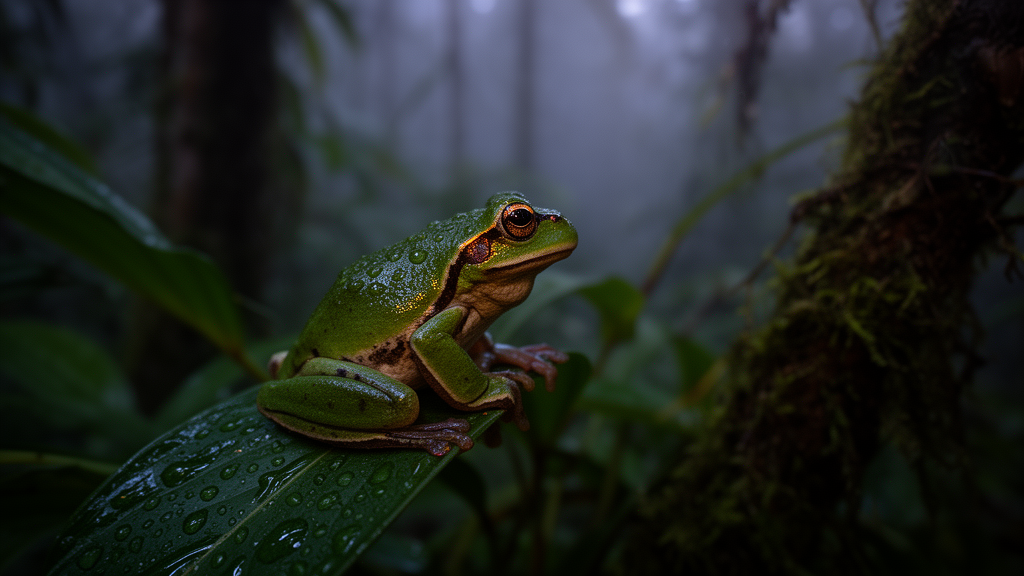
Deep in the humid lowland forests of northwestern Ecuador, a small treefrog with a distinctive hourglass pattern on its back has been hiding in plain sight for decades. Scientists have long labeled it Dendropsophus ebraccatus, the hourglass treefrog, a species familiar across Central America. But a new integrative study combining DNA sequencing, morphology, and bioacoustics has revealed that the Ecuadorian populations are not the same species at all. They belong to an entirely new frog, now formally described as Dendropsophus cannatellai, named in honor of the American herpetologist David C. Cannatella of the University of Texas at Austin.
The discovery, published in the journal Evolutionary Systematics, resolves a long-standing puzzle in the systematics of the genus Dendropsophus, a group of hylid frogs that comprises 107 documented species arranged into nine taxonomic groups. The species group at the center of the study, the Dendropsophus leucophyllatus group, contains 19 species distributed from Central America to the Atlantic Forest of Brazil. Members of this group share two diagnostic traits: an expanded cartilaginous plate in the nasal cartilages and, in males, pectoral glands arranged in two distinct patches. Until now, only one member of the group was thought to live in the Chocó region of Ecuador, the widespread hourglass treefrog itself.
Suspicion that something was amiss began with genomic evidence. An earlier study using genome-wide SNP data recovered Dendropsophus ebraccatus as paraphyletic, and a second analysis found a deep divergence of roughly 12 million years between Central American and Chocoan populations. Either result strongly suggested that the name Dendropsophus ebraccatus was masking more than one species. To test this hypothesis rigorously, the research team sequenced four mitochondrial genes, including 12S, 16S, COI, and ND1 along with flanking transfer RNAs, and two nuclear genes, tyrosinase and proopiomelanocortin. The final concatenated matrix spanned 7,691 base pairs from 203 individuals, analyzed under maximum likelihood with IQ-TREE and supported by ultrafast bootstrap and SH-like likelihood ratio tests.
The phylogenetic results were unambiguous. Populations previously called Dendropsophus ebraccatus in Ecuador form a strongly supported clade whose closest relative is not the Central American hourglass treefrog but Dendropsophus gryllatus, an elusive, poorly known frog endemic to western Ecuador that had never before been included in any phylogenetic analysis. Uncorrected genetic distances at the 16S gene reach 2.9 percent between the new species and Dendropsophus gryllatus, and between 6.6 and 8.7 percent between the new species and true Dendropsophus ebraccatus from Central America. A phylogenetic network built from the nuclear tyrosinase gene independently confirmed reciprocal monophyly between the new species and its sister species, providing evidence untainted by the quirks of mitochondrial inheritance.
A time-tree calibrated with a 37.8-million-year divergence estimate between related lineages added an evolutionary dimension to the story. The split between Dendropsophus cannatellai and Dendropsophus gryllatus dates to the late Pliocene, while the divergence between that pair and Central American Dendropsophus ebraccatus is far deeper, at approximately 17 million years. In other words, the frogs of Ecuador and Central America have been traveling separate evolutionary paths since before the Isthmus of Panama fully formed, yet their outward resemblance kept them classified together. The two species are allopatric, occupying distinct ranges on either side of the continent’s geography.
Morphology and sound provided the clinching evidence. The new species is a small frog, with males averaging 23.4 millimeters in snout-vent length and females 30.7 millimeters. Its brown dorsum carries white to bright yellow dorsolateral bands extending to the eyes and the top of the head, along with a well-defined sacral mark. It differs from Central American Dendropsophus ebraccatus by lacking a clear light band under the eye, and from Dendropsophus gryllatus by its larger body size and its hourglass-shaped dorsal mark, where its sister species shows two longitudinal dark brown lines on a pale yellow background. Bright orange flash coloration in the new species contrasts with the pale yellow of Dendropsophus gryllatus.
The frogs’ voices tell the same story. Advertisement calls of Dendropsophus cannatellai consist of a buzz-like primary note followed by a short secondary click. The primary note lasts about 0.11 seconds, contains roughly 10 pulses delivered at a mean rate of 95 pulses per second, and has a mean dominant frequency of about 3,275 hertz. Dendropsophus gryllatus calls at a significantly higher dominant frequency, around 3,607 hertz, and a slower pulse rate of 66 pulses per second, while Central American Dendropsophus ebraccatus produces a longer primary note of 0.21 seconds at a lower frequency near 2,386 hertz. A principal component analysis of seven acoustic variables showed low overlap in acoustic space between the two Ecuadorian species, and the frequency difference was statistically significant. Because dominant frequency and pulse rate are among the most reliable variables for detecting species limits in frogs, these non-overlapping values point to prezygotic reproductive barriers between the sister species.
Ecology adds further texture. Ecological niche modeling using the MaxEnt algorithm, with an excellent area under the curve of 0.980, predicts a potential range of roughly 17,000 square kilometers for the new species, spanning tropical rainforest and piedmont evergreen forest in northwestern Ecuador and southwestern Colombia. A principal component analysis of 19 bioclimatic variables showed that Dendropsophus cannatellai inhabits significantly warmer environments than Dendropsophus gryllatus. Interestingly, the new frog appears to tolerate human disturbance remarkably well, thriving in pastures, roadside ponds, and artificial open areas with abundant herbaceous vegetation, where males call from leaves and grasses less than two meters above water between dusk and midnight. A captive pair even produced a clutch of 190 eggs, and the tadpoles were raised for a full year, allowing scientists to document the larval and juvenile stages for the first time.
The study also finally pinned down the evolutionary affinities of Dendropsophus gryllatus, the Pacific Lowland treefrog, whose relationships had baffled researchers since its description in 1973. Its assignment had shifted between species groups over the years, but the new phylogeny places it firmly within the Dendropsophus leucophyllatus group, congruent with the presence of pectoral glands and with biogeography, since its sister species is the only other group member in the Chocó. This matters for conservation: Dendropsophus gryllatus is currently listed as Critically Endangered based on incomplete data, and the authors suggest a reevaluation is likely to yield a less alarming category, though its populations remain scarce and its known localities few.
Beyond the naming of a new frog, the discovery carries a broader warning about Neotropical biodiversity. If a colorful, relatively conspicuous treefrog living near roads and pastures could remain unrecognized as a distinct species for nearly 150 years, the true diversity of the Chocó, one of the world’s most biologically rich and most threatened hotspots, is likely far greater than current checklists suggest. The authors also note that Central American populations of the hourglass treefrog themselves show deep regional divergences, hinting that more cryptic species may still be waiting within that familiar name. For now, at least one hidden branch of the tree of life has been given its rightful place, and a name of its own.
Subject of Research: Systematics and description of a new treefrog species in the Dendropsophus leucophyllatus group from the Chocó region of Ecuador
Article Title: Systematics of the Dendropsophus leucophyllatus species group ( Anura , Hylidae ) from the Chocó region of Ecuador, with description of a new species
Article References: Aguirre, P. D., Apunte, K., & Ron, S. R. (2025). Systematics of the Dendropsophus leucophyllatus species group (Anura, Hylidae) from the Chocó region of Ecuador, with description of a new species. Evolutionary Systematics, 9(1), 7-31. https://doi.org/10.3897/evolsyst.9.135431
Image Credits: AI Generated
DOI: 10.3897/evolsyst.9.135431
Keywords: Dendropsophus cannatellai, treefrog, Chocó, Ecuador, amphibian systematics, phylogenetics, bioacoustics, cryptic species, new species, herpetology, conservation, Neotropics
News Source: Drew Townsend. (October 18, 2026). Hidden Treefrog Species Unmasked in Ecuador’s Chocó Rainforest After Decades of Mistaken Identity. Scienmag.