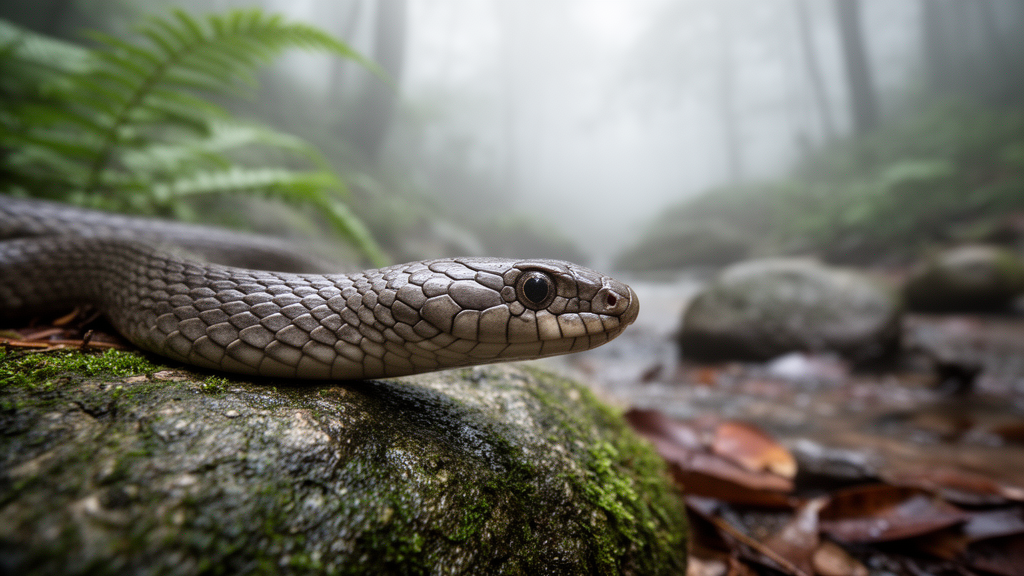
Deep in the subtropical forests of eastern China, a slender, glossy snake has been quietly slipping past scientists for decades. Now, an integrative taxonomic study has confirmed that Zong’s odd-scaled snake, Achalinus jinggangensis, is a genuine species with a far wider range than anyone suspected — and, in a surprise twist, it has revealed an entirely new species hiding in plain sight on Kuocang Mountain in Zhejiang Province, one of the most urbanized corners of the country. The discovery, published in Zoosystematics and Evolution, raises the number of recognized odd-scaled snakes to 30 and underscores how much cryptic diversity still lurks among Asia’s least conspicuous reptiles.
Odd-scaled snakes of the genus Achalinus are among the strangest serpents in Asia. Unlike typical snakes, whose dorsal scales overlap like roof tiles, Achalinus species bear a unique non-imbricate organization in which the scales form a dissociated, non-overlapping pattern. These small, non-venomous snakes lead secretive, fossorial or semi-fossorial lives, burrowing through leaf litter and soil across eastern and southeastern Asia, from China and Japan to Vietnam. Their low detectability has made them chronically understudied: as recently as 2019, only nine species were recognized. Intensified field surveys combined with molecular and morphological analyses have since tripled that tally, with 24 of the currently known species recorded from China, the acknowledged center of diversity for the genus.
Achalinus jinggangensis itself has long been an enigma. Originally described in 1983 as Achalinopsis jinggangensis from two specimens collected at Dajing Village in Jinggangshan, Jiangxi Province, the species was distinguished by a combination of peculiar characters: the suture between its internasal scales is substantially longer than that between its prefrontals, it lacks a loreal scale entirely, its dorsal scales are arranged in 23-23-23 rows with a smooth, enlarged outermost row, and in life it is uniformly black with a metallic sheen. For more than three decades it was believed to be endemic to Jinggang Mountain, and even a 2017 review that extended its range into Hunan Province offered only a brief description. A 2024 study published mitochondrial sequences attributed to the species from Fujian Province, but the specimen was collected far from the type locality and without morphological verification, leaving the species’ taxonomic status never comprehensively assessed.
The new research changed that by examining all available specimens, including newly collected material, and by generating mitochondrial DNA sequences spanning 2,380 base pairs from seven samples across four Chinese provinces. The team studied 22 preserved specimens in total, including 16 of A. jinggangensis and six from an unidentified population collected on Kuocang Mountain in Linhai City, Zhejiang Province, during surveys between 2024 and 2025. Measurements were taken with digital calipers to the nearest 0.01 millimeter, scalation counts followed standardized methods, and sex was determined by checking for hemipenes. In a striking technical flourish, the researchers used micro-computed tomography scanning at the Institute of Vertebrate Paleontology and Paleoanthropology to reconstruct three-dimensional skull models and count maxillary teeth — a method that revealed the original 1983 tooth count of roughly 22 had underestimated the true number by six to seven teeth.
The molecular analyses were equally rigorous. Genomic DNA was extracted from ethanol-preserved liver tissues, and four mitochondrial fragments — 12S and 16S ribosomal RNA, the CO1 gene, and cytochrome b — were amplified by polymerase chain reaction and sequenced. The phylogenetic dataset ultimately comprised 125 sequences representing 27 recognized species of Achalinus, with two related xenodermid species as outgroups. Maximum Likelihood reconstruction in IQ-TREE and Bayesian Inference in MrBayes recovered highly concordant topologies. All samples identified as A. jinggangensis clustered together with strong statistical support, forming a well-defined monophyletic lineage — but within it, the researchers found a clear pattern of geographic structuring, with two moderately divergent yet well-supported clades.
Clade 1 includes a specimen collected roughly 80 kilometers southeast of the type locality, together with populations from Fujian and Guangdong Provinces. Clade 2 is restricted to the Nanling Mountains of Guangdong and adjacent Mangshan in Hunan. Genetic distances between the two clades ranged from 3.4 to 5.1 percent in the CO1 gene, approaching levels seen between some recognized species. Yet the team conservatively interpreted these lineages as intraspecific geographic structuring within a single species rather than distinct species, noting that no stable diagnostic morphological characters distinguish the subclades and no clear geographic barrier prevents dispersal between them. They suggest the pattern may trace back to Pleistocene sea-level fluctuations, when repeated marine transgressions and regressions periodically fragmented and reconnected terrestrial habitats, shaping population connectivity across southern China.
Meanwhile, the six specimens from Kuocang Mountain formed a distinct and strongly supported clade of their own. Although the phylogeny placed this lineage closest to A. jinggangensis, that relationship lacked sufficient statistical confidence, leaving its precise position unresolved. What was unambiguous was the genetic divergence: uncorrected p-distances between the Kuocang population and A. jinggangensis ranged from 9.5 to 10.9 percent in CO1, squarely within the range of interspecific divergence in the genus. Combined with detailed morphological examination confirming that the Kuocang specimens are diagnosable from all known congeners, the evidence was decisive. The team described the population as Achalinus mirabilis sp. nov., the specific epithet meaning marvelous or remarkable in Latin — a nod both to the snake’s distinctive morphology and to the unexpectedness of finding a new species in Taizhou City, a highly urbanized and economically developed region.
Achalinus mirabilis is readily distinguished from its closest relative by a suite of stable characters. Its outermost dorsal scale row is distinctly keeled, whereas in A. jinggangensis that row is completely smooth. It has a higher number of ventral scales in both sexes — 163 to 166 in males and 174 to 178 in females, versus 147 to 155 and 152 to 168 in A. jinggangensis — and higher subcaudal counts in females. Its maxillary teeth number 27, slightly fewer than the 28 or 29 of A. jinggangensis. Most conspicuously, the coloration is entirely different: in life, A. mirabilis is brown to dark brown with a slight metallic sheen above and uniformly light brown below, while A. jinggangensis is entirely black dorsally with a venter ranging from deep blackish brown to black. The new species is currently known only from a few localities within the Kuocang Mountain range, at elevations from 163 to 879 meters, where individuals were encountered at night on mountain roads near villages, in bamboo forests, and in well-preserved subtropical broad-leaved forests. Because so few specimens exist, the species is assessed as Data Deficient under IUCN criteria, with an extent of occurrence of only about 33 square kilometers.
The reassessment also expanded the known range of A. jinggangensis itself. The species is now confirmed across four provinces of southeastern China — Fujian, Guangdong, Hunan, and Jiangxi — occurring from approximately 195 to 1,747 meters above sea level in well-preserved subtropical evergreen broad-leaved forests. Field observations indicate it is nocturnal, most frequently encountered after rainfall and under humid conditions, sheltering by day beneath rocks, leaf litter, or debris. GeoCAT analysis yielded an extent of occurrence of 80,970 square kilometers and an area of occupancy of 16,228.8 square kilometers, supporting the recommendation to retain its current IUCN assessment of Least Concern. The study also settled a long-running nomenclatural dispute: Zong and Ma had originally placed the species in the genus Achalinophis, arguing that the absence of a loreal scale was a generic-level distinction, but the new phylogenetic and morphological results confirm that this character represents species-level variation within Achalinus, vindicating taxonomists who rejected Achalinophis decades ago.
Beyond the two focal species, the findings carry a broader warning for snake taxonomy. The researchers note that in small-bodied snakes with limited dispersal ability, gene flow among populations is likely low, allowing moderate genetic differentiation to accumulate readily across geographic areas — meaning some differences previously interpreted as species-level divergence may instead reflect population-level variation exacerbated by sparse sampling. As sampling density increases, diagnostic characters proposed for some recently described species may require re-evaluation. The team argues that future studies of Achalinus should emphasize dense, wide-ranging sampling combined with integrative approaches to accurately delimit species boundaries. The discovery of A. mirabilis also highlights the conservation value of urban ecological refugia: surrounded by an intensively modified landscape, the Kuocang Mountains harbor a genuinely overlooked species, and the researchers call for systematic biodiversity surveys in cities and their surroundings to better inform conservation of remnant natural habitats within rapidly urbanizing landscapes. With 25 of the genus’s 30 recognized species now recorded from China, the odd-scaled snakes are proving to be anything but odd in their capacity to surprise.
Subject of Research: Taxonomy and biodiversity of odd-scaled snakes in China
Article Title: Taxonomic reassessment of Achalinus jinggangensis (Zong & Ma, 1983) ( Serpentes , Xenodermidae ), with description of a new species from Zhejiang Province, China
Article References: Xu, Y., Hu, J., Qi, S., Ma, S., Chen, H., Zhang, T., Zhang, Y., Sun, F., Zhou, J., Xu, J., Wang, Y., & Peng, L. (2026). Taxonomic reassessment of Achalinus jinggangensis (Zong & Ma, 1983) (Serpentes, Xenodermidae), with description of a new species from Zhejiang Province, China. Zoosystematics and Evolution, 102(2), 387-409. https://doi.org/10.3897/zse.102.183453
Image Credits: AI Generated
Keywords: Achalinus, herpetology, taxonomy, new species, China, Zhejiang, Xenodermidae, cryptic diversity, Taxonomic, reassessment, jinggangensis, Zong
News Source: Margaret Porter. (October 18, 2026). Hidden odd-scaled snake from Chinese mountains turns out to be a brand-new species. Scienmag.