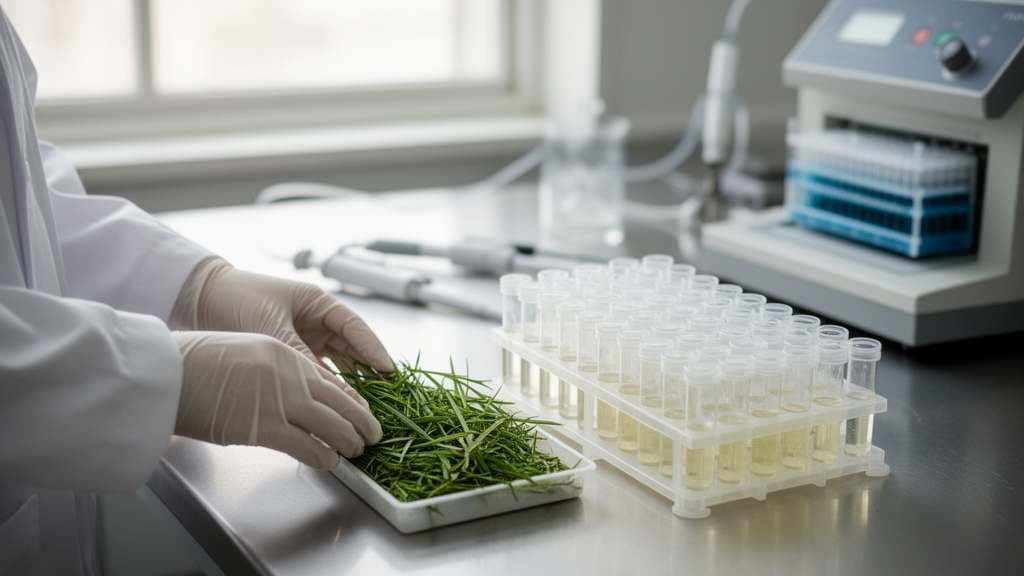
Citronella grass, the aromatic Cymbopogon winterianus whose oil scents candles, soaps, and insect repellents worldwide, has long been trapped in a genetic bottleneck. The crop is propagated almost exclusively by cloning, which means that nearly every commercial plant is a copy of the same elite genotypes. With so little sexual recombination, breeders have had few opportunities to stack new traits or break through yield plateaus. A recent study tried to change that by using polycross breeding—planting several cultivars together and letting them cross-pollinate freely—then using DNA markers to work out which plant fathered which seedling. But a new commentary published in Molecular Biology Reports argues that the approach, while promising, still has serious methodological gaps that must be closed before citronella breeders can rely on it.
The original study, led by Biradar and colleagues, focused on half-sib progenies derived from four commercial citronella cultivars. Using simple sequence repeat (SSR) markers—short, repetitive stretches of DNA that vary in length between individuals—the team attempted to match each offspring to its most likely pollen donor. They succeeded in identifying potential paternal parents for five out of eleven progenies tested. On the surface, that sounds like a breakthrough for a crop where genetic diversity is notoriously limited. But the commentary’s authors, led by Arman A. Gholami of Mashhad University of Medical Sciences, point out that a 45 percent paternity assignment rate falls far short of what is typically achieved in similar polycross systems.
In comparable breeding programs—ranging from white clover to tall fescue to oil palm—researchers routinely recover paternity assignments at rates between 79 and 99 percent. The gap between those benchmarks and the 45 percent achieved in citronella is not trivial. The commentary identifies three main technical reasons for the shortfall. First, the number of SSR markers used was likely insufficient to discriminate between candidate fathers with confidence. Second, the markers themselves had limited informativeness, with a polymorphism information content (PIC) value of just 0.33—well below the threshold generally considered highly informative for parentage work. Third, the study relied on simple exclusion-based matching rather than likelihood-based methods that assign statistical confidence to each paternity call.
SSR markers work by targeting repetitive DNA sequences that mutate frequently enough to create length differences between individuals. When a seedling inherits one allele from its mother and one from its father, comparing those alleles against a panel of candidate fathers can, in principle, pinpoint the true parent. But the power of this approach depends entirely on how many markers are used and how variable they are across the candidate pool. A PIC value of 0.33 means each marker, on average, carries only moderate discriminating power. With too few such markers, many candidate fathers remain statistically indistinguishable, forcing researchers to fall back on exclusion—ruling out fathers whose alleles cannot match the offspring—rather than positively identifying the correct one.
Likelihood-based paternity analysis, by contrast, calculates the probability that each candidate father produced the observed offspring genotype relative to all other candidates. This framework, widely used in human forensics and animal breeding, provides not just a best guess but a quantified confidence level. Without it, paternity assignments remain suggestive rather than definitive. The commentary argues that adopting this approach, alongside expanding the SSR panel to include more informative loci, would substantially improve assignment rates and bring citronella in line with what has been achieved in other clonally propagated crops.
The second major concern raised by the commentary involves pollen contamination. The citronella polycross was conducted in an open field, meaning that wind-borne or insect-carried pollen from plants outside the designated crossing block could easily have fertilized some of the seed mothers. In similar breeding systems, contamination rates as high as 36 percent have been documented. Without a dedicated assessment of how much foreign pollen entered the plot, any paternity assignment—or failure to assign—could be confounded by fathers that were never among the candidates in the first place. This is not a hypothetical worry; it is a well-documented phenomenon in polycross and seed orchard research across multiple species.
The third issue concerns the stability of the traits used to identify superior progenies. The original study selected promising offspring based on a single harvest. But the commentary notes that performance declines of up to 30 percent have been observed between the first and second harvests in comparable systems. Selecting based on one season’s data, without stability analysis across multiple harvests, risks promoting genotypes that perform well initially but cannot sustain their advantage. Stability analysis—statistical methods that evaluate how consistently a genotype performs across environments and time points—is a standard tool in plant breeding for exactly this reason. Its absence from the citronella work leaves the identification of superior families on shaky ground.
None of these criticisms negate the value of the original study. Polycross breeding remains one of the few viable strategies for introducing genetic variation into clonally propagated crops like citronella, where conventional hybridization is difficult and genetic diversity is narrow. The concept of using molecular markers to trace paternity in such systems is well established and has delivered real gains in other crops. What the commentary makes clear is that the citronella work, while a meaningful first step, needs stronger statistical frameworks, more informative marker panels, contamination controls, and multi-harvest stability data before its conclusions can be considered robust.
The broader lesson extends beyond citronella. As molecular tools become cheaper and more accessible, plant breeders working with clonally propagated crops—many of which feed or fragrance billions of people—are increasingly turning to polycross designs paired with DNA-based paternity testing. Getting the methodology right matters. A paternity assignment that is only 45 percent reliable, based on weakly informative markers and unquantified pollen contamination, could mislead breeding decisions just as easily as no assignment at all. The commentary’s authors argue that addressing these gaps is not optional but essential if polycross breeding is to deliver on its promise for citronella and similar crops.
For now, the citronella breeding community has a clear roadmap. Expand the SSR panel with more polymorphic markers. Adopt likelihood-based parentage models with confidence intervals. Quantify pollen contamination using external reference genotypes or spatial isolation. And subject candidate progenies to multi-harvest stability trials before declaring them superior. These are not exotic requirements; they are standard practices in polycross breeding programs for forage grasses, tree species, and other clonally propagated crops. Bringing citronella up to that standard would transform what is currently a preliminary proof of concept into a reliable tool for breaking the crop’s clonal barrier and unlocking the genetic variation it desperately needs.
Subject of Research: SSR marker-based paternity analysis for polycross breeding of citronella grass
Article Title: SSR-based paternity analysis in citronella polycross breeding: progress and remaining challenges
Article References: Kadirov, R., Bakhramov, R., Turgunboev, S., Urmanbaeva, D., Ismatova, M., Khusankhodjaeva, F., & Gholami, A. A. (2026). SSR-based paternity analysis in citronella polycross breeding: progress and remaining challenges. Molecular Biology Reports, 53(1), Article 1746. https://doi.org/10.1007/s11033-026-12885-6
Image Credits: AI Generated
DOI: 10.1007/s11033-026-12885-6
Keywords: citronella, Cymbopogon winterianus, polycross breeding, SSR markers, paternity analysis, pollen contamination, clonal propagation, plant breeding, genetic diversity, stability analysis, molecular markers, Molecular Biology Reports
News Source: Alan Morgan. (October 18, 2026). DNA Paternity Tests for Citronella Grass Reveal Gaps in Clonal Crop Breeding. Scienmag.