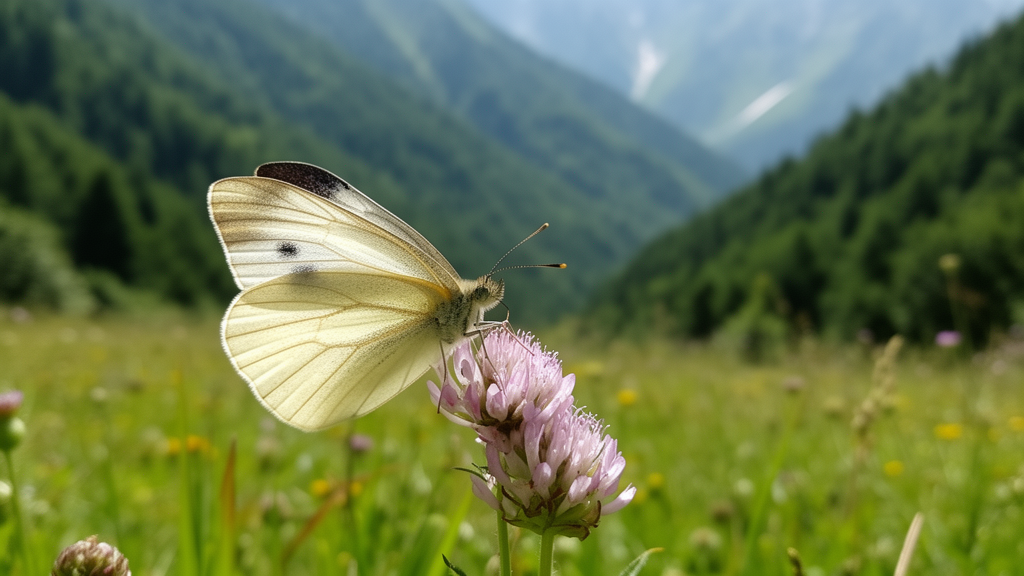
Deep in the forested slopes of the Alborz mountains, where the humid woodlands of northern Iran meet the semi-dry mountain steppes, a small white butterfly has been hiding in plain sight. To any collector’s eye it looks exactly like the familiar Wood White, Leptidea sinapis, a species that flutters across meadows from western Europe to Central Asia. Yet a new study published in Comparative Cytogenetics shows that the populations living along the Caspian coast of Iran carry a genetic signature entirely their own. The researchers have formally described them as Leptidea sinapis tabarestana, a new subspecies named after Tabarestan, the medieval name for the mountainous region south of the Caspian that roughly corresponds to today’s province of Mazandaran, where the type specimen was collected.
The discovery was, by the authors’ own account, accidental. The team had set out to answer a different question: whether any of the Iranian populations of the Wood White actually belonged to Leptidea juvernica, a cryptic sister species that was itself only recognized as distinct in recent decades. Fourteen museum and field specimens from disjunct populations across northwestern and northern Iran had their legs submitted for DNA barcoding, processed at the Center for Biodiversity Genomics in Guelph, Canada, using standard LepF and LepR primers supplemented by mini-primers for degraded samples. Eleven additional sequences from the Javaherdeh locality, generated in 2012, were later added, and thirty-six new barcode sequences were deposited in GenBank. None of the barcoded Iranian specimens turned out to be L. juvernica, but something unexpected emerged instead.
The mitochondrial COI barcodes, mostly full-length sequences of 658 base pairs, told a striking story. Samples from East Azerbaijan province in the northwest, around Arasbaran, carried haplotypes identical to those of the widespread Eurasian nominate subspecies. But specimens collected across the Alborz mountains, from Talesh in the west to the forests of Golestan in the northeast, formed a unique and well-supported clade. In both Maximum Likelihood and Bayesian phylogenetic reconstructions, this lineage appeared as the sister group to all other populations of L. sinapis, meaning it branched off earliest in the species’ genealogy. The average uncorrected genetic distance between the new lineage and other L. sinapis populations was 0.74 percent, with a range from 0.42 to 1.76 percent, clearly smaller than the distances separating L. sinapis from its recognized sibling species L. reali at 0.92 percent and L. juvernica at 1.97 percent, but far from trivial.
What makes the finding remarkable is that the new butterfly is morphologically indistinguishable from the nominate subspecies. The researchers dissected and measured the male genitalia of eight specimens, focusing on three characters known to be the most informative for separating Leptidea species: phallus length, saccus length and vinculum width. The measurements, 1.47, 0.60 and 0.71 millimeters respectively, overlapped broadly with those of typical L. sinapis, and no single external character or combination of characters could reliably separate the two forms. Individual variation within the new taxon mirrors that seen in nominate populations, where butterflies on cold, high-altitude slopes tend to be smaller and darker than those in warmer lowland forests. Only the DNA barcodes betray the difference, placing the new subspecies within the Barcode Identification Number of L. sinapis while forming a distinct cluster of its own.
The chromosomes added another layer of evidence. Chromosome preparations from ten adult males caught at Javaherdeh yielded usable metaphase plates in only two specimens, a common difficulty in this genus. In mitotic cells of one sample, the diploid chromosome number was estimated at approximately 58, though exact counting was hampered by overlapping chromosomes. More intriguingly, the second metaphase plates of another sample showed traces of a phenomenon the researchers call inverted meiosis, in which heterozygosity for chromosomal fusions or fissions produces trivalent-like structures at the second meiotic division. Seven such structures were observed among 29 chromosome entities, allowing the haploid number to be estimated at between 29 and 33. This relatively low chromosome count matches the eastern end of a remarkable cline documented in L. sinapis, in which diploid numbers decline from 106 in Spain to 56 in Sweden and eastern Kazakhstan, marking the Iranian population as carrying an oriental karyotype variant.
The known distribution of the new subspecies, confirmed by DNA evidence, spans the northern Iranian provinces of Ardabil, Gilan, Mazandaran, Tehran and Golestan. It is strictly allopatric with respect to the nominate subspecies, whose nearest Iranian population lies about 100 kilometers away in the Arasbaran region. Intriguingly, specimens from the Talysh mountains across the border in the Republic of Azerbaijan show the same karyotype and may also belong to the new subspecies, though DNA confirmation is still pending, and unconfirmed reports from the Kopet Dagh mountains of Turkmenistan likely refer to it as well. Unlike the nominate form, which in Iran is restricted to humid and damp forest clearings, tabarestana occupies semi-humid and even semi-dry mountainous habitats, flying in humid meadows, along forest river banks and in clearings between 1,000 and 2,000 meters elevation, usually in undisturbed or lightly grazed sites with lush green vegetation.
The butterfly’s ecology follows a familiar seasonal rhythm. Adults appear in two, possibly three, generations each year, from April at lower altitudes to the end of September at higher elevations, flying alongside species such as Ochlodes hyrcana, Pieris napi mazandarana, Lasiommata adrastiodes and Maniola jurtina. Adults are often seen near Lathyrus plants, and the larval host plant is likely among the herbaceous legumes of genera such as Lathyrus, Vicia and Lotus, though it remains unrecorded, leaving open the question of whether the new subspecies shows host preferences different from other populations. The early stages are entirely unknown.
How did such a distinct lineage arise without any visible divergence in body form? The authors propose a biogeographical scenario rooted in the Pleistocene history of the region. Dense forests once covered all of northern Iran, from Azerbaijan province across the Alborz mountains and into the Kopet Dagh in the northeast. Since the Last Glacial Maximum, roughly 21,000 years ago, the Alborz range has been nearly entirely isolated from surrounding regions, and declining forest cover left isolated refugia in the southern Caucasus and northern Iran. As intervening populations died out, the range of the ancestral Wood White fragmented, geographically and genetically isolating the Alborz lineage. Recent estimates place the most recent common ancestor of L. sinapis at about 1.5 million years ago, and of sinapis plus juvernica at about 3 million years, with the eastward dispersal of the species occurring much later, before or after the Last Glacial Maximum.
The Wood White complex holds a special place in the history of cryptic species research. Differences in genital morphology and allozyme markers between L. sinapis and L. reali were among the first documented cases of cryptic species in Europe, and the subsequent discovery of the widespread hidden taxon L. juvernica turned the group into a model system for studying speciation. Yet modern taxonomic treatments had come to regard all populations from Europe to northwestern Mongolia as a single subspecies, and the idea of subspecies within L. sinapis had largely faded from view. The new discovery shows how much diversity can still be concealed within even well-studied butterflies, and how much of Eurasia remains poorly sampled.
The authors caution that the presence of Wolbachia endosymbionts, known to affect mitochondrial DNA in Leptidea, cannot be ruled out as a factor in their results, and further studies are needed to confirm the subspecies’ presence in Azerbaijan and Turkmenistan. If the two taxa are eventually found to co-occur in the intervening areas of northwestern Iran without gene flow, or if additional evidence from nuclear DNA, karyotype or morphology signals full species-level separation, tabarestana may yet be elevated to a bona species. For now, the mountains south of the Caspian have yielded one more reminder that the map of life is still being drawn, one barcode at a time.
Subject of Research: Discovery and description of a new cryptic subspecies of the Wood White butterfly Leptidea sinapis from northern Iran using DNA barcoding, genital morphology and karyotype analysis.
Article Title: More hidden diversity in a cryptic species complex: a new subspecies of Leptidea sinapis ( Lepidoptera , Pieridae ) from Northern Iran
Article References: Nazari, V., Lukhtanov, V. A., Naderi, A., Fric, Z. F., Dincă, V., & Vila, R. (2023). More hidden diversity in a cryptic species complex: a new subspecies of Leptidea sinapis (Lepidoptera, Pieridae) from Northern Iran. Comparative Cytogenetics, 17, 113-128. https://doi.org/10.3897/compcytogen.17.102830
Image Credits: AI Generated
DOI: 10.3897/compcytogen.17.102830
Keywords: Leptidea sinapis, cryptic species, DNA barcoding, COI, karyotype, Alborz mountains, Iran, Pieridae, butterflies, speciation, biogeography, taxonomy
News Source: Margaret Porter. (October 18, 2026). Hidden butterfly diversity uncovered: new subspecies of Wood White from northern Iran. Scienmag.