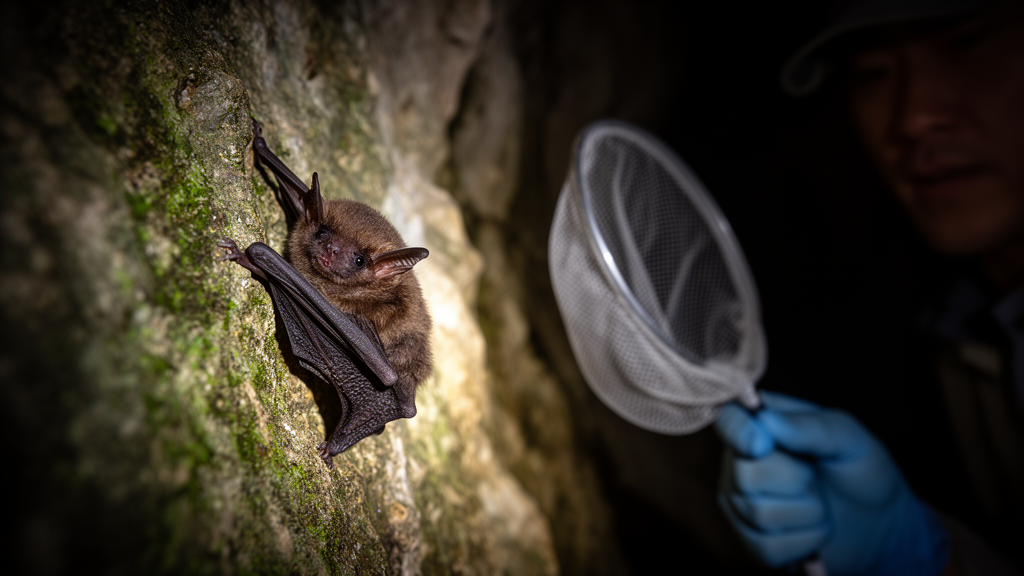
A single small bat netted from the eaves of a building in a remote nature reserve in Yunnan Province has turned out to be a species never before recorded in China, or anywhere on the Asian mainland. Researchers identified the specimen as Peters’s Pipistrelle, Hypsugo petersi, a vespertilionid bat previously documented only from scattered island localities in Borneo, the Philippines, Sulawesi and the Moluccas. The discovery, published in the journal ZooKeys, extends the known range of this poorly understood species by hundreds of kilometres and raises the number of Hypsugo species confirmed in China from six to seven.
The specimen was captured in July 2025 during a series of chiropteran surveys in southwestern Yunnan. Sweep netting at the eaves of the management station building within the Jinguang Temple Provincial Nature Reserve in Dali, at coordinates 25°11’55″N, 99°31’50″E and an elevation of roughly 2,500 metres, yielded one adult female, catalogued as GZHU 25209. Field protocols complied with Chinese law and live-animal handling followed American Society of Mammalogists guidelines. The voucher specimen, preserved in 75 percent ethanol, is now deposited at the South China Biodiversity Research Center at Guangzhou University. Adult status was confirmed by the degree of epiphyseal-diaphyseal fusion in the bones, a standard ageing method in bats.
Identifying the animal required an integrative approach combining morphology, morphometrics and genetics. The team took external measurements including body length, tail length, ear length, hind foot length, forearm length and tibia length, plus twelve craniodental dimensions measured with digital calipers accurate to 0.01 millimetres. The right wing was pinned flat, photographed perpendicular to the plane, and analysed with BAT-WINGAREA software to derive total wing area, wingspan and membrane areas, from which the three primary airfoil parameters were calculated. For the genetic component, total DNA was extracted and the mitochondrial cytochrome b gene, a 1,140-base-pair fragment widely used in bat systematics, was amplified and sequenced with specific primers.
The phylogenetic analysis aligned the new sequence with publicly available data from related genera including Pipistrellus, Vespertilio, Nyctalus and Falsistrellus, using Myotis chinensis as an outgroup. Maximum likelihood inference in IQ-TREE, with a TIM2+F+I substitution model and ultrafast bootstrap support estimated over 1,000 replicates, placed the Yunnan specimen firmly within a clade containing published sequences of Peters’s Pipistrelle from Luzon Island in the Philippines, with a bootstrap value of 100, the maximum possible. Pairwise genetic distances under the K2P model showed the new sample differed from Philippine H. petersi by only 0.10, whereas distances to other Hypsugo species ranged from 0.12 to 0.29. Notably, the Chinese sample formed the basal lineage relative to other conspecifics, hinting at an older, possibly ancestral population in the region.
Morphology told a consistent story. The bat is large for the genus, with a forearm length of 39.94 millimetres and a body mass of 7.5 grams. Its dorsal fur is long and woolly, dark chocolate-brown with lighter tips that give a frosted appearance, while the ventral fur is paler with brown tips. The wing membranes are blackish and hairless except for a small patch of pale-brown fur extending onto the ventral surface of the femur and the area around the anus, a hallmark of the species. The ears are dark, broad and rounded, the tragus short, broad and blunt, and the calcar bears a slight keel. The skull is long and narrow with slender zygomatic arches, well-developed occipital crests, and lower molars of the myotodont type, in which the talonid exceeds the trigonid in size, a diagnostic feature of Hypsugo that distinguishes it from Pipistrellus.
Multivariate statistics added a third line of evidence. Principal component analysis of six external measurements, supplemented with data from four other Chinese Hypsugo species, explained 69.6 percent of total variance in the first two components and separated five morphological groups, with the new specimen distinguished chiefly by its relatively long ears. A second PCA based on twelve craniodental measurements explained 72.1 percent of variance and clearly separated the Yunnan bat from all known Chinese Hypsugo, with condylobasal length and width across the upper canines driving the separation. Some measurements were slightly larger than previously published ranges, but the combined morphological, molecular and multivariate evidence left little doubt about the identification.
The taxonomic history of this bat is convoluted, which partly explains why it has been so easy to overlook. Described as Vespertilio petersi in 1899 from northern Sulawesi, the species was shuffled through the twentieth century between Pipistrellus and the genus Falsistrellus, erected in 1943 for Australian relatives. Hill and Harrison in 1987 even suggested that Asian Falsistrellus might be the eastern representative of Hypsugo. Only in 2018 did a comprehensive study integrating molecular, cranial, dental and multivariate evidence formally transfer the Asian members of Falsistrellus, including petersi, into Hypsugo, a revision now widely adopted. The genus Hypsugo itself comprises 22 species distributed across the southern Palaearctic, most of Africa and the Indomalayan region.
Because confirmed records of H. petersi remain so few, the International Union for Conservation of Nature classifies the species as Data Deficient, with critical gaps in knowledge about population trends, ecology and threats. The new record comes from southern Yunnan, adjacent to the Indo-China Peninsula biodiversity hotspot spanning Laos, Myanmar and Vietnam. The complete absence of records across that vast peninsula suggests a significant distributional gap and indicates that the species’ true geographic range is far less understood than its scattered island records imply. Targeted surveys and molecular screening of museum specimens and field samples across the region are now needed to map where this bat actually occurs.
Wing morphology offers clues to how the species lives. With high wing loading of about 16.77 newtons per square metre, an average aspect ratio of about 6.87 and a low tip-shape index, H. petersi is built for moderately fast flight with limited maneuverability, suited to foraging along semi-open corridors such as forest edges and gaps. This matches the field observation of the individual roosting in a building crevice surrounded by tall, dense coniferous forest at 2,539 metres elevation, and it aligns with earlier accounts of the species being caught in mossy and pine forests at high elevations in the Philippines and roosting under house eaves in Borneo and the Philippines. Remarkably, the Yunnan record extends the known altitudinal limit of the species upward by 400 metres.
To help future surveys, the researchers also published the first comprehensive identification key to all seven Hypsugo species now known from China, in both English and Chinese. Previous guides covered only three species, and the transfer of Asian Falsistrellus species to Hypsugo in 2018 had left the Chinese fauna without an up-to-date diagnostic tool. The key relies on forearm length, fur coloration on the femur and perianal region, dental characters such as the position of the first upper premolar, and tragus shape. The authors caution that the presence of two large-bodied relatives, H. affinis and H. mordax, remains unverified in China and flag them as requiring confirmation. The discovery underscores that bat diversity in China is still incompletely documented and that integrative taxonomy, combining genetics, morphology and morphometrics, remains essential for uncovering it.
Subject of Research: First record of the bat Hypsugo petersi in China based on morphological and genetic evidence
Article Title: First record of the Peters’s Pipistrelle Hypsugo petersi ( Chiroptera , Vespertilionidae ) from China and an updated identification key to Chinese Hypsugo
Article References: Guo, Y., Chen, K.-H., Fan, X.-D., Xue, L.-Y., Yang, H.-H., Xiao, Y.-J., Wang, X.-Y., Wu, Y., Yue, Y., & Yu, W.-H. (2026). First record of the Peters’s Pipistrelle Hypsugo petersi (Chiroptera, Vespertilionidae) from China and an updated identification key to Chinese Hypsugo. ZooKeys, 1290, 171-184. https://doi.org/10.3897/zookeys.1290.186733
Image Credits: AI Generated
DOI: 10.3897/zookeys.1290.186733
Keywords: Hypsugo petersi, bats, Chiroptera, Yunnan, China, new record, cytochrome b, phylogenetics, morphometrics, conservation, ZooKeys, taxonomy
News Source: Margaret Porter. (October 18, 2026). Rare Peters’s Pipistrelle Bat Discovered in China for the First Time. Scienmag.