


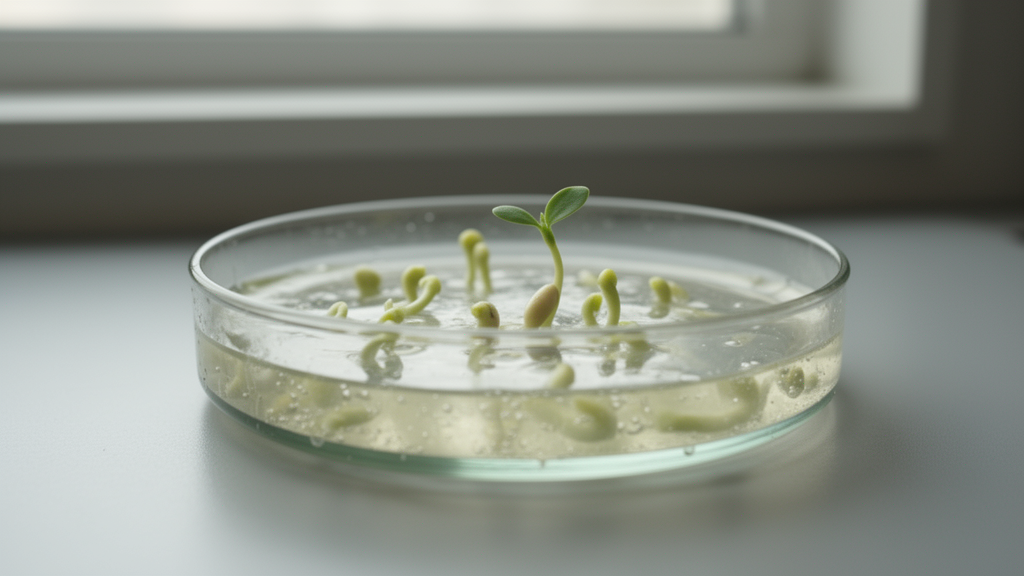
An herbicide best known for killing aquatic weeds has turned out to be an unlikely ally for one of North America’s rarest orchids. In a laboratory study published in Botanical Studies, researchers report that adding fluridone, a commercial compound that blocks the plant hormone abscisic acid, to a standard asymbiotic germination medium dramatically improved seed germination and seedling development of the eastern prairie fringed orchid, Platanthera leucophaea, a U.S. Federally threatened species. The finding opens a potentially powerful new tool for propagating temperate terrestrial orchids, a group whose seeds have long frustrated conservationists because of their stubborn dormancy.
The logic behind the experiment rests on a biochemical quirk. Fluridone interferes with phytoene desaturase, an enzyme in the carotenoid biosynthesis pathway, causing chlorophyll to break down and leaving exposed plants vulnerable to photobleaching and death. Because that same pathway feeds into the production of abscisic acid, or ABA, fluridone also blocks ABA biosynthesis. ABA is the hormone that keeps seeds from germinating prematurely, inducing dormancy until natural weathering gradually strips it away. Seeds of temperate terrestrial orchids are believed to carry unusually high ABA levels in their seed coats, which is precisely why they germinate so reluctantly compared with their tropical epiphytic relatives.
Platanthera leucophaea, the eastern prairie fringed orchid, is a specialist species with demanding ecological requirements. It depends exclusively on hawk moths for cross pollination and needs mycorrhizal fungi of the genus Ceratobasidium in the soil for its seeds to germinate in nature. Although the orchid has been propagated before using cold stratification and symbiotic germination with fungi, earlier work achieved leaf-bearing seedlings from fewer than four percent of seeds with embryos, a yield too low for efficient reintroduction programs. That shortfall motivated the new study, led by Rachel E. Helmich with Lawrence W. Zettler, Caleb J. Dvorak and Susanne DiSalvo, to test whether chemically undermining ABA could do better.
The team worked with seeds collected under permit in August 2021 from one to two capsules on nine plants in a population of roughly fifteen flowering individuals in Grundy County, Missouri, a mesic tallgrass prairie site on loamy soil. After drying over desiccant, the seeds were stored at 4 to 6 degrees Celsius in low humidity for about nineteen weeks. The researchers also excavated lateral roots from mature plants at the same population, taking care to replant the donors, and isolated a Ceratobasidium fungus, designated Pleuc1.1, whose identity was confirmed by sequencing the internal transcribed spacer region and depositing the sequence in GenBank.
The experimental design crossed two germination modes with two media. Symbiotic germination used oatmeal agar inoculated with the Ceratobasidium culture, while asymbiotic germination used P723 medium enriched with potato flour, sucrose and agar. Fluridone at 15 milligrams per liter was added to both, with fluridone-free versions serving as controls. Seeds were surface sterilized in a ten percent bleach solution for five different durations ranging from 10 to 120 minutes, then sown onto the four media types. All plates underwent ninety days of cold stratification in darkness at 4 to 6 degrees Celsius, followed by nearly ten months of incubation, with data recorded 385 days after sowing.
The results were striking. Germination occurred in every treatment, but the asymbiotic medium containing fluridone, labeled ASYM_F, produced germination percentages at least two to three times higher than all other treatments. The 60-minute bleach duration proved optimal, reaching 36.32 percent germination. By contrast, asymbiotic plates without fluridone stayed below 2 percent, and all symbiotic groups remained below 10 percent. A two-way analysis of variance found a highly significant effect of media type and bleaching time, and Tukey-Kramer post hoc comparisons confirmed that the fluridone-containing asymbiotic groups significantly outperformed every other group.
Seedling development told an even clearer story. Some replicate plates in every treatment progressed to Stage 3, the appearance of a shoot promeristem, on the five-stage scale the researchers used. But only the asymbiotic plates containing fluridone showed marked development, with advanced seedlings reaching Stage 5, characterized by elongation of the first leaf and root initiation, 385 days after sowing. In other words, leaf-bearing seedlings, the stage considered suitable for reintroduction efforts, were obtained exclusively on the fluridone-supplemented asymbiotic medium, in a little over one year from sowing.
The symbiotic treatments, surprisingly, underperformed. The Ceratobasidium strain appeared to overwhelm protocorms and ungerminated seeds, some protocorms reached Stage 3 but then collapsed in the fungus’s presence, and no seedlings produced leaves in the oatmeal agar treatments. Germination with and without fluridone was comparable on that medium, suggesting the additive itself was not harmful. The authors speculate that the fungus may have degraded or taken up the fluridone, reducing the dose available to seeds, or that the strain, isolated from a mature plant, simply lacked strong germination-facilitating ability, since fungi from adult orchid roots are often less effective than those from younger stages. They stress that other Ceratobasidium strains, which have performed well in earlier studies of this species, should still be explored.
The authors are careful about mechanism. Their study did not directly measure or localize ABA in the seeds, so definitive claims about how fluridone works in P. leucophaea remain unconfirmed, extrapolated instead from earlier Asian studies on Calanthe tricarinata and Cypripedium formosanum in which fluridone showed promise against ABA’s inhibitory effects. They call for experiments quantifying seed ABA content and testing whether fluridone genuinely inhibits it, possibly using immunofluorescent localization techniques or seed baiting in natural soils. They also flag the question of herbicide resistance: only two species worldwide are documented as fluridone-resistant, both under decades of field exposure, but the researchers recommend screening seedlings for resistance before any outplanting and note that fluridone is not currently labeled for use where these orchids would be reintroduced.
There are also practical caveats about persistence and survival. Fluridone’s reported half-life in soil is roughly three weeks, and it degrades quickly in sunlight, so the authors expect lingering residues to be minimal by the time seedlings initiate leaves and are moved off fluridone-containing media, though degradation under in vitro conditions still needs study. Whether herbicide-grown seedlings survive once deflasked remains undetermined, and prior work on another orchid species found mycorrhizal-grown seedlings had superior survival after acclimatization. The researchers therefore suggest reserving fluridone-grown seedlings for repopulating extinct sites or establishing new populations, avoiding the introduction of foreign fungi to native soils. Until better techniques emerge, they conclude, this counterintuitive use of a weed killer may earn a place in the conservation toolkit for hardy orchids facing a future of climatic extremes.
Subject of Research: Using the herbicide fluridone to overcome seed dormancy and stimulate in vitro germination of the threatened orchid Platanthera leucophaea
Article Title: Fluridone stimulates in vitro seed germination of a rare hardy terrestrial orchid (Platanthera leucophaea)
Article References: Helmich, R. E., Zettler, L. W., Dvorak, C. J., & DiSalvo, S. (2025). Fluridone stimulates in vitro seed germination of a rare hardy terrestrial orchid (Platanthera leucophaea). Botanical Studies, 66(1), Article 37. https://doi.org/10.1186/s40529-025-00484-w
Image Credits: AI Generated
DOI: 10.1186/s40529-025-00484-w
Keywords: Platanthera leucophaea, fluridone, seed germination, abscisic acid, orchid conservation, symbiotic germination, asymbiotic germination, Ceratobasidium, seed dormancy, in vitro propagation, mycorrhizal fungi, temperate terrestrial orchids
News Source: Drew Townsend. (October 30, 2026). Herbicide Added to Growth Medium Boosts Germination of Threatened Prairie Orchid. Scienmag.



