


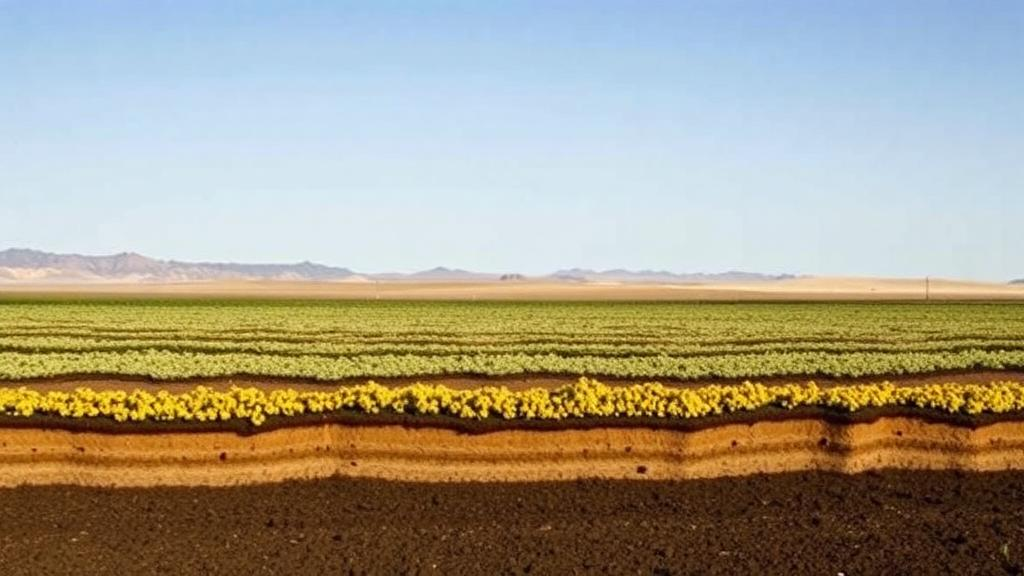
Heavy grazing in a temperate desert steppe of Inner Mongolia does not simply thin the grass above ground. Over three years of monitoring, it cut the biomass of a dominant perennial forb by between 68 and 86 percent, and a new study shows that the microbial communities below the surface respond in a strikingly uneven way: the deepest soil layer examined, 20 to 30 centimetres, lost the most prokaryotic diversity, while the rhizosphere, the narrow zone of soil hugging plant roots, lost its protective buffering capacity altogether under the heaviest stocking rates.
The work was carried out at the Siziwang Banner experimental station of the Inner Mongolia Academy of Agricultural and Animal Husbandry Sciences, on a long-term grazing platform established in 2004. That platform uses three replicate blocks, each containing four 4.4-hectare paddocks assigned to four stocking rates: no grazing, light grazing at 0.93 sheep per hectare, moderate grazing at 1.82, and heavy grazing at 2.71 sheep per hectare, with Mongolian wethers stocked each year from early June to early October.
The plant data alone tell a stark story. Heavy grazing reduced C. ammannii height by 57 to 60 percent relative to ungrazed controls across the three years, and cover fell from 1.25 percent under no grazing to 0.44 percent under heavy grazing in 2020, dropping as low as 0.25 percent by 2022. Density declined from roughly 35.5 plants per square metre under no grazing to 11.6 under heavy grazing in 2020. Two-way analysis of variance confirmed highly significant effects of both treatment and year on height and biomass, with a significant treatment-by-year interaction for biomass reflecting the widening deficit over time, from 68 percent in 2020 to 86 percent in 2022.
To capture the belowground response, the team excavated five to eight C. ammannii individuals at four locations in each paddock, shaking loose the bulk soil and collecting the tightly adhering rhizosphere soil from fine roots. Bulk soil was cored from unvegetated interspaces more than 50 centimetres from the nearest plant, at three depth increments of 0 to 10, 10 to 20, and 20 to 30 centimetres. The design yielded 48 rhizosphere samples and 144 bulk soil samples, which were sequenced on an Illumina NovaSeq 6000 platform, processed through QIIME2 and DADA2, and rarefied to 30,000 sequences per sample. Raw data are deposited in the NCBI Sequence Read Archive under BioProject accession PRJNA1471627.
The diversity results were compartment-specific. In the rhizosphere, both richness and evenness declined monotonically with stocking rate: Chao1 richness fell by 26 percent under heavy grazing, from 2,338 amplicon sequence variants under no grazing to 1,741, and Shannon diversity contracted from 9.40 to 8.98. Bulk soil, by contrast, was governed primarily by depth rather than grazing intensity, with richness peaking consistently in the 10 to 20 centimetre layer regardless of stocking rate. Yet the deepest layer told a different story: the 20 to 30 centimetre horizon showed the most pronounced grazing-associated Chao1 decline, at 18 percent, exceeding losses in surface soils and contradicting the common assumption that grazing disturbance hits the topsoil hardest.
Community composition shifted as well. Non-metric multidimensional scaling of Bray-Curtis dissimilarities showed significant treatment-related differentiation in the rhizosphere, with grazing explaining 15 percent of compositional variance in a PERMANOVA test. In bulk soil, depth explained the largest share of variance at 22 percent, followed by grazing at 16 percent, with a significant treatment-by-depth interaction of the same magnitude. Notably, depth-stratified pairwise comparisons revealed that compositional turnover among grazing treatments was concentrated in the surface horizon, where all six treatment pairs showed large effect sizes, while no detectable pairwise differences emerged at 10 to 20 or 20 to 30 centimetres. The authors caution that limited permutation space at four samples per depth stratum makes effect sizes more informative than p-values alone in those subsets.
Perhaps the most consequential finding concerns which soil chemical variable best tracks the microbial reorganisation. Redundancy analysis identified ammonium nitrogen as the strongest measured predictor of bulk soil community variance, at a marginal 14.9 percent, far ahead of total nitrogen at 4.0 percent, soil organic carbon at 1.9 percent, and nitrate nitrogen at 1.2 percent. The constrained model as a whole explained 37.8 percent of compositional variance. This challenges the traditional emphasis on carbon depletion as the dominant correlate of grazed grassland microbiomes, and is consistent with the idea that livestock excretion, which delivers concentrated pulses of ammonium from urine hydrolysis, plays an outsized role in shaping microbial assembly.
That interpretation comes with an important caveat. Ammonium nitrogen was strongly negatively correlated with soil depth, at r equal to minus 0.88, and its variance inflation factor of 6.74 exceeded the conventional threshold of 5, signalling substantial collinearity. Explicit variance partitioning assigned a unique fraction of 13.1 percent to ammonium and 15.7 percent to depth, but the shared fraction could not be robustly separated. The authors therefore conclude that ammonium nitrogen merits consideration as a sensitive indicator of microbial stability in arid grasslands, while acknowledging that its independence from the depth gradient remains only partially resolved. They also outline alternative explanations: reduced nitrification under heavy grazing could cause ammonium accumulation as a consequence rather than a cause of community change, and the ammonium-depth gradient likely integrates moisture redistribution, redox conditions, and labile carbon quality that observational data alone cannot disentangle.
The rhizosphere findings add another layer. Under no grazing and light grazing, rhizosphere Shannon diversity exceeded that of adjacent bulk soil by 8 to 12 percent, consistent with plant-mediated enrichment through root exudation. Under heavy grazing, that difference disappeared, and rhizosphere dispersion increased to levels comparable to bulk soil, suggesting erosion of the compositional distinctiveness sustained by plant-microbe interactions. Rhizosphere Shannon diversity was also positively associated with plant performance: aboveground biomass increased by 3.40 grams per square metre per unit of Shannon index, and height by 4.18 centimetres, each with a marginal R-squared of 0.20 and grazing treatment included as a random intercept. No individual phylum abundance correlated significantly with plant traits, pointing to aggregate community diversity rather than specific taxonomic groups.
The authors are careful to frame these diversity-performance relationships as correlative. Vigorous plants might drive rhizosphere diversity through greater exudation rather than the reverse, or shared environmental filters such as fertility and moisture might constrain both simultaneously. The single-season, single-species, observational design precludes causal inference, and the study focused on one dominant forb, leaving open whether rhizosphere buffering is a general pattern or species-specific. Still, the practical implications are concrete: monitoring protocols limited to the top 20 centimetres may miss early signals of grazing-induced change in subsurface communities, and the ammonium-to-nitrate balance may serve as a more sensitive indicator of microbial change than total nitrogen or carbon-to-nitrogen ratios alone. Establishing mechanism, the authors note, will require manipulative experiments independently varying nitrogen form, functional gene quantification, and long-term multi-site monitoring before subsurface microbial indicators become routine tools for rangeland management.
Subject of Research: Grazing effects on soil prokaryotic communities, nitrogen speciation, and rhizosphere dynamics in desert steppe
Article Title: Grazing impacts on desert steppe prokaryotic communities: nitrogen speciation, depth stratification, and rhizosphere dynamics
Article References: Yuxin, W., Aimin, Z., Rui, W., & Guodong, H. (2026). Grazing impacts on desert steppe prokaryotic communities: nitrogen speciation, depth stratification, and rhizosphere dynamics. Ecological Processes, 15(1), Article 88. https://doi.org/10.1186/s13717-026-00717-1
Image Credits: AI Generated
DOI: 10.1186/s13717-026-00717-1
Keywords: grazing, desert steppe, prokaryotic communities, rhizosphere, ammonium nitrogen, soil depth, 16S rRNA sequencing, Inner Mongolia, microbial diversity, soil organic carbon, rangeland monitoring, Convolvulus ammannii
News Source: Drew Townsend. (October 29, 2026). Heavy Grazing Reshapes Desert Steppe Soil Microbes, With Deepest Layers Hit Hardest. Scienmag.



