• HOME
  • NEWS
  • EXPLORE
    • CAREER
      • Companies
      • Jobs
    • EVENTS
    • iGEM
      • News
      • Team
    • PHOTOS
    • VIDEO
    • WIKI
  • BLOG
  • COMMUNITY
    • FACEBOOK
    • INSTAGRAM
    • TWITTER
Monday, May 11, 2026
BIOENGINEER.ORG
No Result
View All Result
  • Login
  • HOME
  • NEWS
  • EXPLORE
    • CAREER
      • Companies
      • Jobs
        • Lecturer
        • PhD Studentship
        • Postdoc
        • Research Assistant
    • EVENTS
    • iGEM
      • News
      • Team
    • PHOTOS
    • VIDEO
    • WIKI
  • BLOG
  • COMMUNITY
    • FACEBOOK
    • INSTAGRAM
    • TWITTER
  • HOME
  • NEWS
  • EXPLORE
    • CAREER
      • Companies
      • Jobs
        • Lecturer
        • PhD Studentship
        • Postdoc
        • Research Assistant
    • EVENTS
    • iGEM
      • News
      • Team
    • PHOTOS
    • VIDEO
    • WIKI
  • BLOG
  • COMMUNITY
    • FACEBOOK
    • INSTAGRAM
    • TWITTER
No Result
View All Result
Bioengineer.org
No Result
View All Result
Home NEWS Science News Chemistry

Heat flow through single molecules detected

Bioengineer by Bioengineer
July 19, 2019
in Chemistry
Reading Time: 3 mins read
0
IMAGE
Share on FacebookShare on TwitterShare on LinkedinShare on RedditShare on Telegram

IMAGE

Credit: OIST

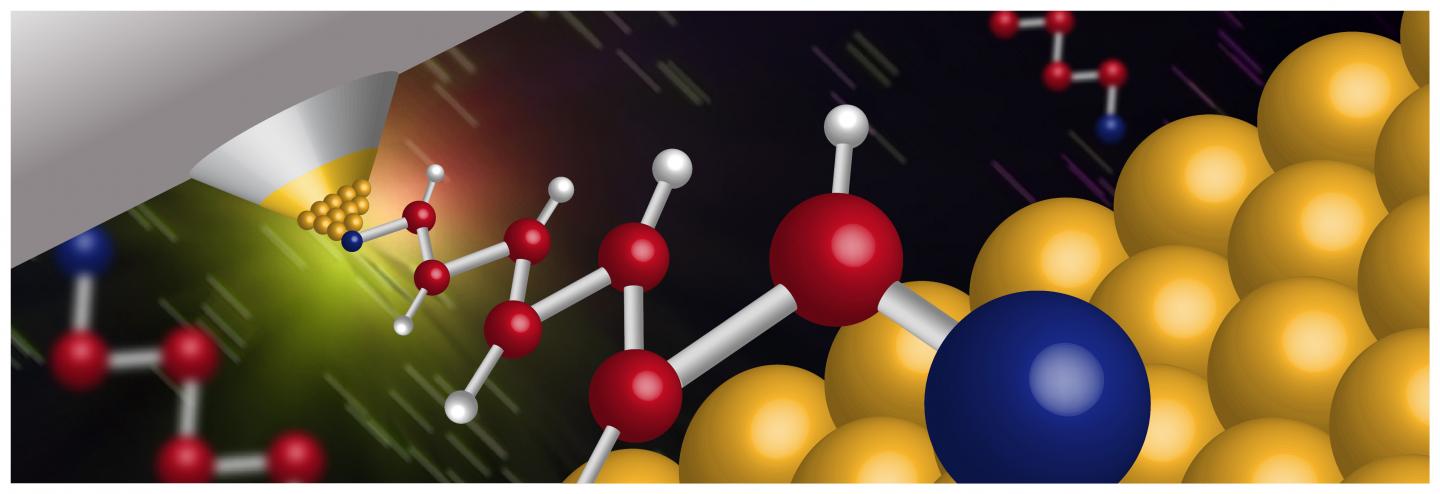
After several years of theorizing and experimenting, an international team of researchers including scientists at Okinawa Institute of Science and Technology Graduate University (OIST) has finally succeeded in measuring how heat passes between two gold electrodes through a single molecule. They report their findings in Nature on July 17, 2019.

Around 2000, scientists first measured how electrons flow through single molecules. Other properties, such as how molecules emit light, have also been studied. But quantifying the heat transfer, or thermal conductance, at the molecular scale remained a persistent challenge because of the high measurement resolution required.

To achieve this elusive goal, the international team of collaborators had to work on both an experimental and a theoretical level.

Scientists at University of Michigan developed a setup called a scanning thermal microscope, which positions a single alkane molecule between a gold-coated probe and a gold layer. The gold probe is heated and then held above a cold gold substrate in such a way that the alkane molecule forms a link between the probe tip and substrate layer. Due to the difference in temperature, heat passes from the hot gold to the cold gold through the molecule. The alkane molecules employed were synthesized by scientists at Kookmin University, South Korea.

Thermal conduction is a process most of us are familiar with, and heat can be transported in various ways. Here, the heat was carried by the vibrations of atoms in the alkane molecule, which the scanning thermal microscope could detect.

OIST’s Leader of the Quantum Transport and Electronic Structure Theory Unit, Prof. Fabian Pauly, and his PhD student Jan Klöckner, were the theorists on the paper.

While each measurement takes only seconds, the microscope gathers averages over many trials to determine the thermal conductance of a single molecule.

The scientist used alkane molecules of different lengths. Previously, Pauly’s group made predictions on the size of thermal conductance values for such single molecule-junctions. The predictions provided important information for the experimentalist in the study regarding the measurement resolution needed.

“Having shown that heat transport at the molecular scale is rather length-independent, we must now try to find out how we can enhance or reduce it,” Pauly said. “Ultimately, what we hope to do in the future is to identify ways of controlling the flow of heat by molecular design.”

The ability to regulate how much heat passes through a material requires a detailed understanding of heat flow at the molecular scale, Pauly explained. “For example, to characterize the efficiency of thermoelectric devices, which can be used to convert heat into electrical energy, the thermal conductance has to be known.”

The research spans several different fields of science. The lead authors on the paper, Prof. Pramod Reddy and Prof. Edgar Meyhofer of University of Michigan, are mechanical engineers. The other corresponding authors, Prof. Sung-Yeon Jang of Kookmin University and OIST’s Prof. Fabian Pauly, are a chemist and a theoretical physicist, respectively.

The experimental and theoretical tools that the international team has developed pave the way for scientists to study how heat moves at the molecular scale, and hopefully to find new ways of controlling this flow by the design of new molecular structures.

###

Media Contact
Tomomi Okubo
[email protected]

Related Journal Article

http://dx.doi.org/10.1038/s41586-019-1420-z

Tags: Atomic PhysicsAtomic/Molecular/Particle PhysicsChemistry/Physics/Materials SciencesIndustrial Engineering/ChemistryMolecular PhysicsNanotechnology/MicromachinesParticle Physics
Share12Tweet8Share2ShareShareShare2

Related Posts

Miniature Sensor Uses Light to Detect Touch — Chemistry

Miniature Sensor Uses Light to Detect Touch

May 8, 2026
Iron Minerals Determine Whether Dissolved Organic Matter Fuels Microbes or Becomes Long-Term Carbon Storage — Chemistry

Iron Minerals Determine Whether Dissolved Organic Matter Fuels Microbes or Becomes Long-Term Carbon Storage

May 8, 2026

Kate Evans Appointed Associate Lab Director for Biological and Environmental Systems Science at ORNL

May 8, 2026

Advancing Multiscale Modeling and Overcoming Operational Challenges in Autothermal CO₂-to-Methanol Reactors

May 8, 2026
Please login to join discussion

POPULAR NEWS

  • Research Indicates Potential Connection Between Prenatal Medication Exposure and Elevated Autism Risk

    840 shares
    Share 336 Tweet 210
  • New Study Reveals Plants Can Detect the Sound of Rain

    728 shares
    Share 290 Tweet 182
  • Salmonella Haem Blocks Macrophages, Boosts Infection

    61 shares
    Share 24 Tweet 15
  • Breastmilk Balances E. coli and Beneficial Bacteria in Infant Gut Microbiomes

    57 shares
    Share 23 Tweet 14

About

We bring you the latest biotechnology news from best research centers and universities around the world. Check our website.

Follow us

Recent News

Tinengotinib Alone or with Atezolizumab in Tumors

Fear of Falling and Activity Affect Elderly Life Quality

Transforming Jellyfish Bycatch into a Valuable Collagen Source for Cosmetics and Biotechnology

Subscribe to Blog via Email

Enter your email address to subscribe to this blog and receive notifications of new posts by email.

Join 82 other subscribers
  • Contact Us

Bioengineer.org © Copyright 2023 All Rights Reserved.

Welcome Back!

Login to your account below

Forgotten Password?

Retrieve your password

Please enter your username or email address to reset your password.

Log In
No Result
View All Result
  • Homepages
    • Home Page 1
    • Home Page 2
  • News
  • National
  • Business
  • Health
  • Lifestyle
  • Science

Bioengineer.org © Copyright 2023 All Rights Reserved.