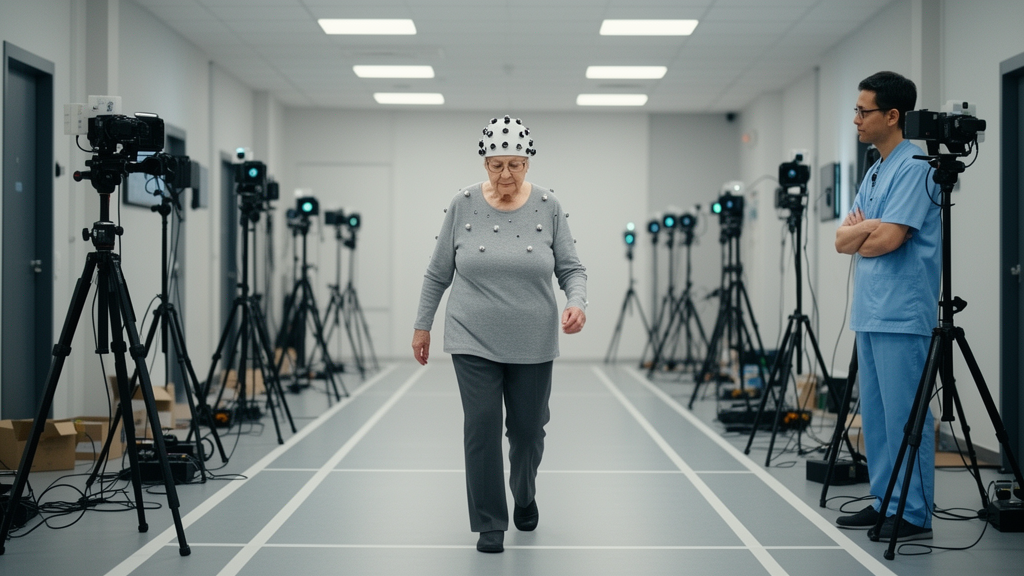
Every step we take is a negotiation between the body and its senses. The inner ear tracks head rotation, the neck muscles report where the head sits on the shoulders, and the eyes confirm what the world is doing. When those signals degrade with age, the negotiation breaks down, and the result is often a fall. A new study published in GeroScience by Eugénie Lambrecht of the University of Antwerp and colleagues offers one of the most direct demonstrations yet of how this sensory decline destabilizes walking in older adults, using an unusual but elegant tool: deliberately cued head movements delivered through an augmented-reality headset while participants walked over force-instrumented ground.
Falls are not a minor inconvenience of aging. The World Health Organization identifies them as the second leading cause of unintentional injury deaths worldwide, and in community-dwelling older adults they are the dominant cause of injury-related mortality. Beyond the deaths, falls generate fractures, hospitalizations, loss of independence, and a cascade of fear that itself restricts activity and accelerates physical decline. Decades of research have catalogued risk factors, from muscle weakness to vision loss to medication side effects, but the precise sensory mechanisms that convert quiet degradation into a stumble remain difficult to isolate in a clinical setting. Balance tests performed while standing still simply do not capture the dynamic demands of walking, where the body is perpetually on the edge of instability and every step is a controlled fall caught just in time.
The Belgian team reasoned that the best way to stress the sensory systems implicated in age-related instability is to do what life does naturally: move the head. Walking in the real world is full of head turns, glances down at curbs, upward checks at traffic signals, and rapid looks toward a sound. Each of these movements challenges the vestibular apparatus of the inner ear, the proprioceptive sensors embedded in the deep neck muscles and cervical facet joints, and the visual system simultaneously. In younger walkers, the nervous system integrates these inputs seamlessly, suppressing the vestibulo-ocular reflex during voluntary gaze shifts and reweighting sensory streams on the fly. In older walkers, that integration becomes slower and less reliable, a phenomenon the literature describes under the umbrella of presbyvestibulopathy, the consensus-defined age-related decline of vestibular function.
To quantify this, the researchers recruited sixty-one healthy, community-dwelling older adults with an average age of 76.2 years, forty of whom were women. Crucially, the cohort included both people with and without a history of falls, allowing the team to test whether sensory function matters more for those who have already experienced the consequences of instability. Participants walked while an augmented-reality application, built on marker-based motion capture and delivered through a headset, cued them to move their head up, down, left, or right at standardized moments during the gait cycle. The approach builds on the group’s earlier cross-sectional work, published in Gait and Posture in 2025, which established that head movements can be standardized in gait assessment through augmented reality rather than left to the vagaries of natural behavior.
The technical core of the study lies in how walking stability was measured. Rather than relying on subjective ratings, the team computed the margin of stability, a biomechanical quantity derived from the extrapolated center of mass concept formalized by Hof and colleagues. The extrapolated center of mass combines the body’s center of mass position with its velocity, effectively predicting where the body will be a fraction of a second later if nothing changes. The margin of stability is the distance between that predicted point and the boundary of the base of support, the area enclosed by the feet in contact with the ground. A small margin means the walker is close to the edge of recoverable instability; a large margin means the nervous system is playing it safe. The researchers computed this margin in both the mediolateral direction, side to side, and the anteroposterior direction, front to back, alongside classic spatiotemporal gait parameters: step length, step width, step time, and gait speed.
The sensory testing was equally rigorous. Cervical sensorimotor control was assessed with a three-dimensional cervical trainer device that measures how accurately people can reproduce joint positions and movements of the neck, a proxy for the proprioceptive acuity of the muscle spindles and mechanoreceptors that populate the deep cervical muscles and facet joints. Vestibular function was evaluated through the vestibulo-ocular reflex generated by the semicircular canals, tested with video head impulse technology that measures how well the eyes stay locked on a target during rapid head rotations. Static visual acuity was measured with standard clinical charts. Each participant thus received a sensory profile spanning the three systems most directly challenged by head movement during locomotion.
The results, analyzed with linear mixed models that included fall history as a moderator, tell a coherent story. Older adults with poorer cervical sensorimotor control and poorer semicircular canal function responded to the head-movement perturbations by increasing their cautiousness: they widened their steps, lengthened their step time, and enlarged their margins of stability. In other words, the nervous system, sensing that its sensory inputs are less trustworthy, buys safety with a more conservative gait pattern. This is an adaptive response, but it comes at a cost, because slower, wider walking is associated with reduced mobility and, over time, with frailty. Worse visual acuity, by contrast, was associated with genuinely decreased walking stability rather than compensatory caution, suggesting that vision loss undermines the visual guidance of foot placement that Reynolds and Day showed is critical for accurate stepping.
Perhaps the most clinically significant finding is the moderation by fall history. Sensory function was more strongly associated with walking stability in individuals who had previously fallen than in those who had not. This asymmetry suggests that a fall history marks a subgroup whose gait control is disproportionately dependent on sensory inputs, and whose stability collapses more readily when those inputs are challenged. It also implies that the head-movement perturbation model could serve as a functional stress test, revealing which older adults are walking on the edge of sensory decompensation even when their ordinary gait looks unremarkable. Current world guidelines for falls prevention, published in Age and Ageing in 2022 by Montero-Odasso and colleagues, emphasize multifactorial assessment, and a test that links specific sensory deficits to measurable gait instability could sharpen that assessment considerably.
The study is not without limits that the authors acknowledge in the broader context of the field. Sixty-one participants is a respectable sample for a biomechanics study but modest for detecting subtle interactions, and the cross-sectional design cannot establish whether poor sensory function causes falls or merely co-occurs with them. The participants were healthy and community-dwelling, so the findings may not generalize to frail older adults or those in institutional care. The datasets have been deposited in a public repository under restriction and will be made freely available upon publication, which should enable independent replication. The work was supported by the University of Antwerp and the Research Foundation Flanders, and the authors declare no competing interests.
What makes this research resonate beyond the laboratory is its conceptual reframing of the head as a sensory organ for balance. We tend to think of the head as the seat of perception, but during walking it is also the platform on which the vestibular and cervical sensors ride, and every head movement is a self-generated perturbation that the nervous system must predict and absorb. As we age, the machinery for absorbing those perturbations wears down, and the margin between a confident stride and a catastrophic fall narrows. By cueing head movements through augmented reality and measuring the biomechanical consequences in real time, the Belgian team has turned that abstract narrowing into something visible, quantifiable, and potentially testable in a clinic. The hope, implicit in the design, is that identifying which sensory system is failing in a given older adult will allow targeted interventions, whether vestibular rehabilitation, cervical proprioceptive training, or vision correction, before the next fall happens rather than after.
Subject of Research: The influence of sensory function on walking stability in aging and falls through a head-movement perturbation model
Article Title: The influence of sensory function on walking stability in aging and falls through a head-movement perturbation model
Article References: Lambrecht, E., Embrechts, E., Beckwée, D., Vereeck, L., Hallemans, A., & De Hertogh, W. (2026). The influence of sensory function on walking stability in aging and falls through a head-movement perturbation model. GeroScience. https://doi.org/10.1007/s11357-026-02602-3
Image Credits: AI Generated
DOI: 10.1007/s11357-026-02602-3
Keywords: influence, sensory, function, walking, stability, aging, falls, head-movement, perturbation, model, scientific research
News Source: Beatrice Stafford. (October 19, 2026). Head movements reveal how aging senses undermine walking stability and drive falls. Scienmag.