• HOME
  • NEWS
  • EXPLORE
    • CAREER
      • Companies
      • Jobs
    • EVENTS
    • iGEM
      • News
      • Team
    • PHOTOS
    • VIDEO
    • WIKI
  • BLOG
  • COMMUNITY
    • FACEBOOK
    • INSTAGRAM
    • TWITTER
Tuesday, August 18, 2026
BIOENGINEER.ORG
No Result
View All Result
  • Login
  • HOME
  • NEWS
  • EXPLORE
    • CAREER
      • Companies
      • Jobs
        • Lecturer
        • PhD Studentship
        • Postdoc
        • Research Assistant
    • EVENTS
    • iGEM
      • News
      • Team
    • PHOTOS
    • VIDEO
    • WIKI
  • BLOG
  • COMMUNITY
    • FACEBOOK
    • INSTAGRAM
    • TWITTER
  • HOME
  • NEWS
  • EXPLORE
    • CAREER
      • Companies
      • Jobs
        • Lecturer
        • PhD Studentship
        • Postdoc
        • Research Assistant
    • EVENTS
    • iGEM
      • News
      • Team
    • PHOTOS
    • VIDEO
    • WIKI
  • BLOG
  • COMMUNITY
    • FACEBOOK
    • INSTAGRAM
    • TWITTER
No Result
View All Result
Bioengineer.org
No Result
View All Result
Home NEWS Science News Biology

Has global warming stopped? The tap of incoming energy cannot be turned off

Bioengineer by Bioengineer
October 10, 2019
in Biology
Reading Time: 2 mins read
0
IMAGE
Share on FacebookShare on TwitterShare on LinkedinShare on RedditShare on Telegram

IMAGE

Credit: Jing Xu


As a result of industrialization, the carbon dioxide in the Earth’s atmosphere has increased continuously over the past 100 years, which is considered as the main reason behind global warming. However, the observational global mean atmospheric temperature leveled off over the first decade of the 21st century, in contrast to the rapid warming during the late 20th century. This phenomenon, known as the “atmospheric warming slowdown” or “global warming hiatus”, has attracted great attention worldwide owing to its ostensible contradiction of the human-induced global warming theory.

The changes in ocean heat content might have a tight relationship with the atmospheric warming slowdown. Dr Changyu Li, Prof. Jianping Huang and their colleagues, a group of researchers from the Key Laboratory for Semi-Arid Climate Change of the Ministry of Education, College of Atmospheric Sciences, Lanzhou University, have had their findings published in Advances of Atmospheric Sciences.

In their paper, they explore the energy redistribution between the atmosphere and ocean at different latitudes and depths by using observational data as well as simulations of a coupled atmosphere-ocean box model.

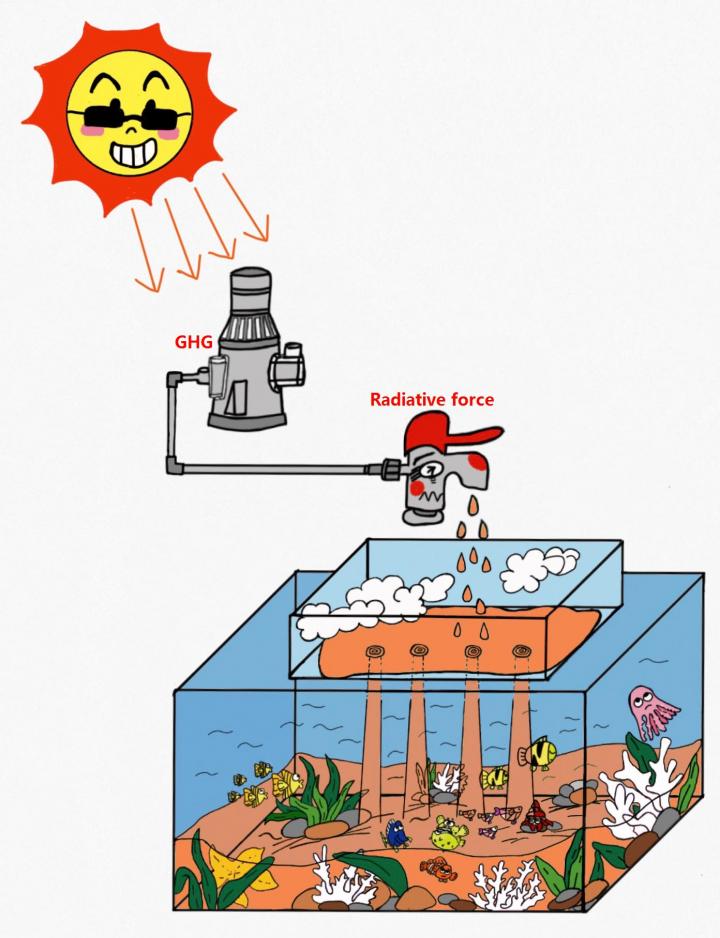
“Imagine the energy transport in our climate system as a water flow”, Dr. Li says. “Let’s turn on a tap at the top of the system, the feed rate of which represents the top-of-the-atmosphere radiative imbalance caused by the greenhouse effect. A bucket below the tap can be an analogue of our atmosphere, and its water level is analogous to atmospheric warming. There is also a sinking flow at its bottom, draining into a larger bucket (i.e. the ocean). Now, here comes the key point. Generally, the water level of the atmospheric bucket rises as a result of global warming. However, if the drain rate approximately equals the feed rate of the tap, the water level of the bucket will not increase (the occurrence of the warming slowdown). That’s the basic idea of our coupled box model.”

“A rapid increase in the global ocean heat content has been detected in observations during the warming slowdown period, at a rate of about 9.8 × 10²¹ J yr-1. That is, from the energy point of view, there is no slowdown in global warming if we take the ocean into consideration”, he adds. “Furthermore, the increase of heat content provides a worrisome picture of the ocean. This rapid oceanic warming could lead to serious degradation of marine ecosystems, eventually becomes a great threat to the ocean biodiversity.”

###

Media Contact
Ms. Zheng Lin
[email protected]
86-108-299-5053

Original Source

http://www.iapjournals.ac.cn/aas/news/xinwen-lunbotu/15aa189c-66d3-48c0-86c4-d1f140397b91_en.htm

Related Journal Article

http://dx.doi.org/10.1007/s00376-019-8281-0

Tags: Atmospheric ScienceClimate Change
Share12Tweet8Share2ShareShareShare2

Related Posts

Scientists map plant-fungus symbiosis at single-cell resolution

Scientists map plant-fungus symbiosis at single-cell resolution

August 18, 2026
One in 20 Australian women now receive intravenous iron infusions

One in 20 Australian women now receive intravenous iron infusions

August 18, 2026

Scientists identify crucial steps that initiate DNA replication

August 18, 2026

Diverse Legume Defence Signals and Clustered Receptors Co-Evolved from Conserved Subtilase Scaffolds

August 18, 2026
Please login to join discussion

POPULAR NEWS

  • Scientists map plant-fungus symbiosis at single-cell resolution

    29 shares
    Share 12 Tweet 7
  • Machine Learning Predicts Microslit Panel Surface Impedance in Grazing Flow

    29 shares
    Share 12 Tweet 7
  • UC San Diego Wins $12.3 Million Grant to Study HIV-Methamphetamine Connection

    29 shares
    Share 12 Tweet 7
  • Engineered Gel Cells Carry Artificial DNA Receptors to Detect and Treat Aflatoxin

    29 shares
    Share 12 Tweet 7

About

We bring you the latest biotechnology news from best research centers and universities around the world. Check our website.

Follow us

Recent News

Scientists map plant-fungus symbiosis at single-cell resolution

Machine Learning Predicts Microslit Panel Surface Impedance in Grazing Flow

UC San Diego Wins $12.3 Million Grant to Study HIV-Methamphetamine Connection

Subscribe to Blog via Email

Enter your email address to subscribe to this blog and receive notifications of new posts by email.

Join 85 other subscribers
  • Contact Us

Bioengineer.org © Copyright 2023 All Rights Reserved.

Welcome Back!

Login to your account below

Forgotten Password?

Retrieve your password

Please enter your username or email address to reset your password.

Log In
No Result
View All Result
  • Homepages
    • Home Page 1
    • Home Page 2
  • News
  • National
  • Business
  • Health
  • Lifestyle
  • Science

Bioengineer.org © Copyright 2023 All Rights Reserved.