WASHINGTON, Dec. 5, 2023 – More than 2.2 billion people currently live in water-stressed countries, and the United Nations estimates that 3.5 million die every year from water-related diseases. Because the areas most in need of improved drinking water are also located in some of the sunniest places in the world, there is strong interest in harnessing sunlight to help obtain clean water.
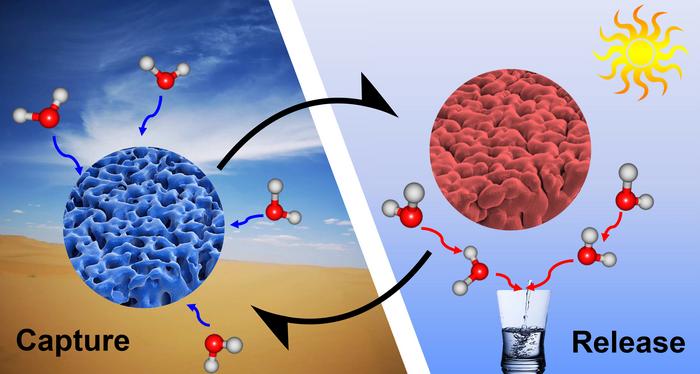
Credit: Wang Ruzhu
WASHINGTON, Dec. 5, 2023 – More than 2.2 billion people currently live in water-stressed countries, and the United Nations estimates that 3.5 million die every year from water-related diseases. Because the areas most in need of improved drinking water are also located in some of the sunniest places in the world, there is strong interest in harnessing sunlight to help obtain clean water.
Researchers from Shanghai Jiao Tong University in China developed a promising new solar-powered atmospheric water harvesting technology that could help provide enough drinking water for people to survive in those difficult, dryland areas. They published their work in Applied Physics Reviews, an AIP Publishing journal.
“This atmospheric water harvesting technology can be used to increase the daily water supply needs, such as household drinking water, industrial water, and water for personal hygiene,” said author Ruzhu Wang.
Historically, researchers have faced challenges when injecting salt into hydrogels as the higher salt content reduced the swelling capacity of the hydrogel due to the salting-out effect. This led to salt leakage and the water absorption capacity decreased.
“We were impressed that even when up to 5 grams of salt was injected into 1 gram of polymer, the resulting gel maintained good swelling and salt-trapping properties,” said Wang.
The researchers synthesized a super hygroscopic gel using plant derivatives and hygroscopic salts that was capable of absorbing and retaining an unparalleled amount of water. One kilogram of dry gel could adsorb 1.18 kilograms of water in arid atmospheric environments and up to 6.4 kilograms in humid atmospheric environments. This hygroscopic gel was simple and inexpensive to prepare and would consequently be suitable for large-scale preparation.
In addition, the team adopted a prototype with desorption and condensation chambers, configured in parallel. They employed a turbofan in the condensation chamber to increase the recovery of desorbed water to more than 90%.
In an outdoor prototype demonstration, the team found it released adsorbed water even in the morning or afternoon when the sun is weak. The system could also achieve simultaneous adsorption and desorption during the daytime.
The team will work to achieve simultaneous adsorption and desorption using renewable energy to maximize daily water yield per unit mass of adsorbent to further optimize the system’s performance for practical applications in water generation.
In addition to daily water production, sorbent materials that harvest atmosphere water could also play an important role in future applications such as dehumidification, agriculture irrigation, and thermal management for electronic devices.
###
The article “Daytime air-water harvesting based on super hygroscopic porous gels with simultaneous adsorption-desorption” is authored by Chengjie Xiang, Xinge Yang, Fangfang Deng, Zhihui Chen, and Ruzhu Wang. It will appear in Applied Physics Reviews on Dec. 5, 2023 (DOI: 10.1063/5.0160682). After that date, it can be accessed at https://doi.org/10.1063/5.0160682.
ABOUT THE JOURNAL
Applied Physics Reviews features articles on significant and current topics in experimental or theoretical research in applied physics, or in applications of physics to other branches of science and engineering. The journal publishes both original research on pioneering studies of broad interest to the applied physics community, and reviews on established or emerging areas of applied physics. See https://aip.scitation.org/journal/are.
###
Journal
Applied Physics Reviews
DOI
10.1063/5.0160682
Article Title
Daytime air-water harvesting based on super hygroscopic porous gels with simultaneous adsorption-desorption
Article Publication Date
5-Dec-2023