BTI, USDA and UW researchers identified 122 peptides that could be used to as insecticides to halt a disease that is destroying the U.S.’s multi-billion dollar citrus industry.
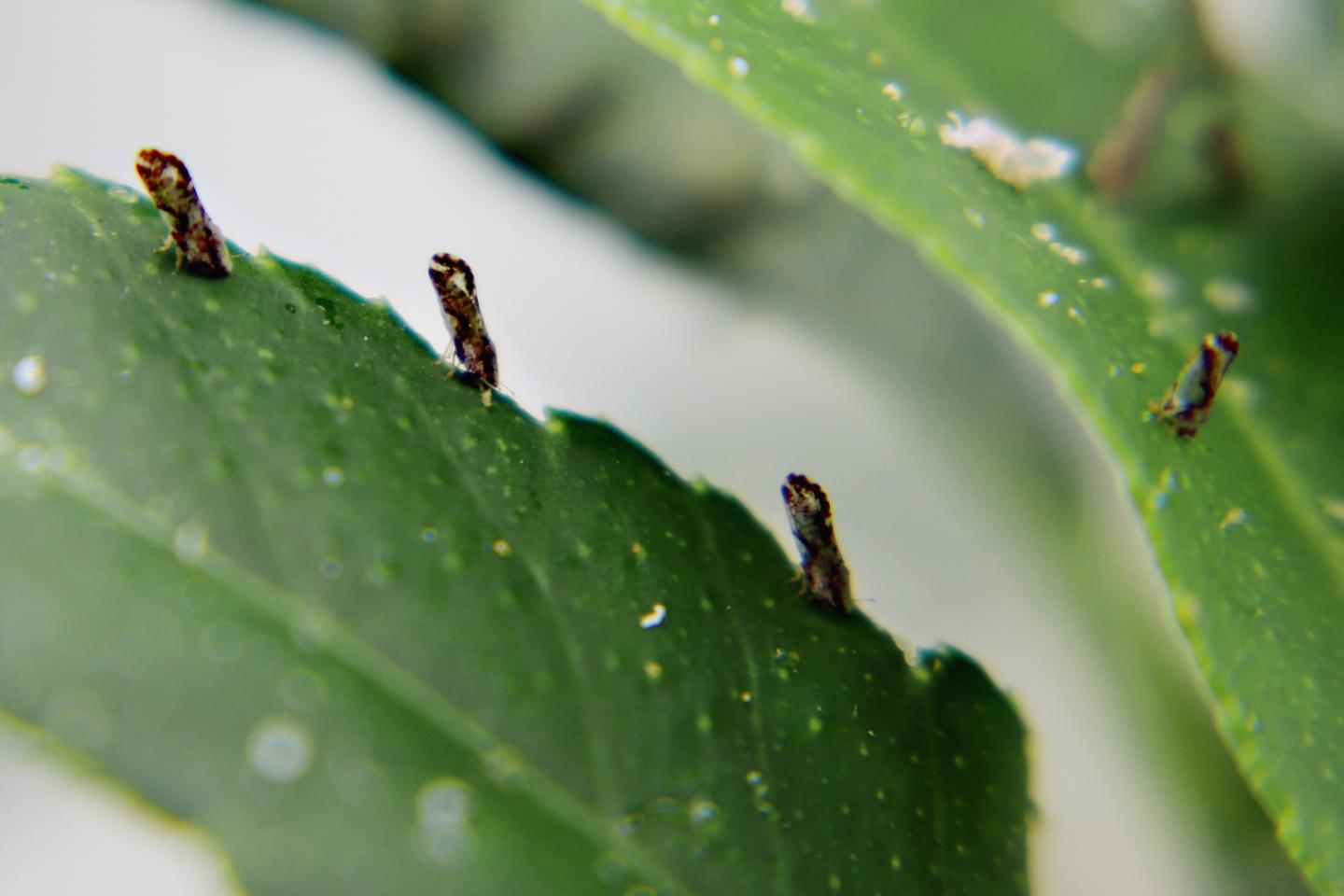
Credit: Image credit: BTI
ITHACA, NY, April 17, 2020 — Citrus greening disease, also called huanglongbing (HLB), is a bacterial infection of citrus trees that results in small, misshapen and sour fruits that are unsuitable for consumption, ultimately killing the tree. Because there is no cure, HLB is a major threat to the $10 billion citrus industry in Florida, where it was first detected in 2005, and to the $7 billion industry in California, where it appeared last year.
Researchers from the Boyce Thompson Institute, the U.S. Department of Agriculture Agricultural Research Service (USDA-ARS) and the University of Washington (UW), led by Michelle Heck, investigated a seemingly unlikely source of biocontrols for HLB: neuropeptides found in the insect that carries the disease-causing bacterium. Asian citrus psyllids (Diaphorina citri) infect citrus trees with Candidatus Liberibacter asiaticus (CLas) bacterium by feeding on their leaves and stems.
Laura Fleites, a USDA T.W. Edminster Research Associate in Heck’s group at BTI, focused on neuropeptides because they function as hormones in hemipteran insects – a class that includes psyllids, aphids, whiteflies, shield bugs and other crop-plaguing species – to regulate growth, development and other biological functions. Moreover, other studies have shown that analogs of insect-derived neuropeptides kill pea aphids, and insecticides based on the kinin family of neuropeptides have been developed.
“If we could develop an insecticide that is specific for Asian citrus psyllids based on one of the insect’s own neuropeptides, then we could protect citrus trees from the insect that spreads CLas,” Heck said. “Citrus greening disease is devastating our citrus industry, and we need to develop new ways for our citrus growers to control it.”
As reported in the April 3 issue of Journal of Proteome Research, Fleites and the team characterized the full array of peptides found in the psyllids and identified 122 candidate neuropeptides. While promising, the findings offer only potential starting points for combatting HLB, because unmodified insect-derived neuropeptides lack the stability, bioavailability and half-lives needed for use as insecticides in the citrus grove.
To turn the findings into a usable product, the team is now collaborating with Ronald Nachman, a USDA researcher at College Station, Texas, Robert Shatters, a USDA researcher in Fort Pierce Florida, and Mark Trimmer from AgroSource, Inc, a small agritech company, to identify the best psyllid-derived neuropeptide for development. Then, the team will stabilize the peptide and decide the optimum method for delivering the insecticidal molecule to citrus trees – whether as a spray, by engineering trees to make the peptides themselves, or some other method.
For the study, Fleites, developed new extraction and analysis methods that other researchers could use in their investigations of insect peptides.
“Thanks to USDA support, I was able to develop techniques that enable the identification of small, functional insect peptides separately from their larger, inactive precursors,” said Fleites. “Because these techniques aren’t specific to psyllids, they may be useful for identifying neuropeptides in other hemipteran insects to protect crop plants.”
Heck noted that this work shows how USDA grant programs can be used to fund everything from discovery to product development. “We performed the neuropeptide discovery in a study funded by NIFA, and are now doing the translational work under a different USDA grant program from APHIS,” she said.
###
Heck is a faculty member of BTI; a research molecular biologist at the USDA-ARS Robert W. Holley Center; and an adjunct associate professor at Cornell University’s School of Integrative Plant Science.
The published study was supported by funding from the USDA Specialty Crops Grant No. 607 2016-70016-24779, the USDA ARS Headquarters Research Associate Program, and USDA ARS 608 CRIS project 510-21. The ongoing collaboration is funded by a grant from USDA’s HLB-MAC program, which was launched to develop products to fight HLB.
CITATION: Fleites, L.A., Johnson, R., Kruse, A.R., Nachman, R.J., Hall, D.G., MacCoss, M.J., Heck, Michelle L. (2020) Peptidomics approaches for the identification of bioactive molecules from Diaphorina citri, J Proteome Res. 19, 4, 1392-1408, DOI: 10.1021/acs.jproteome.9b00509
About Boyce Thompson Institute:
Boyce Thompson Institute is a premier life sciences research institution located in Ithaca, New York. BTI scientists conduct investigations into fundamental plant and life sciences research with the goals of increasing food security, improving environmental sustainability in agriculture, and making basic discoveries that will enhance human health. Throughout this work, BTI is committed to inspiring and educating students and to providing advanced training for the next generation of scientists. BTI is an independent nonprofit research institute that is also affiliated with Cornell University. For more information, please visit BTIscience.org.
Media Contact
AJ Bouchie
[email protected]
Original Source
https:/
Related Journal Article
http://dx.