Europe’s Most Dangerous Tapeworm Is Redrawing Its Map—and the News Is Not All Bad
A massive systematic review and meta-analysis has delivered the most complete picture to date of where Echinococcus multilocularis—the tiny tapeworm behind one of the world’s deadliest parasitic diseases—lurks across European wildlife and domestic animals. The study, published in Parasites & Vectors, synthesizes a decade of surveillance data from 2015 to 2025 and reveals a continent-wide pattern that is strikingly heterogeneous: rising infection pressure in many long-established hotspots, clear declines in several others, and the parasite appearing for the first time in countries and species where it had never been documented before.
Echinococcus multilocularis is no ordinary parasite. Its larval stage causes human alveolar echinococcosis (AE), a disease in which parasite vesicles infiltrate the liver and behave, in many respects, like a slow-growing malignancy, invading surrounding tissue and, if untreated, spreading further. The World Health Organization ranks AE as the third most impactful food-borne zoonotic parasitic disease globally, and its case fatality and treatment burden place it among the most serious helminthic threats to public health in the Northern Hemisphere. The tapeworm’s life cycle depends on two players: definitive hosts—carnivores, chiefly the red fox, in whose intestines the adult worms live and shed eggs—and intermediate hosts, typically small rodents such as voles and mice, which ingest the eggs from contaminated soil and develop the larval stage. Humans are accidental hosts, infected through the unintentional ingestion of microscopic eggs shed by infected foxes, raccoon dogs, dogs, and other carnivores.
Since the 1980s, the parasite’s range has demonstrably expanded outward from its central European strongholds, and human AE cases have increased, prompting growing concern among epidemiologists and public health authorities. But the actual prevalence of the parasite in many marginal regions—its edges of distribution—has remained uncertain, and even the identity of the intermediate host species that maintain the life cycle across different parts of Europe has been only partly understood. The new study, led by Salvatore Andrea Cafiero and Luca Colla of the University of Pisa together with Adriano Casulli of the Istituto Superiore di Sanità in Rome and Alessandro Massolo of the University of Pisa, University of Calgary, and Université Marie et Louis Pasteur, set out to close those gaps. Crucially, the team followed the exact methodological approach of the previous Europe-wide systematic review, which covered 1968–2014, making the new results directly comparable with the earlier picture.
The methodological machinery behind the analysis is considerable. Rather than simply tallying the proportion of animals that test positive—the “apparent prevalence,” which is distorted by the imperfect sensitivity and specificity of the diagnostic tests used in each study—the researchers estimated “true prevalence,” corrected for diagnostic error. Data were pooled across studies and aggregated at the level of NUTS regions, the European Union’s standard statistical territorial units, allowing regional trends to be quantified with statistical rigor. The team employed generalized linear mixed models and Bayesian Monte Carlo Markov chain (MCMC) estimation to derive pooled true prevalence figures with credible intervals, using adjusted odds ratios to determine which regions had experienced statistically significant increases or decreases relative to the previous review period. This design matters because raw positivity rates from different laboratories, different diagnostic assays—necropsy, intestinal scraping, PCR—and different sampling schemes cannot be honestly compared without such adjustments.
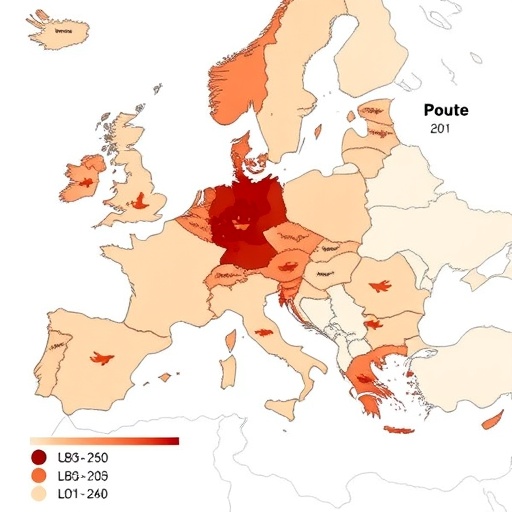
The headline finding is a patchwork rather than a single continental trend. Pooled true prevalence in red foxes—the parasite’s principal reservoir—rose significantly in eastern Austria, Denmark, southeast-central and southeast France, southwestern Germany, southwestern Hungary, northeastern Italy, northwestern and southeastern Poland, Slovenia, East Middle Sweden, and Switzerland. In several of these regions, fox infection levels were already high; their further increase suggests intensifying transmission in the very cores where the parasite has been entrenched for decades, with correspondingly greater environmental contamination by eggs and higher potential exposure risk for people living in rural areas where foxes, rodents, and humans overlap.
Yet the same dataset shows the opposite signal in other territories. Prevalence significantly decreased in red foxes and raccoon dogs in Latvia, in Arctic foxes on the Svalbard Islands in Norway—a well-known natural experiment following successful rat eradication and changes in the fox population’s feeding ecology—in raccoon dogs in northeastern Germany, in red foxes in east-central and northeastern France and northeastern Poland, and in water voles in northern Switzerland. These declines demonstrate that E. multilocularis dynamics are not inevitably ratcheting upward; local ecosystem conditions, host community composition, and control measures can and do bend the curve downward. The result challenges any simplistic narrative of a uniformly spreading epidemic across Europe.
Equally significant are the first-time detections. The parasite emerged for the first time in red foxes from Bosnia and Herzegovina, central Italy, and Serbia, extending its known range along the Balkan Peninsula and into the Italian Peninsula’s interior. First-ever true prevalence estimates were also established for a remarkable list of host-parasite combinations: raccoon dogs in Denmark and Estonia; golden jackals in Bosnia and Herzegovina, Croatia, southern Hungary, Serbia, and Slovenia; grey wolves in southeast-central and southeastern France, central Italy, and Slovakia; domestic dogs in northeastern France, northwestern Italy, southeastern Poland, and eastern Turkey; and domestic cats in southeastern Poland, central-east and northeastern France. The spread of golden jackals across Europe in recent decades, and their role as competent definitive hosts, is one of the more underappreciated aspects of the shifting epidemiology, and the documentation of the parasite in wolves and jackals underscores that large carnivore recovery in Europe has implications for parasite ecology, not just for conservation.
Perhaps the most biologically novel contribution is the identification of entirely new host species for the parasite. The study reports E. multilocularis in three definitive hosts in which it had never previously been confirmed: the European wildcat, the Eurasian lynx, and the Eurasian badger. It also records the parasite in novel intermediate hosts: Harting’s vole and the Persian vole, the Macedonian mouse, and the European brown hare. Finding the parasite in such a phylogenetically diverse set of carnivores suggests the definitive host spectrum may be broader than the fox-centric model assumed, while the new intermediate hosts indicate that local life cycles can be maintained by rodent and lagomorph species specific to particular regions—explaining how the parasite can persist and amplify in habitats ranging from Alpine meadows to Mediterranean hillsides.
For public health, the practical message is one of vigilance in specific places rather than blanket alarm. Alveolar echinococcosis in humans is notoriously difficult and costly to treat, often requiring surgical resection combined with years or lifetime therapy with benzimidazole anthelmintics, so prevention is overwhelmingly the preferred strategy. The parasite’s long, silent incubation period—human cases can appear a decade or more after exposure—means that today’s fox prevalence figures are a leading indicator of future human disease burden. The authors’ conclusion points directly to the policy implication: the scale-dependent, regionally variable results underscore the need to prioritize spatially standardized surveillance of competent hosts, so that border regions and newly invaded areas are monitored with comparable methods rather than the patchwork of ad hoc surveys that has historically left marginal areas in uncertainty. The study was supported by the Italian Ministry of University and Research, the European Commission’s Directorate-General for Health and Food Safety through the EU Reference Laboratory for Parasites, EU Next Generation EU funding, and the Horizon Europe EUPAHW partnership, reflecting the European-level coordination that such a continental surveillance challenge demands.
As Europe’s carnivore populations recover and expand, and as climate and land-use change reshape rodent communities, the landscape of E. multilocularis transmission will keep moving. This study provides the updated baseline—and a clear warning that the map of one of the world’s most serious zoonoses is anything but static.
Subject of Research: The European distribution, prevalence trends, and host range of the zoonotic tapeworm Echinococcus multilocularis in wild and domestic animals (2015–2025)
Subject of Research: Biology
Article Title: The European distribution of Echinococcus multilocularis in animals: a systematic review and meta-analysis updating the state of the art
Article References: Cafiero, S. A., Colla, L., Casulli, A., & Massolo, A. (2026). The European distribution of Echinococcus multilocularis in animals: a systematic review and meta-analysis updating the state of the art. Parasites & Vectors. https://doi.org/10.1186/s13071-026-07635-3
Image Credits: AI Generated
DOI: 10.1186/s13071-026-07635-3
Keywords: Echinococcus multilocularis, alveolar echinococcosis, definitive host, intermediate host, Europe, pooled prevalence, red fox, systematic review, meta-analysis, zoonotic parasite, raccoon dog, wildlife surveillance
Cite Scienmag News
APA
MLA
Chicago
Kristina Jarvis. (August 30, 2026). New meta-analysis maps Europe-wide spread of Echinococcus multilocularis in animals. Scienmag. https://scienmag.com/new-meta-analysis-maps-europe-wide-spread-of-echinococcus-multilocularis-in-animals/
Kristina Jarvis. “New meta-analysis maps Europe-wide spread of Echinococcus multilocularis in animals.” Scienmag, 30 August 2026, https://scienmag.com/new-meta-analysis-maps-europe-wide-spread-of-echinococcus-multilocularis-in-animals/. Accessed 30 August 2026.
Kristina Jarvis. “New meta-analysis maps Europe-wide spread of Echinococcus multilocularis in animals.” Scienmag. August 30, 2026. https://scienmag.com/new-meta-analysis-maps-europe-wide-spread-of-echinococcus-multilocularis-in-animals/
Copy citation
Download RIS
Tags: alveolar echinococcosis riskalveolar echinococcosis risk mappingdisease mapping and hotspot identificationEchinococcus multilocularisEchinococcus multilocularis spread in Europeemerging hotspots of Echinococcus multilocularisemerging parasitic disease in new regionsEurope-wide disease prevalence trendsEuropean parasite distributionglobal health and parasitic disease controlimpact on human health and disease managementlongitudinal meta-analysis of parasitic infectionsparasite control and mitigation strategiesparasite distribution in Europeparasite life cycle and hostsparasite life cycle and transmissionparasitic disease surveillancepublic health impact of Echinococcus multilocularispublic health implications of parasitic infectionssystematic review of parasitic diseaseswildlife and domestic animal infection patternswildlife and domestic animal surveillancezoonotic tapeworm diseasezoonotic tapeworm infections