Soil contamination is an escalating environmental crisis with profound implications for ecosystems, agriculture, and human health worldwide. As industrial activities, improper waste disposal, and chemical usage continue to accelerate, the infiltration of persistent organic pollutants into the soil poses a threat to biodiversity, groundwater safety, and food security. Traditional soil remediation methods such as thermal desorption and in-situ chemical oxidation have demonstrated effectiveness but are plagued by excessive energy consumption and a considerable carbon footprint, hindering their sustainability for widespread application.
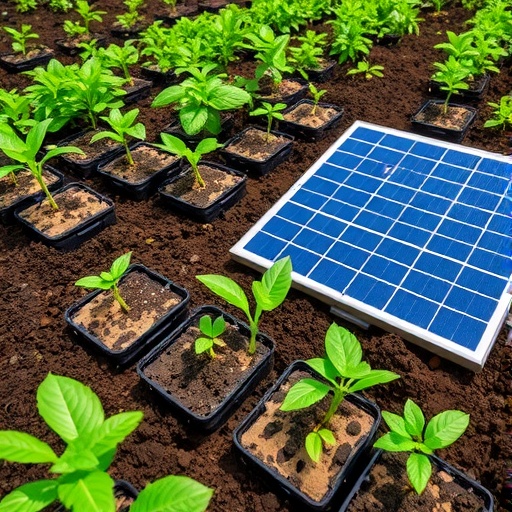
Addressing these challenges requires innovative approaches that combine efficiency with environmental responsibility. Emerging at the forefront of such efforts is a revolutionary photovoltaic thermo-electro dual module system (PTEDMS) developed by a research collaboration between the Research Center for Eco-Environmental Sciences at the Chinese Academy of Sciences and China Jiliang University. This system merges photovoltaic (PV) solar energy utilization, electrical resistance heating (ERH), electrokinetic transport, and thermal energy storage into a seamlessly integrated platform designed for continuous, carbon-free soil remediation.
The core innovation of PTEDMS lies in its ability to optimize solar energy allocation through real-time machine learning algorithms. Unlike conventional remediation systems which rely heavily on fossil fuels or static power inputs, PTEDMS harnesses fluctuating solar irradiance efficiently, balancing the demands of both thermal and electrochemical remediation pathways without interruption. This dynamic management ensures pollutant degradation proceeds at maximum rates regardless of environmental variability, marking a significant step forward in smart, adaptive environmental engineering.
Electrical resistance heating (ERH) plays a seminal role within the PTEDMS framework by elevating subsurface temperatures through controlled Joule heating. This thermal uplift volatilizes and breaks down stubborn organic contaminants entrenched at various soil depths. Complementing ERH, electrokinetic transport enhances the mobility of ionic and molecular pollutant species within soil micropores, facilitating their migration towards treatment zones and stimulating native microbial communities that contribute to biodegradation processes. The synergy between thermal and electrokinetic mechanisms results in removal efficiencies roughly 46% higher than those achievable by either technology alone, while reducing energy consumption by approximately 20%.
A distinguishing feature of PTEDMS is its departure from battery-dependent energy storage systems. Instead, it employs a sophisticated hot water thermal storage subsystem that boasts energy exchange efficiencies surpassing 85%, facilitating uninterrupted operation during periods of diminished sunlight. This design circumvents issues of battery degradation and resource constraints, ensuring sustainable long-term deployment, particularly in sunny regions with limited access to reliable grid electricity.
The incorporation of pump-driven dynamic water cycling is pivotal for seamless power delivery. This innovation allows for flexible thermal energy transfer and management, thereby maintaining system operation during intermittent cloud cover or nighttime conditions. By coupling this physical component with intelligent software controls, PTEDMS exemplifies a next-generation hybrid remediation system that leverages both hardware and algorithmic sophistication to address one of the most persistent challenges in environmental restoration.
Machine learning forms an indispensable component of PTEDMS’s operational protocol. By continuously analyzing solar irradiance, soil contaminant profiles, and energy system parameters, algorithms dynamically allocate PV-generated energy between thermal heating and electrokinetic modules. This smart energy distribution not only maximizes pollutant breakdown, but also ensures the system adapts to site-specific geochemical conditions and pollutant heterogeneity, improving scalability and field applicability across diverse contaminated sites.
The environmental and economic implications of PTEDMS are vast. Its carbon-neutral operation aligns with pressing international climate commitments while offering industry and municipalities cost-effective solutions for long-term rehabilitation. Deployment of PTEDMS directly reduces reliance on fossil fuels, mitigates carbon emissions associated with conventional soil remediation, and fosters sustainable ecosystems, directly benefiting public health and agricultural productivity.
This technology holds substantial promise beyond soil remediation alone. The dual-module approach, with its inherent flexibility and renewable integration, can be adapted for wastewater treatment, restoration of contaminated agricultural lands, and broader eco-engineering applications. By marrying renewable energy technologies with cutting-edge digital intelligence, PTEDMS represents a paradigmatic shift towards scalable environmental technologies designed to meet global sustainability goals.
Dr. Wentao Jiao, the corresponding author of the study, underscores the transformative potential of PTEDMS: “Our integrated system marries solar power with advanced electrothermal and electrokinetic techniques to address the stubborn issue of organic soil pollutants without the environmental costs associated with fossil energy sources. The incorporation of machine learning empowers continuous, efficient, and site-tailored remediation, making PTEDMS a breakthrough in sustainable environmental management.”
The study detailing PTEDMS’s design and field validation was published on July 23, 2025, in the journal Eco-Environment & Health. Funded by the National Natural Science Foundation of China and the Strategic Priority Research Program of the Chinese Academy of Sciences, this work highlights the critical intersection of renewable energy, environmental science, and artificial intelligence in solving complex ecological problems.
In sum, PTEDMS encapsulates a visionary approach to soil remediation, offering a zero-carbon, intelligent, and adaptable solution for the environmental challenges of today and tomorrow. Its design principles and operational successes pave the way for a new era of eco-friendly technologies that can be tailored to various contamination contexts worldwide, promising healthier ecosystems and communities through sustainable innovation.
Subject of Research: Not applicable
Article Title: Photovoltaic-driven thermo-electro dual module sustainable decontamination in soil
News Publication Date: 23-Jul-2025
References:
DOI: 10.1016/j.eehl.2025.100173
Image Credits: Eco-Environment & Health
Keywords: Research methods
Tags: addressing soil contamination with technologycarbon footprint reduction in soil treatmentdual module systems for environmental sustainabilityeco-friendly soil remediation methodselectrokinetic transport for pollution removalEnhancing Biodiversity through Soil Healthinnovative soil cleanup technologiesmachine learning for soil remediationphotovoltaic systems for decontaminationreal-time energy optimization in agriculturesustainable solar energy solutionsthermal energy storage in soil decontamination