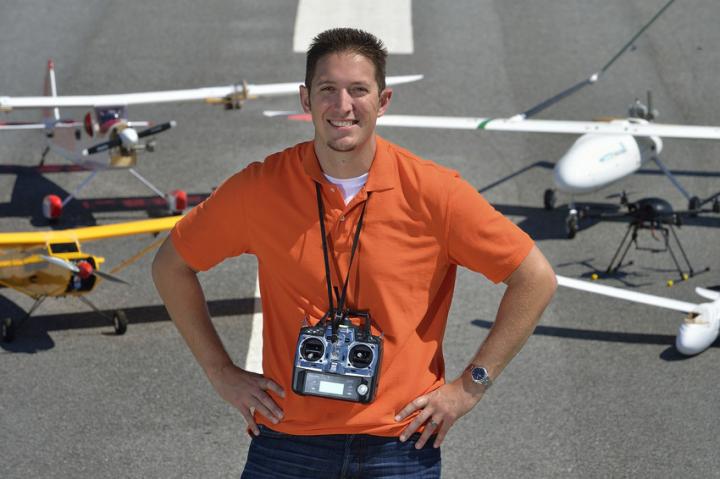
Credit: Virginia Tech
The U.S. Department of State and the J. William Fulbright Foreign Scholarship Board announced that David Schmale, a professor in the Virginia Tech College of Agriculture and Life Sciences, has received a Fulbright U.S. Scholar Program award to New Zealand, where he will work to improve the security of water systems by developing new remote-sensing capabilities to sense and respond to harmful algal blooms (HABs).
Due to the ubiquity of HABs in New Zealand and the U.S. and their increasing prevalence with rising temperatures and higher nutrient runoff, this research area addresses a compelling problem requiring a deep integration across disciplines.
Schmale will conduct research at the University of Waikato with professor Troy Baisden and members of the Lakes Ecosystem Research New Zealand group, a cross-institutional team of the country’s top lake researchers. In addition to developing and testing unmanned sampling systems for tracking HABs in freshwater lakes, he and his colleagues will create a unique unit for secondary school students to design and fabricate robots for environmental monitoring, helping them take an active part in determining what role this new technology should play in the society they will inherit.
A professor in the School of Plant and Environmental Sciences, Schmale is one of more than 800 U.S. citizens who will teach, conduct research, and/or provide expertise abroad for the 2019-20 academic year through the Fulbright U.S. Scholar Program. Recipients of Fulbright awards are selected on the basis of academic and professional achievement, as well as record of service and demonstrated leadership in their respective fields.
“The proposed research will involve the creative collision of remote-sensing capabilities in the air and water and the targeted collection and analysis of water samples,” said Schmale. “This project has the potential to transform environmental monitoring and management strategies for a wide range of natural or human-managed environments, including lakes as sources of drinking water and recreational activities. Our work will enable a more timely and accurate exposure assessment in affected areas. Moreover, the education units we will offer will have a direct impact on the indigenous people who live in the region.”
The Fulbright Program is the flagship international educational exchange program sponsored by the U.S. government and is designed to build lasting connections between the people of the United States and the people of other countries. The Fulbright Program is funded through an annual appropriation made by the U.S. Congress to the U.S. Department of State. Participating governments and host institutions, corporations, and foundations around the world also provide direct and indirect support to the program, which operates in more than 160 countries worldwide.
Since its establishment in 1946 under legislation introduced by the late U.S. Sen. J. William Fulbright of Arkansas, the Fulbright Program has given more than 380,000 students, scholars, teachers, artists, and scientists the opportunity to study, teach, conduct research, exchange ideas, and contribute to finding solutions to shared international concerns.
Fulbrighters address critical global challenges in all disciplines, while building relationships, knowledge, and leadership in support of the long-term interests of the United States. Fulbright alumni have achieved distinction in many fields, including 59 who have been awarded the Nobel Prize, 82 who have received Pulitzer Prizes, and 37 who have served as a head of state or government.
###
At Virginia Tech, the program is administered through the Global Education Office. For further information about the Fulbright Program, please visit http://eca.
Media Contact
Zeke Barlow
[email protected]
Original Source
https:/