Hydrogen is emerging as a popular eco-friendly alternative to fossil fuel resources owing to its carbon-neutral combustion products (water, electricity, and heat) and is considered to be the next-generation fuel for a zero-emission society. However, the major source of hydrogen is, ironically, fossil fuels.
Credit: Sanghan Lee from Gwangju Institute of Science and Technology, Korea
Hydrogen is emerging as a popular eco-friendly alternative to fossil fuel resources owing to its carbon-neutral combustion products (water, electricity, and heat) and is considered to be the next-generation fuel for a zero-emission society. However, the major source of hydrogen is, ironically, fossil fuels.
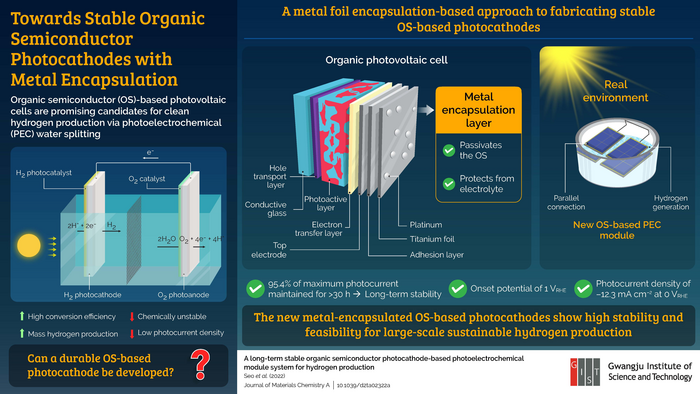
One way to produce hydrogen in a clean and sustainable manner is through water splitting driven by sunlight. The process, known as “photoelectrochemical (PEC) water splitting” is the basis of operation of organic photovoltaic cells. What makes this method attractive is that it enables 1) mass hydrogen production in limited space without a grid system and 2) high-efficiency conversion of solar energy to hydrogen. Despite such advantages, however, the photoactive materials used in conventional PECs do not have the properties required for a commercial setting. In this regard, organic semiconductors (OSs) have emerged as a potential photoelectrode material for commercial PEC hydrogen production due to their high performance and low-cost printing. But, on the downside, OSs suffer from poor chemical stability and low photocurrent density.
Now, a team of researchers led by Prof. Sanghan Lee from Gwangju Institute of Science and Technology, Korea, may have finally solved this problem. In their recent breakthrough that appeared on the front cover page of the Journal of Materials Chemistry A, the team adopted an approach based on encapsulating the OS photocathode in platinum-decorated titanium foil, a technique known as “metal foil encapsulation,” to prevent its exposure to the electrolyte solution.
“The metal foil encapsulation is a powerful approach for realizing long-term stable OS-based photocathodes since it helps impede the penetration of electrolytes into the OS, improving their long-term stability as has been demonstrated in our previous studies and other reports on OS-based photoelectrodes, ” explains Prof. Lee. The study was made available online on 14 May 2022 and was published in Issue 25 of the journal on 07 July 2022.
The team fabricated an organic photovoltaic cell, in which the OS photocathode was covered with titanium foil and well-dispersed platinum nanoparticles. Upon testing, the OS photocathode showed an onset potential of 1 V versus the reversible hydrogen electrode (RHE) and a photocurrent density of -12.3 mA cm-2 at 0 VRHE. Most remarkably, the cell demonstrated a record operation stability, retaining 95.4% of the maximum photocurrent for over 30 hours without any noticeable deterioration in the OS. Further, the team tested the module under actual sunlight and was able to produce hydrogen.
The highly stable and efficient PEC module developed in this study can enable large-scale production of hydrogen and inspire innovative routes for building future hydrogen gas stations. “With the growing threat of global warming, it is imperative to develop eco-friendly energy sources. The PEC module explored in our study could be installed in hydrogen gas stations, where hydrogen can be both mass-produced and sold at the same time,” speculates an optimistic Prof. Lee.
We sure hope his vision is realized soon!
***
Reference
DOI: https://doi.org/10.1039/d2ta02322a
Authors: Sehun Seo,ab Jong-Hoon Lee,ac Yejoon Kim,a Seungkyu Kim,a Chang Jae Yoon,d Hojoong Choi,a Sanseong Lee,ade Kwanghee Lee, ade Heejoo Kim ef and Sanghan Lee *a
Affiliations:
a School of Materials Science and Engineering, Gwangju Institute of Science and Technology
b Chemical Science Division and Liquid Sunlight Alliance, Lawrence Berkeley National Laboratory
c Department of Chemical and Biomolecular Engineering, University of Illinois at Urbana-Champaign
d Research Institute for Solar and Sustainable Energies, Gwangju Institute of Science and Technology
e Heeger Center for Advanced Materials, Gwangju Institute of Science and Technology
f Graduate School of Energy Convergence, Institute of Integrated Technology, Gwangju Institute of Science and Technology
About the Gwangju Institute of Science and Technology (GIST)
The Gwangju Institute of Science and Technology (GIST) is a research-oriented university situated in Gwangju, South Korea. Founded in 1993, GIST has become one of the most prestigious schools in South Korea. The university aims to create a strong research environment to spur advancements in science and technology and to promote collaboration between international and domestic research programs. With its motto of “A Proud Creator of Future Science and Technology,” GIST has consistently received one of the highest university rankings in Korea.
Website: http://www.gist.ac.kr/
About the author
Dr. Sanghan Lee is a Professor at the School of Materials Science and Engineering at Gwangju Institute of Science & Technology (GIST), Korea. Before coming to GIST, he received his Ph.D. in Materials Science & Engineering from the University of Wisconsin-Madison, USA, and conducted research as a postdoctoral fellow at the same university thereafter. Currently, his group at GIST is developing various semiconductor material-based thin films for the fabrication of high-performance photoelectrodes, memory devices, and gas sensors.
Journal
Journal of Materials Chemistry A
DOI
10.1039/d2ta02322a
Method of Research
Experimental study
Subject of Research
Not applicable
Article Title
A long-term stable organic semiconductor photocathode-based photoelectrochemical module system for hydrogen production
Article Publication Date
7-Jul-2022
COI Statement
There are no conflicts to declare