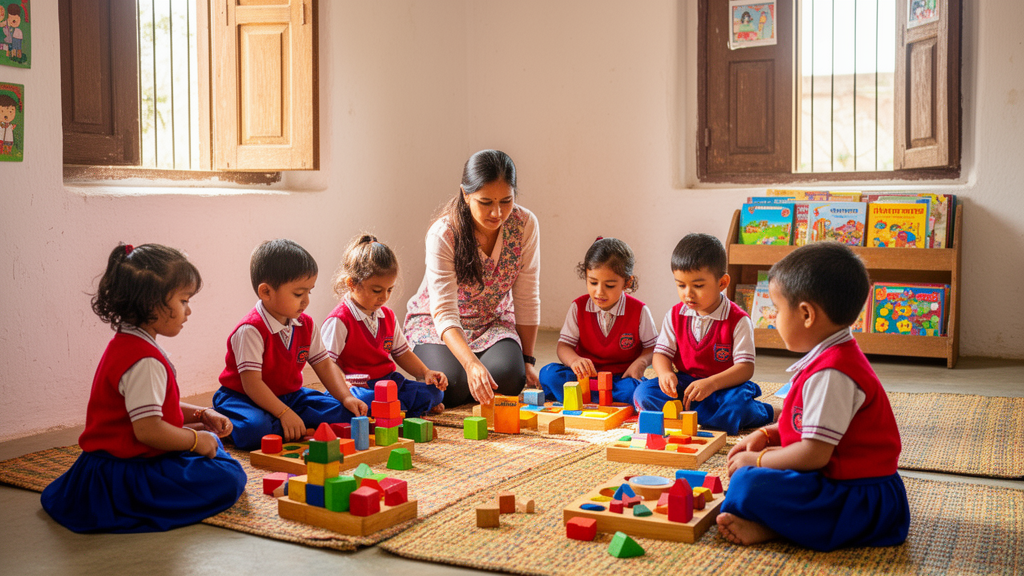
In the classrooms and courtyards of early childhood development centers across Rupandehi District in southern Nepal, researchers have been quietly measuring something invisible: the building blocks of thinking itself. A new cross-sectional study of 401 preschool children aged three to five years, published in BMC Public Health, has mapped how nutrition, psychosocial stimulation, socioeconomic conditions, and family circumstances converge to shape conceptual skill development during a window of childhood that never comes again. The findings, drawn from one of the first studies in Nepal to focus specifically on conceptual skills rather than overall cognitive development, offer a striking portrait of how biology and social environment intertwine in the earliest years of learning.
Conceptual skill development is the foundation on which later learning rests. It encompasses the abilities that allow young children to classify objects, understand quantities, grasp cause and effect, follow sequences, and solve simple problems. These are not abstract academic luxuries; they are the cognitive scaffolding that supports reasoning, language, and eventual school readiness. Developmental scientists have long known that nutrition, stimulation, and family environment influence cognitive outcomes in early childhood, but evidence from low- and middle-income countries has tended to lump these abilities together with broader measures of development. The new study, conducted by Prakash Sharma of Butwal Multiple Campus, Tribhuvan University, as part of his PhD research, zooms in on this specific domain with unusual precision for the region.
The methodology was deliberately comprehensive. Children enrolled in early childhood development centers across Rupandehi District were recruited through a multistage sampling procedure, ensuring that the sample represented the district’s diverse communities rather than a single convenient cluster. Each child’s conceptual skills were assessed using the conceptual skill development component of a standardized Cognitive Development Tool designed for preschool children. Beyond the cognitive testing, the study collected anthropometric measurements, allowing the researchers to calculate height-for-age and weight-for-age z-scores, the standard indicators of chronic and acute nutritional status. Interviewer-administered structured questionnaires captured socio-demographic characteristics, the level of psychosocial stimulation children received at home, and caregivers’ nutritional practices. Observation with standardized tools rounded out the picture of each child’s daily environment.
When the data were subjected to multiple linear regression analysis, a clear hierarchy of influences emerged. The single most robust nutritional finding concerned linear growth: children with higher height-for-age z-scores, a marker of long-term nutritional adequacy, scored significantly better on conceptual skill assessments. This aligns with a substantial body of international evidence linking chronic malnutrition, or stunting, to diminished cognitive development. Height-for-age reflects not just a child’s diet in recent weeks but the cumulative nutritional history of the first years of life, a period during which the brain undergoes its most rapid architectural changes. A child who is well-nourished through this critical period appears, in this dataset, to carry a measurable cognitive advantage into the preschool years.
Psychosocial stimulation proved equally consequential. Children whose caregivers provided richer stimulation, more talking, more play, more responsive interaction, more exposure to books and learning materials, achieved higher conceptual skill scores. This finding speaks to a growing consensus in developmental science that the quantity and quality of caregiver-child interaction is not a soft variable but a hard driver of neurocognitive growth. Responsive caregiving stimulates the developing brain through language exposure, joint attention, and emotionally secure interaction, all of which are thought to support the neural circuits underlying memory, attention, and reasoning. In a district where many families face economic hardship, the finding suggests that stimulation is one of the few powerful developmental levers that costs nothing but time and attention.
The social dimension of the results is perhaps the most sobering. Children from relatively advantaged caste and ethnic groups scored higher on conceptual skill development than children from relatively disadvantaged groups, an association that persisted in the final regression model. Nepal’s caste system has historically shaped access to education, economic opportunity, healthcare, and social capital, and this study provides quantitative evidence that these structural inequalities reach into the cognitive development of preschool children. The finding is not a statement about any group’s inherent abilities; it is a measurement of how social disadvantage, operating through nutrition, stimulation, healthcare access, and family stress, becomes biologically embedded in early childhood. The author explicitly frames this as evidence for interventions that attend to caste-based disadvantage alongside nutrition and caregiving.
Two findings ran in a direction that might surprise readers. Cesarean delivery was associated with lower conceptual skill scores, and so was increasing child age within the three-to-five-year window. The cesarean association, observed in cross-sectional data, cannot establish causation; it may reflect differences in birth circumstances, maternal health, or unmeasured perinatal factors that cluster with delivery mode. The age association is equally intriguing and may reflect cohort composition, sampling patterns, or the possibility that older children in the sample came from backgrounds with fewer developmental resources. The study is careful to note that these are associations, not proven causal effects, and that cross-sectional designs cannot disentangle the direction of influence.
The analysis also demonstrated scientific restraint in an era of overclaimed findings. Associations for nutritional edema, the swelling that signals severe acute malnutrition, and for household economic ranking were unstable across different model specifications. Rather than forcing these variables into the narrative, the author explicitly declined to interpret them as independent effects. This kind of sensitivity analysis, testing whether a finding survives when the model is respecified, is exactly the practice that separates robust evidence from statistical noise. The final model explained 35.3 percent of the variance in conceptual skill development, a substantial proportion for a study of this kind, indicating that the measured nutritional, psychosocial, and social factors capture a meaningful share of what drives conceptual growth, while leaving room for unmeasured influences ranging from genetics to community environment.
The statistical rigor extended to the diagnostics. Supplementary materials include histograms of standardized residuals, normal probability plots, and scatterplots of residuals against predicted values, confirming that the regression model met its underlying assumptions. A Pearson correlation matrix among continuous variables and a sensitivity analysis with categorical predictors entered as dummy variables further tested the stability of the findings. Ethical procedures were equally thorough: the study received approval from the Nepal Health Research Council, written informed consent was obtained from all primary caregivers, permission was granted by the early childhood development centers, and verbal assent was sought from each child before assessment, with hesitant children given time until they were ready to participate willingly.
The practical implications reach far beyond Rupandehi District. The study argues for early childhood development interventions that combine three strands: nutrition improvement to support physical growth, responsive caregiving and psychosocial stimulation to feed the developing mind, and attention to caste-based social disadvantage to level the structural playing field. In a country where nearly one in three children under five is stunted, and where preschool enrollment is expanding rapidly, the message is that cognitive development is not determined by any single factor but by the convergence of biology, interaction, and social structure. For policymakers, the convergence is an opportunity: each strand is a proven target for intervention, and the evidence suggests that acting on all three together, during the narrow window before formal schooling begins, may yield the greatest returns for the next generation of Nepali children.
Subject of Research: Child Development
Article Title: Nutritional, psychosocial, socioeconomic, and family factors associated with conceptual skill development among preschool children: evidence from Rupandehi District, Nepal
Article References: Sharma, P. (2026). Nutritional, psychosocial, socioeconomic, and family factors associated with conceptual skill development among preschool children: evidence from Rupandehi District, Nepal. BMC Public Health. https://doi.org/10.1186/s12889-026-29933-2
Image Credits: AI Generated
DOI: 10.1186/s12889-026-29933-2
Keywords: conceptual skill development, preschool children, nutrition, psychosocial stimulation, Nepal, BMC Public Health, early childhood development, Nutritional, psychosocial, socioeconomic, family, factors
News Source: Daisy Hatcher. (October 18, 2026). Growth, Play and Privilege Shape Preschool Thinking Skills in Nepal Study. Scienmag.