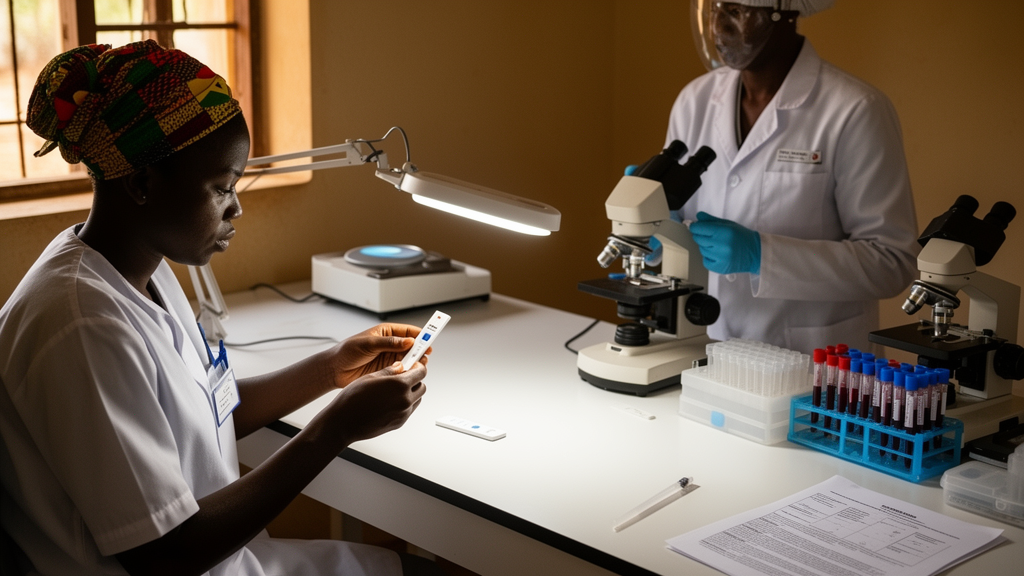
Onchocerciasis, commonly known as river blindness, remains one of the most stubborn parasitic diseases in sub-Saharan Africa, and the tools used to detect it are now under intense scrutiny as elimination programs accelerate. A new community-based study from Ghana has revealed a striking gap between two widely used diagnostic approaches, raising important questions about how the disease should be monitored in the final stretch toward eradication. The research, published in BMC Infectious Diseases, directly compared the SD-Bioline Ov-16 rapid diagnostic test with a quantitative polymerase chain reaction assay targeting the O-150 repeat sequence of the parasite Onchocerca volvulus, and the results show that these two methods are measuring fundamentally different biological phenomena.
The study was conducted between September and November 2023 in seven communities across three districts in the Volta and Oti Regions of Ghana. Researchers recruited participants aged five years and older using convenience sampling, ultimately enrolling 1,705 individuals. Of these, 901 participants had complete paired samples suitable for analysis, meaning that both dried blood spots for the rapid diagnostic test and skin snips for the molecular assay were available from the same person. This paired design allowed the team to assess concordance between the two tests at the individual level, a critical requirement for any meaningful diagnostic accuracy evaluation.
The technical basis of the two tests could not be more different. The SD-Bioline Ov-16 rapid diagnostic test detects antibodies against the Ov-16 antigen, a protein specific to Onchocerca volvulus. When the immune system encounters the parasite, it produces antibodies that persist long after the initial exposure, meaning the test essentially identifies whether a person has ever been exposed to the parasite rather than whether they currently carry an active infection. In contrast, the O-150 qPCR assay detects parasite DNA in skin snips, specifically amplifying the O-150 repeat sequence that is unique to Onchocerca volvulus. This molecular approach identifies active infection by finding genetic material from living parasites in the skin, making it a much more direct indicator of current parasite burden.
The results revealed a dramatic disparity in prevalence estimates. Using the Ov-16 rapid diagnostic test, the overall prevalence was 27.5 percent, with 248 of 901 participants testing positive. However, when the same population was assessed by qPCR, only 2.9 percent tested positive, with just 26 of 901 participants showing parasite DNA in their skin snips. This nearly tenfold difference in prevalence estimates underscores the fundamental biological distinction between antibody detection and parasite DNA detection. The antibody test captures cumulative exposure over a lifetime, while the molecular test identifies only those with detectable active infections at the moment of sampling.
When qPCR was used as the reference standard, the rapid diagnostic test showed a sensitivity of 65.4 percent with a 95 percent confidence interval ranging from 44.3 to 82.8 percent, and a specificity of 73.6 percent with a 95 percent confidence interval from 70.5 to 76.6 percent. The overall concordance between the two tests was 73.4 percent, but the kappa score was just 0.0759 with a p-value less than 0.001, indicating poor agreement beyond chance. A kappa statistic this low means that the two tests are essentially identifying different populations of positive individuals, which is exactly what one would expect given that they measure different biological endpoints.
The implications of these findings extend far beyond Ghana. The World Health Organization has set ambitious targets for onchocerciasis elimination by 2030, and accurate surveillance tools are essential for determining when mass drug administration can be safely stopped and when elimination has been achieved. The Ov-16 rapid diagnostic test has been widely adopted for field surveillance because it is simple, affordable, and does not require laboratory infrastructure. However, this study demonstrates that the test’s limitations in detecting low-level infections could lead to significant underestimation of active transmission in areas where parasite burdens have been reduced by years of treatment programs.
The poor sensitivity of the rapid diagnostic test when compared to qPCR is particularly concerning in the context of elimination settings. As mass drug administration programs succeed in reducing parasite burdens, the number of people with detectable active infections decreases dramatically. In these low-endemic settings, the antibody test may continue to return positive results from historical exposure long after active transmission has ceased, or conversely, it may fail to identify the small number of people who still carry low-level infections capable of sustaining transmission. This dual challenge means that the test cannot reliably distinguish between active transmission and residual antibody positivity from past exposure.
The study’s findings also highlight the broader challenge of developing appropriate diagnostic tools for elimination programs. The WHO Diagnostic Technical Advisory Group has established target product profiles for onchocerciasis diagnostics, calling for tests that can identify active infection rather than mere exposure. The current generation of antibody-based tests, while valuable for mapping the historical distribution of the disease and for identifying areas requiring intervention, cannot meet the technical requirements for verifying elimination. Molecular methods such as qPCR offer the specificity needed to confirm active infection, but they require laboratory infrastructure, trained personnel, and cold chain logistics that are often unavailable in the remote communities where onchocerciasis persists.
The research team, led by scientists at the Noguchi Memorial Institute for Medical Research at the University of Ghana, acknowledges that the Ov-16 rapid diagnostic test remains useful for surveillance purposes, particularly in high-endemic settings where the prevalence of exposure closely tracks active transmission. However, the study’s conclusion is clear: improved diagnostic tools are necessary to support the WHO’s 2030 elimination goals. The gap between what the antibody test measures and what the molecular test measures represents a critical technical challenge that must be addressed if elimination programs are to accurately determine when transmission has been interrupted and when interventions can be safely discontinued.
As the global health community approaches the 2030 deadline for onchocerciasis elimination, studies like this one from Ghana provide essential evidence for refining surveillance strategies. The poor concordance between the Ov-16 rapid diagnostic test and the O-150 qPCR assay is not a failure of either test per se, but rather a reflection of the fundamental biological reality that antibody positivity and parasite DNA detection capture different stages of the infection process. Moving forward, elimination programs will need to carefully consider which diagnostic endpoint is most appropriate for their specific goals, whether mapping historical exposure, identifying active transmission, or verifying that elimination has been achieved. The findings from this Ghanaian study serve as a timely reminder that the path to elimination requires not just effective treatments, but also diagnostic tools that can accurately measure the biological state of the populations being monitored.
Subject of Research: Rapid Test for River Blindness Falls Short Against Molecular Gold Standard in Ghana
Article Title: Assessing the diagnostic accuracy of the SD-Ov16 rapid diagnostic test compared to the O-150 qPCR for the diagnosis of onchocerciasis in high- and low-endemic settings of Ghana
Article References: Nyarko, A. A., Ashong, Y., Dogbe, S.-S. M., Afatodzie, M. S., Gyamfi, G. O., Nketia, K., Logonia, B., Frempong, K. K., & de Souza, D. K. (2026). Assessing the diagnostic accuracy of the SD-Ov16 rapid diagnostic test compared to the O-150 qPCR for the diagnosis of onchocerciasis in high- and low-endemic settings of Ghana. BMC Infectious Diseases. https://doi.org/10.1186/s12879-026-14645-0
Image Credits: AI Generated
DOI: 10.1186/s12879-026-14645-0
Keywords: Assessing, diagnostic, accuracy, SD-Ov16, rapid, test, compared, O-150, qPCR, diagnosis, onchocerciasis, high-
News Source: Ophelia Keating. (October 18, 2026). Rapid Test for River Blindness Falls Short Against Molecular Gold Standard in Ghana. Scienmag.