Microbes in meltwater stream sediment may help boost island’s contribution to sea-level rise
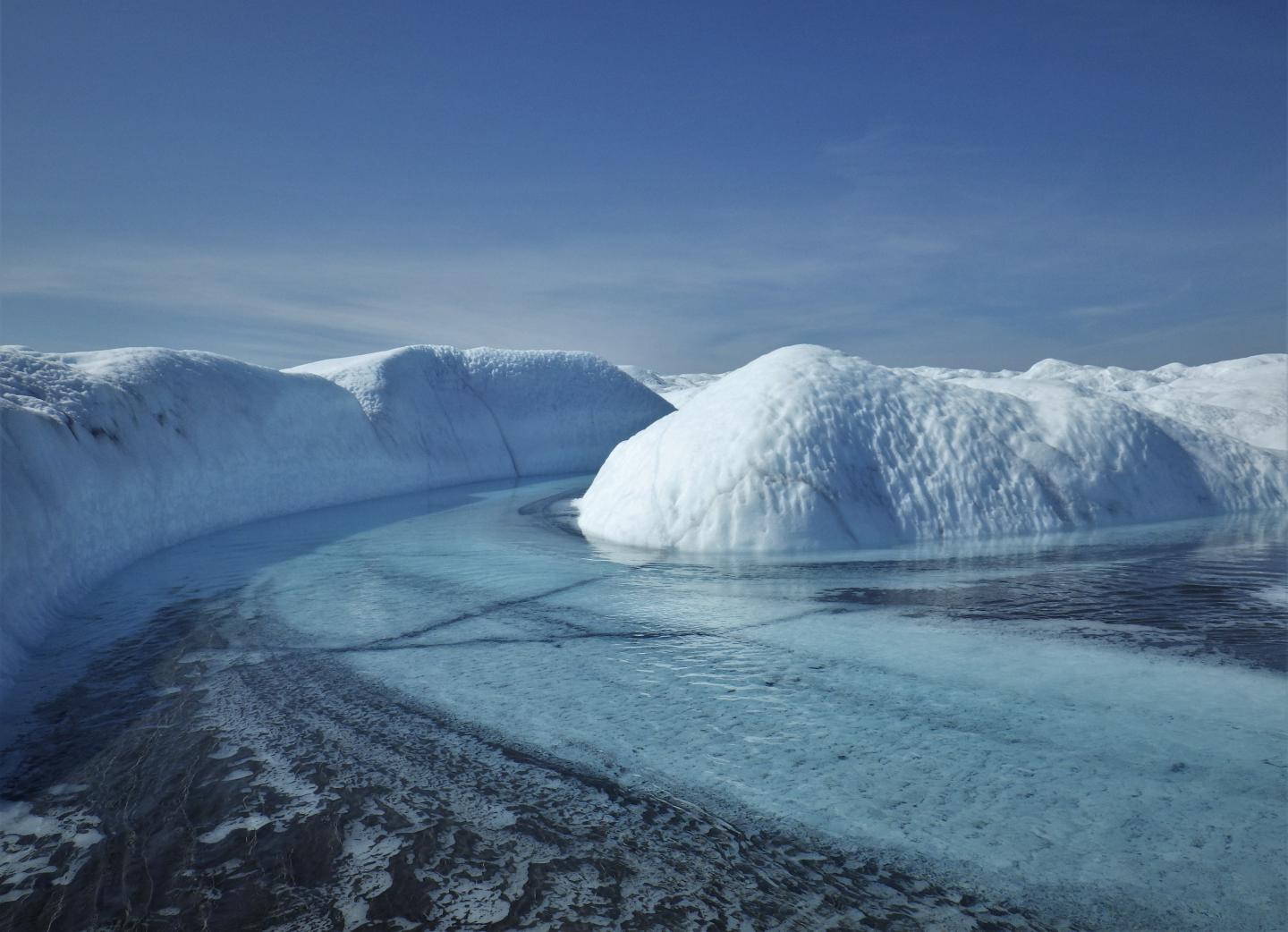
Credit: Sasha Leidman
Bacteria are likely triggering greater melting on the Greenland ice sheet, possibly increasing the island’s contribution to sea-level rise, according to Rutgers scientists.
That’s because the microbes cause sunlight-absorbing sediment to clump together and accumulate in the meltwater streams, according to a Rutgers-led study – the first of its kind – in the journal Geophysical Research Letters. The findings can be incorporated in climate models, leading to more accurate predictions of melting, scientists say.
“These streams can be seen all over Greenland and they have a brilliant blue color, which leads to further melting since they absorb more sunlight than the surrounding ice,” said lead author Sasha Leidman, a graduate student in the lab of co-author Asa K. Rennermalm, an associate professor in the Department of Geography in the School of Arts and Sciences at Rutgers University-New Brunswick. “This is exacerbated as dark sediment accumulates in these streams, absorbing even more sunlight and causing more melting that may increase sea-level rise.”
The Greenland ice sheet covers about 656,000 square miles – most of the island and three times the size of Texas, according to the National Snow & Ice Data Center. The global sea level would rise an estimated 20 feet if the thick ice sheet melted.
With climate change, sea-level rise and coastal storms threaten low-lying islands, cities and lands around the world.
YouTube video: Drone flight over a supraglacial stream in Greenland
Most scientists ignore sediment in glacial streams that form on top of the Greenland ice sheet as meltwater flows to the ocean, but the Rutgers-led team wanted to find out why they accumulated so much sediment. In 2017, scientists flew drones over an approximately 425-foot-long stream in southwest Greenland, took measurements and collected sediment samples. They found that sediment covers up to a quarter of the stream bottom, far more than the estimated 1.2 percent that would exist if organic matter and cyanobacteria did not cause sediment granules to clump together. They also showed that streams have more sediment than predicted by hydrological models.
“We found that the only way for sediment to accumulate in these streams was if bacteria grew in the sediment, causing it to clump into balls 91 times their original size,” Leidman said. “If bacteria didn’t grow in the sediment, all the sediment would be washed away and these streams would absorb significantly less sunlight. This sediment aggregation process has been going on for longer than human history.”
The solar energy absorbed by streams likely depends on the health and longevity of the bacteria, and further warming in Greenland may lead to greater sediment deposits in glacial streams, the study says.
“Decreases in cloud cover and increases in temperature in Greenland are likely causing these bacteria to grow more extensively, causing more sediment-driven melting,” Leidman said. “With climate change causing more of the ice sheet to be covered by streams, this feedback may lead to an increase in Greenland’s contribution to sea-level rise. By incorporating this process into climate models, we’ll be able to more accurately predict how much melting will occur, with the caveat that it is uncertain how much more melting will take place compared with what climate models predict. It will likely not be negligible.”
###
Rutgers co-authors include graduate student Rohi Muthyala and School of Engineering Professor Qizhong (George) Guo. A scientist at the University of Colorado Boulder contributed to the study.
Media Contact
Todd Bates
[email protected]
Original Source
https:/
Related Journal Article
http://dx.