• HOME
  • NEWS
  • EXPLORE
    • CAREER
      • Companies
      • Jobs
    • EVENTS
    • iGEM
      • News
      • Team
    • PHOTOS
    • VIDEO
    • WIKI
  • BLOG
  • COMMUNITY
    • FACEBOOK
    • INSTAGRAM
    • TWITTER
Tuesday, October 20, 2026
BIOENGINEER.ORG
No Result
View All Result
  • Login
  • HOME
  • NEWS
  • EXPLORE
    • CAREER
      • Companies
      • Jobs
        • Lecturer
        • PhD Studentship
        • Postdoc
        • Research Assistant
    • EVENTS
    • iGEM
      • News
      • Team
    • PHOTOS
    • VIDEO
    • WIKI
  • BLOG
  • COMMUNITY
    • FACEBOOK
    • INSTAGRAM
    • TWITTER
No Result
View All Result
Bioengineer.org
No Result
View All Result
Home NEWS Science News Agriculture

Greenhouse study finds treatment-specific responses in cactus pear under reduced soil-water target

by
October 20, 2026
in Agriculture
Reading Time: 2 mins read
0
Greenhouse study finds treatment-specific responses in cactus pear under reduced soil-water target

Irradiated Water-Holding Polymers and Biostimulant Blends Boost Cactus Pear Growth Under Tight Water Limits

Share on FacebookShare on TwitterShare on LinkedinShare on RedditShare on Telegram

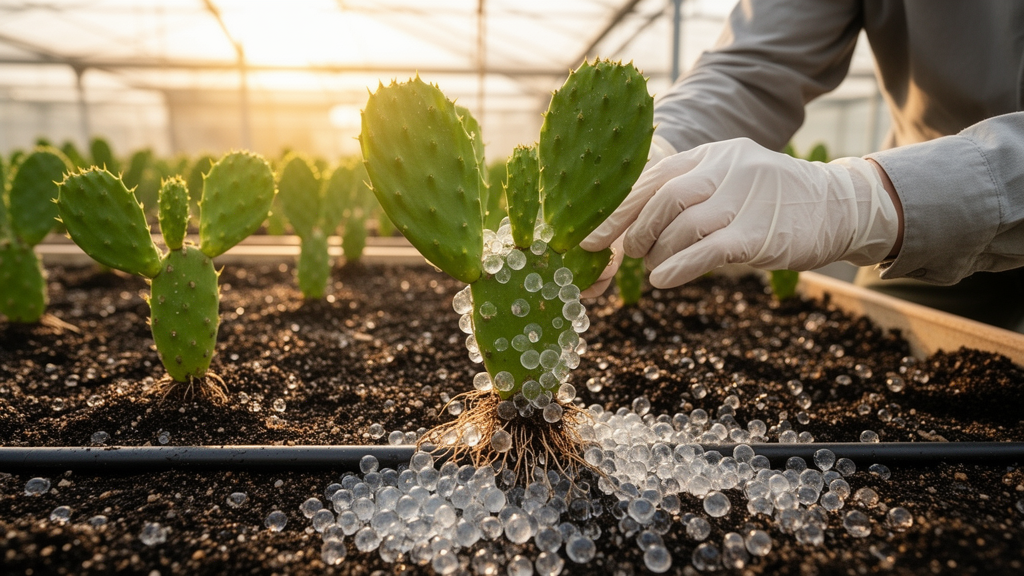
A 90-day greenhouse experiment found that responses of cactus pear (Opuntia ficus-indica) to water-retentive amendments and biostimulants varied by treatment combination and measured trait. The highest observed shoot fresh mass occurred with mycorrhizal inoculum, seaweed extract, humic acid and electron-beam-irradiated superabsorbent polymer at 2 g kg⁻¹ soil: 99.50 g per pot compared with 45.95 g for the untreated control.

Researchers crossed five physicochemical regimes—unamended soil, electron-beam-irradiated superabsorbent polymer at 1 or 2 g kg⁻¹ soil, and zeolite at 1 or 2 g kg⁻¹—with all eight presence-or-absence combinations of arbuscular-mycorrhizal inoculum, seaweed extract and humic acid. Three independent pots were used for each combination. Soil water was maintained gravimetrically at a target derived from 70% of the unamended soil’s field capacity. Continuous responses were evaluated with a 5 × 8 fixed-effects model, followed by Tukey-adjusted comparisons where appropriate, while cladode number was analyzed with a Poisson model.

The physicochemical regime, biostimulant regime and their interaction affected most continuous traits, with the interaction detected for 15 of 17 responses; it was not detected for chlorophyll b or total phenolics. The highest observed relative water content was 98.66% under mycorrhizal inoculum, seaweed extract and irradiated superabsorbent polymer at 2 g kg⁻¹, compared with 83.06% in the untreated control. The highest observed total chlorophyll was 1.835 mg g⁻¹ fresh weight under humic acid, seaweed extract and irradiated superabsorbent polymer at 2 g kg⁻¹, versus 0.770 mg g⁻¹ in the control. The highest DPPH value, 76.89% compared with 65.78%, was observed under mycorrhizal inoculum, seaweed extract, humic acid and zeolite at 2 g kg⁻¹. Principal components PC1 and PC2 described 48.34% of treatment-mean variation, while the first four components described 75.02%.

These results come from the article abstract and describe a controlled greenhouse experiment rather than field research. The authors identified combinations containing irradiated superabsorbent polymer or zeolite at 2 g kg⁻¹ as candidates for further replicated greenhouse and field evaluation, but the experiment did not establish drought mitigation, irrigation savings, mycorrhizal colonization or superiority to non-irradiated superabsorbent polymer. The observed treatment maxima therefore identify combinations for subsequent testing, not proven field benefits.

Subject of Research: Greenhouse evaluation of amendments and biostimulants for cactus pear under a reduced soil-water target

Article Title: Treatment-dependent responses of Opuntia ficus-indica to electron-beam-irradiated superabsorbent polymer, zeolite, and biostimulants at a reduced soil-water target

Article References: Hadad, M. N., & Kordrostami, M. (2026). Treatment-dependent responses of Opuntia ficus-indica to electron-beam-irradiated superabsorbent polymer, zeolite, and biostimulants at a reduced soil-water target. BMC Plant Biology. https://doi.org/10.1186/s12870-026-10020-y

Image Credits: AI Generated

DOI: 10.1186/s12870-026-10020-y

Keywords: cactus pear, Opuntia ficus-indica, greenhouse experiment, soil water, superabsorbent polymer, zeolite, arbuscular mycorrhiza, seaweed extract, humic acid, plant growth traits, Treatment-dependent, responses

News Source: Alan Morgan. (October 20, 2026). Greenhouse study finds treatment-specific responses in cactus pear under reduced soil-water target. Scienmag.


Tags: arbuscular mycorrhizacactus peargreenhouse experimenthumic acidOpuntia ficus-indicaplant growth traitsresponsesseaweed extractsoil watersuperabsorbent polymerTreatment-dependentzeolite
Share12Tweet7Share2ShareShareShare1

Related Posts

Agronomic performance and leaf-morphological evaluation of basil (Ocimum basilicum L.) germplasm under the environmental conditions of Adana

Agronomic performance and leaf-morphological evaluation of basil (Ocimum basilicum L.) germplasm under the environmental conditions of Adana

October 20, 2026
Serotonin and 24-epibrassinolide enhance physiological performance and saffron quality under water deficit: evidence from two-year field and multivariate analyses

Serotonin and 24-epibrassinolide enhance physiological performance and saffron quality under water deficit: evidence from two-year field and multivariate analyses

October 20, 2026

Single-dataset orange image benchmark reports 99.12% accuracy with ViT, PCA and SVM

October 20, 2026

Conserved β-tubulin as a target of ivermectin in plant-parasitic nematodes: molecular modelling and experimental protection of potato

October 20, 2026

POPULAR NEWS

  • Cross-sectional study links job satisfaction with turnover intention and well-being among Saudi and non-Saudi critical care and emergency nurses

    Cross-sectional study links job satisfaction with turnover intention and well-being among Saudi and non-Saudi critical care and emergency nurses

    29 shares
    Share 12 Tweet 7
  • Kinetic model reproduces Sri Lanka dengue patterns after adding climate and social factors

    29 shares
    Share 12 Tweet 7
  • Kazakhstan’s registered syphilis incidence fell 21.9% from 2022 to 2025, surveillance study reports

    29 shares
    Share 12 Tweet 7
  • Agronomic performance and leaf-morphological evaluation of basil (Ocimum basilicum L.) germplasm under the environmental conditions of Adana

    29 shares
    Share 12 Tweet 7

About

We bring you the latest biotechnology news from best research centers and universities around the world. Check our website.

Follow us

Recent News

Cross-sectional study links job satisfaction with turnover intention and well-being among Saudi and non-Saudi critical care and emergency nurses

Kinetic model reproduces Sri Lanka dengue patterns after adding climate and social factors

Kazakhstan’s registered syphilis incidence fell 21.9% from 2022 to 2025, surveillance study reports

Subscribe to Blog via Email

Enter your email address to subscribe to this blog and receive notifications of new posts by email.

Join 85 other subscribers
  • Contact Us

Bioengineer.org © Copyright 2023 All Rights Reserved.

Welcome Back!

Login to your account below

Forgotten Password?

Retrieve your password

Please enter your username or email address to reset your password.

Log In
No Result
View All Result
  • Homepages
    • Home Page 1
    • Home Page 2
  • News
  • National
  • Business
  • Health
  • Lifestyle
  • Science

Bioengineer.org © Copyright 2023 All Rights Reserved.