


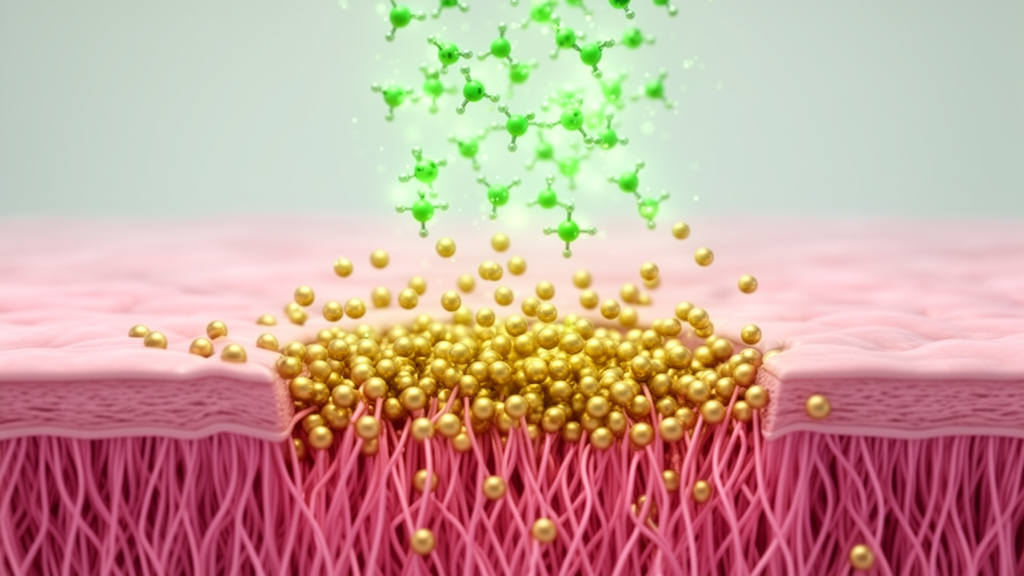
Ultraviolet radiation from chronic sun exposure drives photoaging, a process the authors of a new study say accounts for up to 80 percent of visible facial aging, including wrinkles, laxity and hyperpigmentation. Beyond its cosmetic toll, the same cascade impairs skin barrier function and raises the risk of carcinogenesis. A team reporting in the journal Collagen and Leather has now built a single nanoscale particle that combines two agents usually delivered separately: epigallocatechin-3-gallate (EGCG), the major catechin of green tea, and recombinant human type III collagen. In a mouse model of UVB-induced photoaging, the combined nanospheres outperformed either component alone, reversing epidermal hyperplasia and restoring the balance between type I and type III collagen in the dermis.
The two ingredients were chosen for complementary reasons. EGCG is a potent free-radical scavenger and anti-inflammatory molecule that can dampen the reactive oxygen species unleashed by UV exposure and suppress the matrix metalloproteinases that chew up collagen. But it is chemically fragile: it oxidizes readily under physiological conditions, has poor bioavailability, and at higher doses it is itself toxic to cells. Recombinant human collagen, produced by fermenting the yeast Pichia pastoris with an amino acid sequence based on the native human type III collagen region hCOL3A1 (Glu451-Pro1195), is a roughly 78-kilodalton triple-helix protein that supports dermal architecture. Previous work has shown it can alleviate UV-induced photoaging in animals, yet direct topical application is hampered by poor transdermal penetration, rapid enzymatic degradation and weak integration into the existing extracellular matrix network.
The researchers’ solution was a carrier-free co-assembly. Rather than encapsulating either molecule inside a liposome or polymer particle, they exploited the intrinsic chemistry between the two: the repetitive Gly-Pro-Hyp motifs of collagen, rich in proline, present docking sites that geometrically match the galloyl rings of EGCG. Molecular docking predicted four hydrogen bonds between EGCG and alanine and glycine residues of collagen, with distances of 2.2 to 3.1 angstroms, and a favorable docking energy of −4.1 kcal/mol. A 50-nanosecond all-atom molecular dynamics simulation in explicit solvent then showed that EGCG stayed confined within the predicted binding pocket throughout the trajectory, with a stable backbone RMSD, a minimum ligand-residue distance fluctuating around 0.2 nanometers, persistent intermolecular hydrogen bonds and a dominant low-energy basin in the free energy surface.
An MM/GBSA energetic analysis put the total binding free energy at −38.53 kcal/mol, dominated by van der Waals contributions of −35.67 kcal/mol with an additional electrostatic component of −2.68 kcal/mol. The polar solvation penalty of +4.68 kcal/mol was almost exactly offset by the nonpolar solvation term of −4.86 kcal/mol. The authors are careful to note the limits of this computational work: the simulations used a simplified single-ligand, single-chain model and cannot resolve colloidal-scale reorganization or assembly kinetics, so macroscopic nanosphere formation rests primarily on the experimental characterization that followed.
That characterization was straightforward. Lyophilized collagen and EGCG powders were dissolved in physiological saline and mixed by dropping the EGCG solution into the collagen solution at a 1:1 mass ratio, stirred for five minutes at room temperature. Dynamic light scattering showed the resulting nanospheres had a hydrodynamic diameter of 94.55 ± 2.32 nanometers with a narrow polydispersity index of 0.18 ± 0.01. The zeta potential of −2.74 ± 0.71 millivolts closely matched that of collagen alone, indicating a collagen-dominated surface. Electron microscopy, transmission electron microscopy and atomic force microscopy confirmed dry-state particles below 100 nanometers with uniform morphology. Fourier transform infrared spectroscopy revealed red-shifted aromatic vibrations consistent with EGCG encapsulation, a hydroxyl peak displacement from 3477.58 to 3418.06 cm⁻¹ indicating extensive hydrogen bonding, and shifted C–H and C–O bands pointing to hydrophobic and π–π interactions. The picture that emerges is a core-shell structure with EGCG enriched in the core and collagen forming the shell.
The formulation solved both molecules’ problems at once. Encapsulation efficiency reached 94.94 percent, meaning nearly all the EGCG was incorporated. Release studies showed a biphasic profile with an initial burst followed by sustained release over 24 hours; under skin-relevant conditions of 37 °C and pH 5.5, release was moderately accelerated but remained controlled rather than explosive, with cumulative release of 60.8 ± 1.2 percent at 24 hours. Cytotoxicity dropped dramatically: free EGCG reduced the viability of HaCaT keratinocytes to 38.04 percent at 40 micrograms per milliliter, while the nanospheres kept viability above 80 percent across the same concentration range. The DPPH assay confirmed the particles preserved EGCG’s free-radical scavenging activity, matching the positive control Trolox. Ultraviolet-visible spectroscopy additionally showed the nanospheres broadened absorption across the UVB window of roughly 280 to 320 nanometers, likely due to nanoscale scattering, hinting at a possible secondary role as a UVB filter.
Delivery also improved. FITC-labeled nanospheres were taken up by HaCaT cells more efficiently than labeled collagen alone, and Franz diffusion cell experiments on porcine skin showed 2.04-fold higher cumulative permeation after 24 hours. In mice, confocal imaging of skin cryosections demonstrated deeper penetration of the labeled nanospheres than of labeled free collagen at 6 and 12 hours. Storage testing over 12 weeks showed the particles remained stable at 4 °C in the dark and 25 °C in the dark, though light exposure at room temperature gradually increased particle size and polydispersity, so light-protected or refrigerated storage is advisable.
In cell models of UVB damage, the nanospheres outperformed both monotherapies. At 10 micrograms per milliliter they markedly enhanced HaCaT viability after UVB exposure, restored colony formation to a significantly higher count than either EGCG or collagen alone, and improved scratch-wound closure in NIH-3T3 fibroblasts, with control experiments confirming the migration benefit was not an artifact of differential cell survival. Mechanistically, the particles most strongly reduced intracellular reactive oxygen species in irradiated keratinocytes and restored mitochondrial membrane potential, measured by JC-1 staining, more effectively than either component alone. Quantitative PCR showed they downregulated the pro-inflammatory cytokine TNF-α while upregulating anti-inflammatory TGF-β1. In an LPS-stimulated RAW264.7 macrophage model, the nanospheres raised the proportion of CD206-positive M2 macrophages to 27.5 ± 2.1 percent, a 1.4-fold increase over EGCG and 2.5-fold over collagen. The authors caution that CD206 is a single M2-associated marker and that additional markers such as Arg1, iNOS, CD86 and IL-10 were not assessed, so macrophage phenotype cannot be conclusively defined from this staining alone.
The in vivo results were the most striking. Forty-eight female KM mice received daily UVB irradiation at 120 mJ/cm² for 14 days to establish photoaging, followed by a further 14 days in which topical treatments were applied 30 minutes before each daily exposure. By the end, model and vehicle-control animals showed severe erythema and coarse wrinkles, while the nanosphere-treated group displayed minimal wrinkling, hair regrowth and smooth skin closely resembling unexposed controls. Histology confirmed the macroscopic impression: epidermal hyperplasia was reversed and epidermal thickness returned toward normal, Masson’s trichrome staining showed total dermal collagen content nearly doubled relative to the model group with dense, well-organized fibers, and Sirius Red staining showed type I collagen restored and the collagen I/III ratio approaching that of normal skin. MMP-3 mRNA, which UVB drove up roughly threefold, was suppressed back toward baseline. Tissue ROS, which UVB had raised 15.2-fold, returned to near-normal levels; senescence-associated β-galactosidase-positive cells, elevated by 16.19 ± 2.47 percent after irradiation, were reduced by 14.28 ± 2.25 percent; and TUNEL-positive apoptotic cells fell significantly below model-group levels.
The authors frame the work as resolving a delivery-stability paradox for protein-polyphenol therapeutics, and they are candid about the translational gap. Murine dorsal skin has a higher follicle density than human facial skin, which may overestimate follicular accumulation and penetration; the release medium is a simplified system that does not reproduce sweat, sebum, enzymes and evaporation at the skin surface; and the proposed molecular pathways, such as EGCG’s suppression of the ROS-MAPK/AP-1 axis and collagen’s engagement of integrin signaling, were drawn from the literature rather than directly interrogated in this study. Future work, they write, should validate permeation and efficacy in human skin explants, organotypic skin equivalents and minipig skin, and could engineer ROS-labile linkers or MMP-cleavable peptides to trigger pulsed EGCG release in the high-ROS microenvironment that UV exposure creates. For now, the study offers a proof of concept that two biologically active molecules can be co-assembled, without crosslinkers or organic solvents, into a single particle in which each fixes the other’s chief weakness.
Subject of Research: A self-assembled nanosphere combining EGCG and recombinant human collagen for treating UVB-induced skin photoaging
Article Title: A synergistic nanotherapy for skin photoaging via self-assembly of epigallocatechin-3-gallate and recombinant human collagen
Article References: Xia, H., Huang, R., Wu, Q., Tang, X., Meng, T., Fan, Y., Li, Z., Zhang, J., Huang, Y., & Yang, Y. (2026). A synergistic nanotherapy for skin photoaging via self-assembly of epigallocatechin-3-gallate and recombinant human collagen. Collagen and Leather, 8(1), Article 34. https://doi.org/10.1186/s42825-026-00264-7
Image Credits: AI Generated
DOI: 10.1186/s42825-026-00264-7
Keywords: EGCG, recombinant human collagen, skin photoaging, nanospheres, UVB radiation, self-assembly, oxidative stress, collagen remodeling, drug delivery, macrophage polarization, green tea polyphenol, molecular dynamics simulation
News Source: Denise Maddox. (October 28, 2026). Green tea compound and self-assembled collagen nanospheres reverse UV skin damage in mice. Scienmag.



