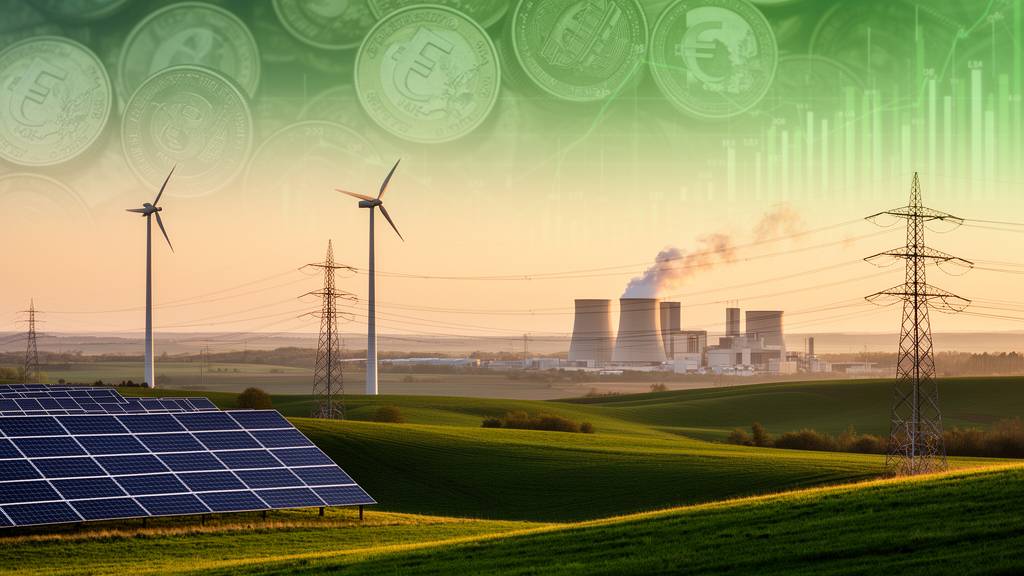
Green taxation, green finance, green research and development, and digitalization all significantly increase the production of renewable energy, bioenergy, and nuclear energy across the 27 member states of the European Union, according to a new open-access study published in Discover Energy on 5 October 2026. The research, led by Emmanuel Uche and Nicholas M. Odhiambo, analyzed annual panel data for the EU27 from 2005 to 2022 and found that the strength of each driver differs sharply by energy type. Green taxes and green finance showed their strongest positive effects on nuclear energy, while green R&D did more for renewables. Digitalization and resource efficiency worked especially well for bioenergy. One result stood out as a warning: gross domestic product mostly harmed carbon-free energy production, a finding the authors say signals a need for strategic policy changes if the bloc is to meet its net-zero goals under the European Green Deal.
The study addresses a persistent gap in the empirical literature. Most previous work has examined what drives the consumption of carbon-free energy rather than what boosts its production, and fewer studies have examined all three carbon-free sources side by side in a single comparative framework. The authors argue that this narrow focus limits the ability of policymakers to design targeted interventions, because the drivers of renewables, bioenergy, and nuclear power may not behave the same way. Their analysis is the first, they report, to compare the effects of green taxation, green finance, green R&D, digitalization, and resource efficiency across all three energy categories simultaneously in the EU27, a region they describe as a global front-runner in sustainable energy transitions.
Methodologically, the paper departs from the linear, time-insensitive estimators common in earlier research, such as GMM, 2SLS, CS-ARDL, ARDL, and PMG. Instead, the authors applied a Markov Chain Monte Carlo-estimated Generalized Quantile Regression, or MCMC-GQREG, combined with a time-variant frequency-domain panel Granger causality test. The baseline estimates were produced with an adaptive optimizer using 10,000 noisy draws and 3,000 burn-ins. This quantile-based approach matters because the effects of policy variables can differ across the distribution of energy output: a tax reform may stimulate production strongly in countries with low output but weakly in countries already producing at high levels. The dataset covered 27 countries over 18 years, and the scope was determined by the availability and consistency of data across the selected indicators.
Before estimating marginal effects, the authors ran a battery of preliminary diagnostics. Cross-sectional dependency tests indicated significant dependence across the EU27 panel units, with the exception of bioenergy under one of the two CD statistics. Panel unit-root tests showed that most variables were stationary after first differencing, while resource efficiency was level stationary. A slope heterogeneity test rejected the null hypothesis of homogeneous slopes, and a Westerlund Durbin-Hausman panel cointegration test with Fisher effect rejected the null of no cointegration, indicating that the variables converged in the long term. Descriptive statistics showed bioenergy with the highest mean in the panel, at 9.68, compared with 0.148 for renewables and 0.334 for nuclear, and bioenergy was also the most variable series. Green taxes had the highest average among the predictors, reflecting what the authors call the large fiscal role of environmental levies in the EU.
The headline results on green taxation were consistent across the quantile distribution. Renewable energy production rose by approximately 38 percent at the fifth quantile, an effect that dipped to about 1 percent at the tenth quantile before climbing back to roughly 18 percent at the ninety-fifth quantile. Comparing the strongest effects across energy types, nuclear energy showed the highest response to green taxation, with a significant 47 percent increase, followed by bioenergy at 45 percent and renewables at 38 percent. The authors note that relatively modest effects at some quantiles, such as the twenty-fifth quantile for renewables, may reflect regulatory inefficiencies or limited compliance with green tax policies. Overall, they conclude, green taxation plays a critical role in enhancing carbon-free energy production in the EU27.
Green finance produced a more complicated picture. Its effects were heterogeneous across the distribution: it constrained renewable energy production at the lower and middle quantiles, with an observed reduction of approximately 40 percent, but enhanced output at the seventy-fifth and ninety-fifth quantiles, where gains of about 33 percent and 31 percent were recorded. For bioenergy and nuclear energy, by contrast, the effects were positive across the quantiles. Green finance delivered its strongest positive impact on nuclear energy production, at 84 percent, followed by bioenergy at 54 percent and renewables at 33 percent. The authors argue that the negative effects observed at lower and middle quantiles point to the need for targeted policy actions to mitigate or eliminate these adverse outcomes, even as the findings reaffirm the potential relevance of green finance in supporting the energy transition.
Resource efficiency and digitalization showed distinct patterns of their own. Resource efficiency had a predominantly negative effect on bioenergy and nuclear energy outputs but a considerable positive impact on renewable energy production from the middle to the upper quantiles. Its most pronounced contribution was in bioenergy, at 23 percent, followed by renewable energy at 15 percent, while its effect on nuclear energy was marginal at 0.005 percent. Digitalization, meanwhile, enhanced renewable energy production significantly across its quantiles, with the most pronounced effects between the fifth and seventy-fifth quantiles and a peak impact of 21 percent at the seventy-fifth quantile. Comparatively, digitalization exerted its strongest positive effect on bioenergy production, at 38 percent, followed by nuclear energy at 0.066 percent and renewable energy at 0.021 percent. The authors say this underscores the role of digital technologies in advancing the objectives of the EU Green Deal.
The frequency-domain Granger causality analysis reinforced these findings. For each predictor, the incremental R-squared curves consistently exceeded the critical frequency-domain thresholds, confirming the rejection of the null hypothesis of no causality and establishing significant time-varying Granger causal effects of green taxation, green finance, green R&D, digitalization, resource efficiency, and GDP on renewable energy production. For conciseness, the published plots report only the renewable energy results, but the authors state that the enlisted variables serve as significant drivers of carbon-free energy production across the EU27 economies. Robustness checks using FGLS, PCSE, and fixed-effects Driscoll-Kraay estimators, the latter selected on the basis of a generalized Hausman test with a Chi2 value of 72.350 and a p-value of 0.000, validated the baseline estimates, again showing all six predictors to be significant drivers while highlighting negative effects from GDP, resource use, and some aspects of green finance.
The policy implications flow directly from the comparative estimates. The authors recommend that EU27 countries strengthen their energy and environmental tax frameworks, expand the scope of green taxes across all sectors, and substantially reduce tax exemptions, consistent with the EU Green Tax Directives. They suggest that green tax revenues, if allocated efficiently, could support carbon-free energy initiatives, and they advise policymakers to prioritize renewable and bioenergy production over nuclear energy given the latter’s resource-intensive nature and reliance on finite fuels such as uranium. On the financing side, the study recommends a dedicated funding pool for carbon-free energy production, potentially including a specialized capital market for carbon-free technologies, and points to the Horizon Europe program, with its 95.5 billion euro research allocation, and to directing a greater share of European Emission Trading Scheme revenues toward digitalization and innovation.
The study also carries clear limitations. The authors state that the conclusions highlight country-specific peculiarities and may not be entirely generalizable to non-EU27 countries, and that data limitations may have undermined some policy insights. They call for future research using updated or more detailed data, extending the analysis to other regions such as the G20 and emerging and developing economies, and examining individual EU countries for country-specific insights. Even so, the central message is that the drivers of carbon-free energy production in Europe are energy-specific and distribution-sensitive: green taxes and finance lift nuclear output most strongly, green R&D favors renewables, and digitalization and resource efficiency matter most for bioenergy, while GDP consistently works against production gains. The findings arrive as the EU pursues its Fit for 55 target of cutting CO2 emissions by at least 55 percent from 1990 levels by 2030, a 42.5 percent carbon-free share of the energy mix, and an updated Renewable Energy Directive targeting 45 percent carbon-free energy by 2030.
Subject of Research: Drivers of renewable, bioenergy and nuclear energy production across EU27 countries from 2005 to 2022
Article Title: Investigating the key drivers of carbon-free energy production: New evidence from EU countries
Article References: Uche, E., & Odhiambo, N. M. (2026). Investigating the key drivers of carbon-free energy production: New evidence from EU countries. Discover Energy, 6(1), Article 77. https://doi.org/10.1007/s43937-026-00144-5
Image Credits: AI Generated
DOI: 10.1007/s43937-026-00144-5
Keywords: carbon-free energy, EU27, green taxation, green finance, digitalization, renewable energy, bioenergy, nuclear energy, MCMC-GQREG, European Green Deal, resource efficiency, energy policy
News Source: Denise Maddox. (October 29, 2026). Green Taxes and Finance Steer Nuclear, Renewable and Bioenergy Output Across the EU27. Scienmag.