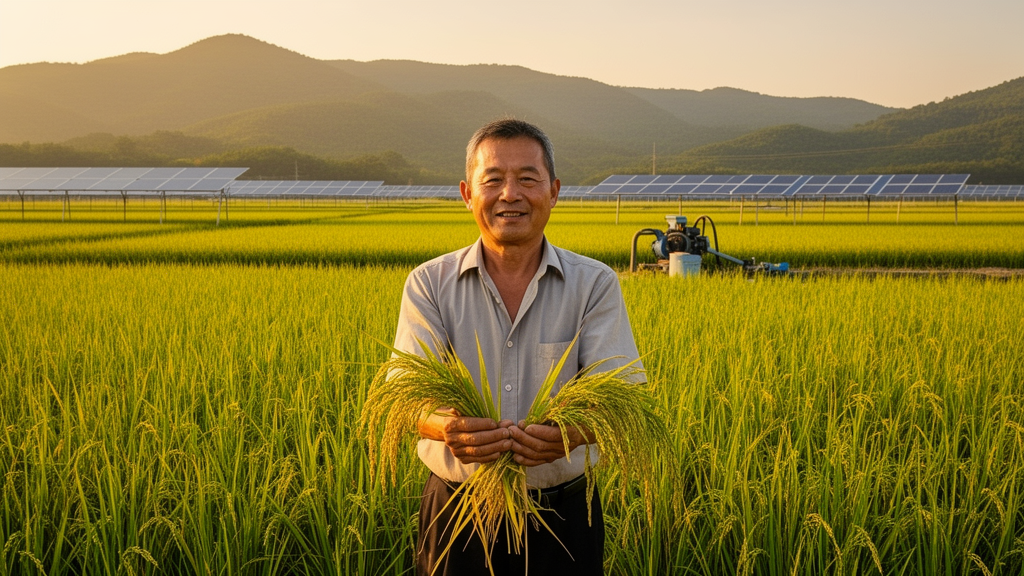
Green subsidies do more than any other single policy to lift the green development level of China’s family farms, but pushing every policy lever at once erodes the balance between the economic, environmental, resource-use and management dimensions that make green development sustainable. That is the central message of a new modeling study published in Agricultural and Food Economics, which simulates alternative green agricultural policy strategies for Chinese planting-oriented family farms out to the year 2030. The research, led by Yuanyuan Zhang and colleagues, argues that the sequencing of policies matters as much as their strength: a phased strategy that deploys green subsidies early and then shifts emphasis to green credit and standardized management raises the green development level by 8.43 percent relative to the baseline while preserving higher coordination among subsystems than simultaneous intensification.
The study addresses a puzzle in China’s agricultural policy record. With less than 8 percent of the world’s arable land, Chinese agriculture feeds nearly 18 percent of the global population, but that achievement has come at the cost of high input intensity and environmental pressure, notably overconsumption of fertilizers and pesticides. In response, the government has built a comprehensive system of green agricultural policy and regulation, and fiscal investment in green agricultural initiatives alone reached nearly 44 billion yuan in 2021. Yet China’s agricultural green development index increased by only 2.34 percent between 2015 and 2021, suggesting that intensifying the policy response has not produced proportionate improvements in outcomes.
Family farms sit at the center of this policy landscape. Compared with traditional smallholders, they combine moderate-scale land operation with family-based labor and market-oriented management, and they tend to show greater economic power, management capability and willingness to adopt green technologies. Their registered number in China grew from 343,000 in 2015 to 3,914,000 in 2021, with the land area operated also increasing substantially, making them natural targets for green agricultural policy. The authors conceptualize the green development of family farms as a coordinated outcome of four dimensions: agricultural economic performance, ecological environment, resource utilization and standardized management.
Methodologically, the team built a system dynamics model integrated with a coupling coordination framework. Data came from the China Family Farm Monitoring Program, which has collected continuous data on planting-oriented family farms across all 31 provinces since 2014 and covers nearly 2,000 such farms. After cleaning, the calibration dataset contained 9,876 valid farm-year observations from 2014 to 2018. The model, implemented in VENSIM with 35 variables, simulates the green development system over 2014 to 2030 with a one-year time step, using 2014 to 2018 for calibration and validation and 2019 to 2030 as the policy simulation horizon. Historical validation against observed green development levels showed deviations within the conventional plus-or-minus 10 percent error range in each validation year.
The coupling coordination model quantifies balance among the four subsystems, with equal weights of 0.25 assigned to each, a choice the authors justify as reflecting the premise that all four dimensions are jointly indispensable. A sensitivity analysis perturbing the weights by plus or minus 20 percent left the relative ranking of policy scenarios stable, indicating the conclusions are not driven by the equal-weight assumption. In the baseline scenario, the green development level of family farms rises to 0.88 by 2030, an increase of 68.4 percent compared with the 2018 level, though the pace of improvement gradually slows. Family farm profit in the simulation climbs from 167,500 yuan in 2018 to 334,600 yuan in 2030, while quality management grows most steeply among the subsystems, by 169.33 percent, followed by ecological and environmental benefits at 153.31 percent and resource utilization at 122.96 percent.
The single-policy simulations raise each of five instruments, land transfer policy, green credit policy, green subsidy policy, green technology training and standardized management policy, by 30 percent in implementation intensity while holding other conditions constant. The green subsidy policy proves the most effective for the green development level, delivering a 9.58 percent improvement over the baseline by 2030, followed by green technology training at 7.44 percent, green credit at 2.46 percent, land transfer at 1.93 percent and standardized management at 1.21 percent. But the coupling coordination degree deteriorates under the subsidy, land transfer and training scenarios. The authors attribute this to uneven adjustment speeds: subsidies produce large gains in the environmental dimension while economic and management dimensions move more modestly, and the coordination index is sensitive to such cross-dimensional disparities.
Simultaneous intensification of all five policies by 10, 20 and 30 percent raises the green development level by 6.39, 9.63 and 13.01 percent respectively, though with diminishing marginal benefit as intensity increases. Coordination, however, declines in every simultaneous scenario. The dispersion of subsystem growth rates widens as policy strength intensifies, with economic and environmental subsystems growing strongly while the resource subsystem contracts and management expands only modestly. The authors describe this as an inherent tension between performance and balance: policies that boost one subsystem too strongly widen the gaps across others, producing unbalanced development paths that are hard to sustain.
Portfolio scenarios reveal a similar pattern. An ecological priority scenario combining enhanced green subsidies and technology training, each at intensity 1.15, delivers the largest average green development gain at 8.46 percent, followed by a comprehensive development scenario at 4.52 percent, an economic priority scenario at 2.20 percent and a standardized management priority scenario at 1.57 percent. Yet all four portfolios show a tendency toward lower coordination than the baseline, with stronger priority orientations producing wider cross-subsystem disparities. Even the comprehensive scenario, which adjusts all five instruments moderately to 1.06, generates adjustment speed differences among the subsystems.
The phased scenarios, anchored to China’s 14th and 15th Five-Year Plans with the first stage extended to 2026 to capture carryover effects, test seven timing arrangements for the three most consequential instruments. The preferred scenario, labeled SC6, strengthens green subsidies in the first stage and then shifts to green credit and standardized management in the second stage, from 2027 to 2030. It raises the green development level by 8.43 percent relative to the baseline, the largest gain among the phased options, while avoiding the marked coordination deterioration seen in several alternatives. The authors explain the logic: subsidies are most effective early, when they directly meet farmers’ green production needs, whereas China’s agricultural green credit system remains imperfect, with many producers lacking collateral and knowledge of financial policies, and family farms often lack the capital for institutional and brand building until economic and ecological benefits have begun to spill over. In later stages, farmers expanding green production require more financial support and efficient management solutions, so credit and standardization become the higher-value levers.
The authors caution that the analysis operates at the national aggregate level and abstracts from regional heterogeneity; because the model is calibrated on plantation-oriented family farms, its implications apply most directly to regions with relatively high degrees of farm scaling and market-oriented production, and regional recalibration may be needed where fragmented smallholder systems dominate. They also note that the phased strategy assumes a continuous baseline policy framework with incremental rebalancing rather than replacement of existing measures, and that learning and coordination frictions during policy transitions are treated as a working assumption rather than an estimated parameter. Future work, they suggest, could incorporate richer instruments such as digital agricultural initiatives and climate risks. Within those limits, the study’s core recommendation stands: rather than intensifying every green policy at once, governments should sequence them, using subsidies to launch the green transition and credit and standardized management to sustain it.
Subject of Research: Simulation of green agricultural policy instruments and their sequencing for the green development of Chinese family farms
Article Title: Which policy options are more effective in promoting the green development of family farms within the framework of coordinated development?
Article References: Zhang, Y., Zhang, M., Yang, C., Xue, Y., & Wang, W. (2026). Which policy options are more effective in promoting the green development of family farms within the framework of coordinated development?. Agricultural and Food Economics, 14(1), Article 85. https://doi.org/10.1186/s40100-026-00518-2
Image Credits: AI Generated
DOI: 10.1186/s40100-026-00518-2
Keywords: family farms, green subsidies, green credit, standardized management, system dynamics, coupling coordination, China, agricultural policy, green development, policy sequencing, sustainable agriculture, policy simulation
News Source: Alan Morgan. (October 29, 2026). Green subsidies lead the way, but phased policy mixes best protect China’s family farm gains. Scienmag.