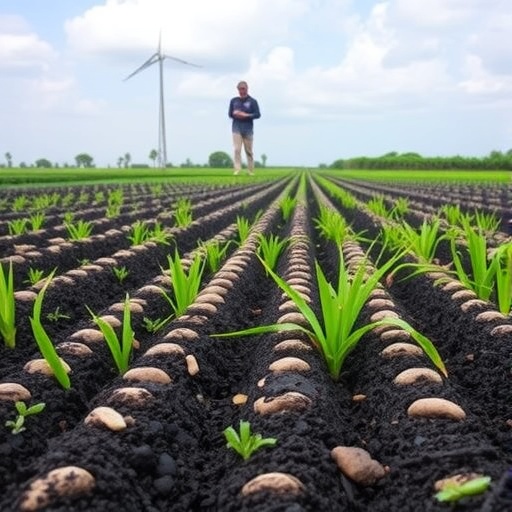
A groundbreaking study published in the journal Biochar unveils a transformative approach to enhancing the degradation of pollutants in paddy soils through the use of an engineered form of biochar known as graphitized biochar. This advanced material fundamentally alters the microbial electron transfer processes, facilitating faster and more efficient pollutant breakdown, which holds immense promise for sustainable agricultural practices and environmental remediation.
At the core of this innovation lies the ability of graphitized biochar to act as a geoconductor—an electrically conductive bridge embedded within the soil matrix that bridges microorganisms and insoluble iron minerals. By elevating the electrical conductivity of biochar more than twofold via a flash Joule heating technique, this material drastically improves microbial interactions with iron (Fe(III)), effectively redirecting microbial electron transfer pathways. This modification enhances the microbial iron reduction process, a critical biochemical reaction that stimulates the generation of hydroxyl radicals, potent oxidizing agents capable of degrading persistent organic contaminants.
Rice paddies, essential for global food security, are increasingly burdened by the accumulation of antibiotic residues and other organic pollutants introduced through manure and irrigation sources. These contaminants often resist natural degradation, raising concerns about soil health, crop safety, and broader ecological impacts. Traditional biochar applications have been valued primarily for their capacity as electron reservoirs; however, this study challenges that paradigm by emphasizing biochar’s role as an active conductor facilitating direct electron flow. Such conductive properties enable microbial communities to overcome electron transfer bottlenecks that have historically limited hydroxyl radical formation and subsequent pollutant degradation.
The interplay between microbial metabolism and soil chemistry is crucial in this context. Electrons released by microbes during Fe(III) reduction must travel efficiently through the soil environment to sustain the redox reactions that produce reactive iron species and hydroxyl radicals. The introduction of graphitized biochar enhances this electron mobility, increasing reactive iron species production by almost 19% and hydroxyl radical generation by over 50%, compared to soils lacking this material. These shifts translate into markedly higher degradation rates of antibiotics such as sulfamethoxazole, achieving nearly complete elimination under controlled experimental conditions.
One of the remarkable dimensions of this research is the reshaping of soil microbial communities driven by graphitized biochar. The conductive biochar selectively enriches populations of iron-reducing bacteria, which further accelerates electron transfer cycles and creates a self-reinforcing ecological feedback loop. This synergistic interaction not only improves contaminant removal but also suggests broader implications for soil microbial ecology and biogeochemical cycling in agricultural soils.
The study’s findings underscore the critical influence of indigenous soil microbiomes and physicochemical properties on the efficacy of graphitized biochar. Variability across different soil types revealed that soils with more metabolically active microbial consortia benefited most from the enhanced electron transfer capabilities. These insights highlight the necessity of considering site-specific soil biological factors when designing bioremediation strategies involving conductive carbon materials.
Practically, the synthesis of graphitized biochar via flash Joule heating represents a scalable advance in biochar production technology. This rapid thermal processing increases graphitization levels, creating extended conjugated carbon structures that facilitate long-range electron transport. This approach not only enhances biochar functionality but also opens avenues for engineering other carbon-based materials tailored to environmental remediation and sustainable agriculture.
The implications of this research extend beyond pollutant degradation. By redefining the electronic role of biochar in soil ecosystems, this work invites a reevaluation of carbon materials in broader soil biochemical processes, including nutrient cycling and greenhouse gas mitigation. The recognition of conductive biochar as an active electron conduit rather than merely an electron reservoir represents a paradigm shift with significant future research potential.
As global food production faces mounting pressures from soil contamination and antibiotic pollution, technologies that integrate advanced materials science with microbial ecology offer a promising path forward. By harnessing the geoconductor properties of graphitized biochar, scientists and farmers alike may unlock new capabilities for sustainably managing soil health and ensuring the safety and productivity of agricultural systems.
In summary, this pioneering study reveals that engineering biochar’s electrical properties can redirect microbial metabolic pathways, enhancing iron reduction and stimulating hydroxyl radical production in paddy soils. These bioelectrochemical interactions facilitate robust pollutant degradation, positioning graphitized biochar as a cutting-edge tool in the fight against environmental contamination and contributing toward more sustainable agricultural landscapes.
Subject of Research: Interaction between graphitized biochar and microbial electron transfer in paddy soils for pollutant degradation.
Article Title: Geoconductor function of graphitized biochar redirects microbial Fe(III) reduction and stimulates hydroxyl radical production in paddy soil.
News Publication Date: 17-Apr-2026.
Web References:
https://link.springer.com/journal/42773
http://dx.doi.org/10.1007/s42773-026-00597-w
References:
Shang, H., Jia, C., Wu, S. et al. Geoconductor function of graphitized biochar redirects microbial Fe(III) reduction and stimulates hydroxyl radical production in paddy soil. Biochar 8, 92 (2026).
Image Credits: Hua Shang, Chao Jia, Song Wu, Ning Chen, Yujun Wang & Xiangdong Zhu
Keywords: biochar, graphitized biochar, microbial electron transfer, Fe(III) reduction, hydroxyl radical production, paddy soil remediation, pollutant degradation, antibiotic residues, soil microbiome, conductive carbon materials, flash Joule heating, environmental sustainability
Tags: advanced biochar for environmental cleanupantibiotic residue degradation in agriculturebiochar-driven sustainable agriculture practicesbiochar-enhanced iron reductionelectrically conductive biochar for soilflash Joule heating biochar modificationgraphitized biochar for pollutant degradationhydroxy radical generation for contaminant breakdownmicrobial electron transfer in soilorganic pollutant remediation in paddy soilssoil microbial interactions with iron mineralssustainable remediation in rice paddies