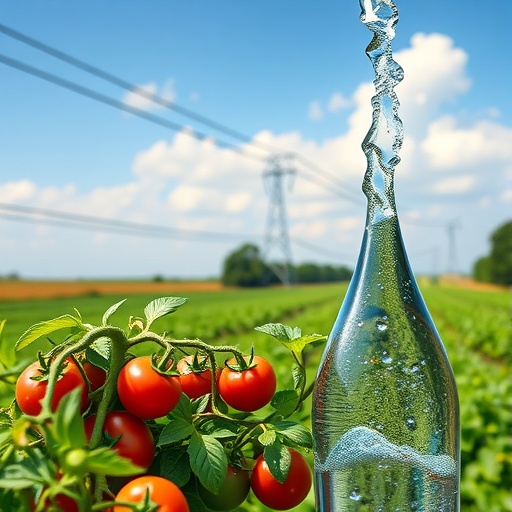
In the face of mounting global challenges such as water scarcity, climate change, and the increasing demand for clean energy, innovative agricultural practices are becoming essential to ensuring food security and environmental sustainability. A groundbreaking study conducted by researchers from the University of Seville (US) and the Polytechnic University of Madrid (UPM) presents a compelling case for the combined use of regulated deficit irrigation and agrivoltaic systems in tomato cultivation as a dual solution to these pressing issues. This pioneering research, carried out in the spring of 2024 in both Madrid and Seville, explores the synergistic potential of simultaneously generating solar energy and enhancing water-use efficiency in horticultural crop production.
At the core of this study lies the innovative concept of agrivoltaics—an approach which integrates photovoltaic panels with crop production on the same land. By strategically positioning solar panels above tomato plants, the agrovoltaic system modulates the microclimate through shading, which notably reduces plant evaporative demand. This shading effect mitigates water loss via transpiration, creating an environment that requires lower water input to maintain crop vitality. The researchers coupled this system with regulated deficit irrigation (RDI), an advanced irrigation strategy that imposes controlled water stress on plants based on their physiological water status, thereby optimizing water usage without drastically impairing yield.
The experimental design involved three distinct treatments: a control group receiving full irrigation, an RDI group subjected to water limitations based on plant stress indicators, and an agrivoltaic system applying the same RDI protocol under the partial canopy of photovoltaic installations. Extensive measurements including leaf water potential and gas exchange parameters were recorded to assess the plants’ stress levels and physiological responses throughout various developmental stages. This comprehensive monitoring enabled the team to elucidate the delicate balance between water restriction and plant performance under shaded versus unshaded conditions.
One of the most striking outcomes was the remarkable 50% reduction in water consumption achieved by the RDI treatments compared to the traditional full irrigation regime. This halving of water input underscores the potential of regulated deficit irrigation as a water-saving agricultural technique. Nonetheless, this conservation came at a trade-off; the RDI method resulted in approximately 20% lower tomato yields, mostly attributable to heightened water stress during the critical fruit ripening phase. The observed yield decline underscores the importance of precision irrigation scheduling to avoid detrimental stress levels that compromise productivity.
Despite the decrease in total fruit production, the researchers emphasize the increased irrigation water productivity—expressed as the amount of fruit produced per unit of water applied—in the RDI treatments. This metric improved substantially, especially in Seville, signifying that the system effectively maximizes the output from limited water resources. Such enhancement in water-use efficiency reflects a paradigm shift towards sustainable intensification where crop production is optimized relative to water availability.
The interplay between photovoltaic shading and crop growth was another focal point of the investigation. While the shadow cast by solar panels inherently diminishes incident radiation, a crucial driver of photosynthesis, the system’s design accommodated sufficient light interception during most crop growth stages. The findings suggest that tomato plants can maintain adequate physiological functions under the moderated light environment, thereby supporting viable yields despite reduced direct solar exposure. This balance between light reduction and plant adaptability is fundamental to the feasibility of agrivoltaic agriculture.
To holistically evaluate the combined efficacy of crop cultivation and energy generation on the same land, the study employed the Land Equivalent Ratio (LER), a widely accepted metric measuring land-use efficiency in intercropping or multifunctional systems. The agrivoltaic setups demonstrated LER values of 1.54 in Madrid and 1.67 in Seville, substantially exceeding the benchmark of 1 that indicates equivalent standalone land use. These elevated LER values unequivocally demonstrate that integrating photovoltaic panels with tomato cultivation enhances overall land productivity, validating the multifaceted benefits of agrivoltaic innovation.
The sustainability dimension of the agrivoltaic system was further reinforced by the economic and environmental advantages conferred by clean energy generation. Despite some diminution in tomato yield under the panels, the added value from photovoltaic electricity production increased the system’s profitability and reduced its ecological footprint. This integrated model offers a compelling narrative for optimizing land use in a world where both arable land and freshwater resources are increasingly scarce, while simultaneously contributing to renewable energy targets.
However, the researchers caution that successful implementation of such agrovoltaic systems requires meticulous irrigation management to prevent excessive plant stress, which can negate productivity gains. They advocate for advanced sensor integration, combining plant water status measurements with soil moisture monitoring, to refine irrigation schedules and adapt dynamically to fluctuating environmental conditions. This precision agriculture approach is anticipated to further elevate the efficiency and resilience of agrivoltaic crop systems.
Looking ahead, this study sheds light on a promising agricultural paradigm that aligns with the dual imperatives of climate resilience and sustainable intensification. By leveraging the complementary interactions between solar energy capture and crop water regulation, agrivoltaic systems signify a transformative leap toward embracing multifunctionality in farming landscapes. The research team envisages this technology as a pivotal element to overcome imminent challenges related to water scarcity and energy transition in agricultural sectors worldwide.
Published in the esteemed journal Agricultural Water Management, the study underscores the collaborative effort between Spanish academic institutions—namely the ETSIAAB at the Polytechnic University of Madrid, CEIGRAM, and ETSIA at the University of Seville. The work is part of the Ministry of Science and Innovation and the State Research Agency’s project titled ‘Sustainable vegetable production based on agrovoltaic systems’ (PID2021-122772OB-I00), evidencing the strategic national emphasis on sustainable agriculture innovation.
In summary, integrating regulated deficit irrigation with agrivoltaic technology represents a sustainable pathway for horticultural crop production amidst escalating resource constraints. The ability to halve irrigation water usage while maintaining economically viable yields, combined with on-site renewable energy generation, defines a win-win scenario for farmers and the environment alike. As the global community grapples with the intertwined crises of water scarcity, food security, and energy demand, such pioneering research provides a beacon guiding future agricultural strategies.
The findings affirm that with ongoing refinement and adoption of smart irrigation techniques, agrivoltaics has the potential to revolutionize the way food and energy coexist on the landscape. These innovations herald an era where agricultural productivity and sustainability are mutually reinforced, reinforcing the urgent need to adopt integrative land-use models that address the multifaceted realities of climate change and resource limitations.
Subject of Research: Sustainable vegetable production through integrating regulated deficit irrigation and agrivoltaic systems to optimize water resources and energy generation in tomato cultivation.
Article Title: Regulated deficit irrigation based on plant water status and Agrivoltaic systems as possible improvements on water resources management in tomato
News Publication Date: 12-Mar-2026
Web References: http://dx.doi.org/10.1016/j.agwat.2026.110281
Image Credits: University of Seville
Keywords: Agriculture, Engineering, Energy resources, Food science
Tags: agrivoltaic systems in agricultureclimate-smart agriculture practicesdual-use land for energy and cropsenergy-efficient farming solutionsenhancing food security with agrivoltaicsinnovative irrigation methods for sustainabilityintegrated solar panel agriculturereducing water use in tomato cultivationregulated deficit irrigation benefitssolar energy in horticulturesustainable tomato farming techniqueswater conservation in crop production