• HOME
  • NEWS
  • EXPLORE
    • CAREER
      • Companies
      • Jobs
    • EVENTS
    • iGEM
      • News
      • Team
    • PHOTOS
    • VIDEO
    • WIKI
  • BLOG
  • COMMUNITY
    • FACEBOOK
    • INSTAGRAM
    • TWITTER
Sunday, May 10, 2026
BIOENGINEER.ORG
No Result
View All Result
  • Login
  • HOME
  • NEWS
  • EXPLORE
    • CAREER
      • Companies
      • Jobs
        • Lecturer
        • PhD Studentship
        • Postdoc
        • Research Assistant
    • EVENTS
    • iGEM
      • News
      • Team
    • PHOTOS
    • VIDEO
    • WIKI
  • BLOG
  • COMMUNITY
    • FACEBOOK
    • INSTAGRAM
    • TWITTER
  • HOME
  • NEWS
  • EXPLORE
    • CAREER
      • Companies
      • Jobs
        • Lecturer
        • PhD Studentship
        • Postdoc
        • Research Assistant
    • EVENTS
    • iGEM
      • News
      • Team
    • PHOTOS
    • VIDEO
    • WIKI
  • BLOG
  • COMMUNITY
    • FACEBOOK
    • INSTAGRAM
    • TWITTER
No Result
View All Result
Bioengineer.org
No Result
View All Result
Home NEWS Science News Chemistry

Graphene drum: Researchers develop new phonon laser design

Bioengineer by Bioengineer
September 6, 2025
in Chemistry
Reading Time: 2 mins read
0
IMAGE
Share on FacebookShare on TwitterShare on LinkedinShare on RedditShare on Telegram

Professor Konstantin Arutyunov of the HSE Tikhonov Moscow Institute of Electronics and Mathematics (MIEM HSE), together with Chinese researchers, has developed a graphene-based mechanical resonator, in which coherent emission of sound energy quanta, or phonons, has been induced. Such devices, called phonon lasers, have wide potential for application in information processing, as well as classical and quantum sensing of materials. The study is published in the journal Optics Express.

Using an analogy with photons, quanta of the electromagnetic spectrum, there are also particles of sound energy, phonons. In fact, these are artificially introduced objects in physics – quasi-particles, which correspond to vibrations of the crystal lattice of matter.

Some substances, when irradiated, emit photons of the same wavelength, phase, and polarisation. This process, called stimulated emission, was predicted by Albert Einstein over a century ago and is the basis of the device we all know – the laser. The first lasers were constructed about sixty years ago, and they have become firmly established in our lives in various fields.

A similar process, involving the emission of ‘identical’ phonons, underlies a device called, by analogy, a phonon laser, or saser. In fact, it was predicted at the same time as lasers, but only a few experimental realisations have been developed over a long period of time, and none of them have been widely used in the industry.

Magnesium ions, semiconductors, composite systems with microcavities, electromechanical resonators, nanoparticles, and many other substances and systems have been used as active media for phonon lasers over the last decade. Unlike previous studies, the present study used graphene to create coherent acoustic excitations. Due to the unique properties of graphene, such resonators can potentially be widely used.

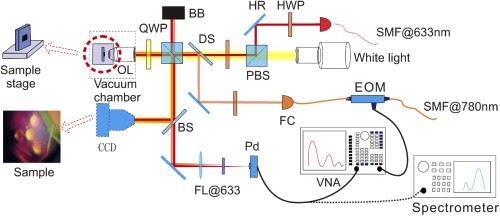
The graphene resonator was produced by microlithography: a photo-sensitive polymer film is deposited on a silicon substrate. Using ultraviolet light, a certain structure is ‘drawn’ on the substrate, which subsequently allows the formation of a repeating system of micro-cavities by means of plasma treatment. The treated substrate is covered with a layer of graphene, and this system of ‘drums’ behaves like a resonator, i.e. it amplifies external vibrations if they are generated with a certain frequency.

If such a ‘drum’ is irradiated with laser light at a specific wavelength, photons are repeatedly reflected between the silicon backing and the graphene, thereby forming optical cavities where mechanical vibrations of the appropriate frequency are produced.

‘Experimentally, we have examined a nanostructure, which is a fixed membrane made of a monatomic layer of carbon, or a graphene. Vibrations of atoms, or phonons, were activated in it through exposure to external optical radiation,’ says Konstantin Arutyunov. ‘The research is expected to continue, as it is of considerable interest both for physics of ultra small objects and has the potential to create a new generation of quantum optomechanical sensors and transducers.’

###

Media Contact
Liudmila Mezentseva
[email protected]

Original Source

https://www.hse.ru/en/news/478717889.html

Related Journal Article

http://dx.doi.org/10.1364/OE.423904

Tags: Chemistry/Physics/Materials SciencesElectromagneticsgraphene technologymechanical resonatorNanotechnology/MicromachinesNuclear PhysicsOpticsoptomechanical sensorsphonon laserquantum sensing
Share12Tweet8Share2ShareShareShare2

Related Posts

Miniature Sensor Uses Light to Detect Touch — Chemistry

Miniature Sensor Uses Light to Detect Touch

May 8, 2026
Iron Minerals Determine Whether Dissolved Organic Matter Fuels Microbes or Becomes Long-Term Carbon Storage — Chemistry

Iron Minerals Determine Whether Dissolved Organic Matter Fuels Microbes or Becomes Long-Term Carbon Storage

May 8, 2026

Kate Evans Appointed Associate Lab Director for Biological and Environmental Systems Science at ORNL

May 8, 2026

Advancing Multiscale Modeling and Overcoming Operational Challenges in Autothermal COâ‚‚-to-Methanol Reactors

May 8, 2026
Please login to join discussion

POPULAR NEWS

  • Research Indicates Potential Connection Between Prenatal Medication Exposure and Elevated Autism Risk

    840 shares
    Share 336 Tweet 210
  • New Study Reveals Plants Can Detect the Sound of Rain

    727 shares
    Share 290 Tweet 181
  • Scientists Investigate Possible Connection Between COVID-19 and Increased Lung Cancer Risk

    68 shares
    Share 27 Tweet 17
  • Salmonella Haem Blocks Macrophages, Boosts Infection

    61 shares
    Share 24 Tweet 15

About

We bring you the latest biotechnology news from best research centers and universities around the world. Check our website.

Follow us

Recent News

Urdu Fall Risk Questionnaire Adapted for Elderly

Key Pharmacological Markers for HIV Prevention in MSM

Taking 8,500 Steps Daily May Aid Long-Term Weight Management, Study Finds

Subscribe to Blog via Email

Success! An email was just sent to confirm your subscription. Please find the email now and click 'Confirm' to start subscribing.

Join 82 other subscribers
  • Contact Us

Bioengineer.org © Copyright 2023 All Rights Reserved.

Welcome Back!

Login to your account below

Forgotten Password?

Retrieve your password

Please enter your username or email address to reset your password.

Log In
No Result
View All Result
  • Homepages
    • Home Page 1
    • Home Page 2
  • News
  • National
  • Business
  • Health
  • Lifestyle
  • Science

Bioengineer.org © Copyright 2023 All Rights Reserved.