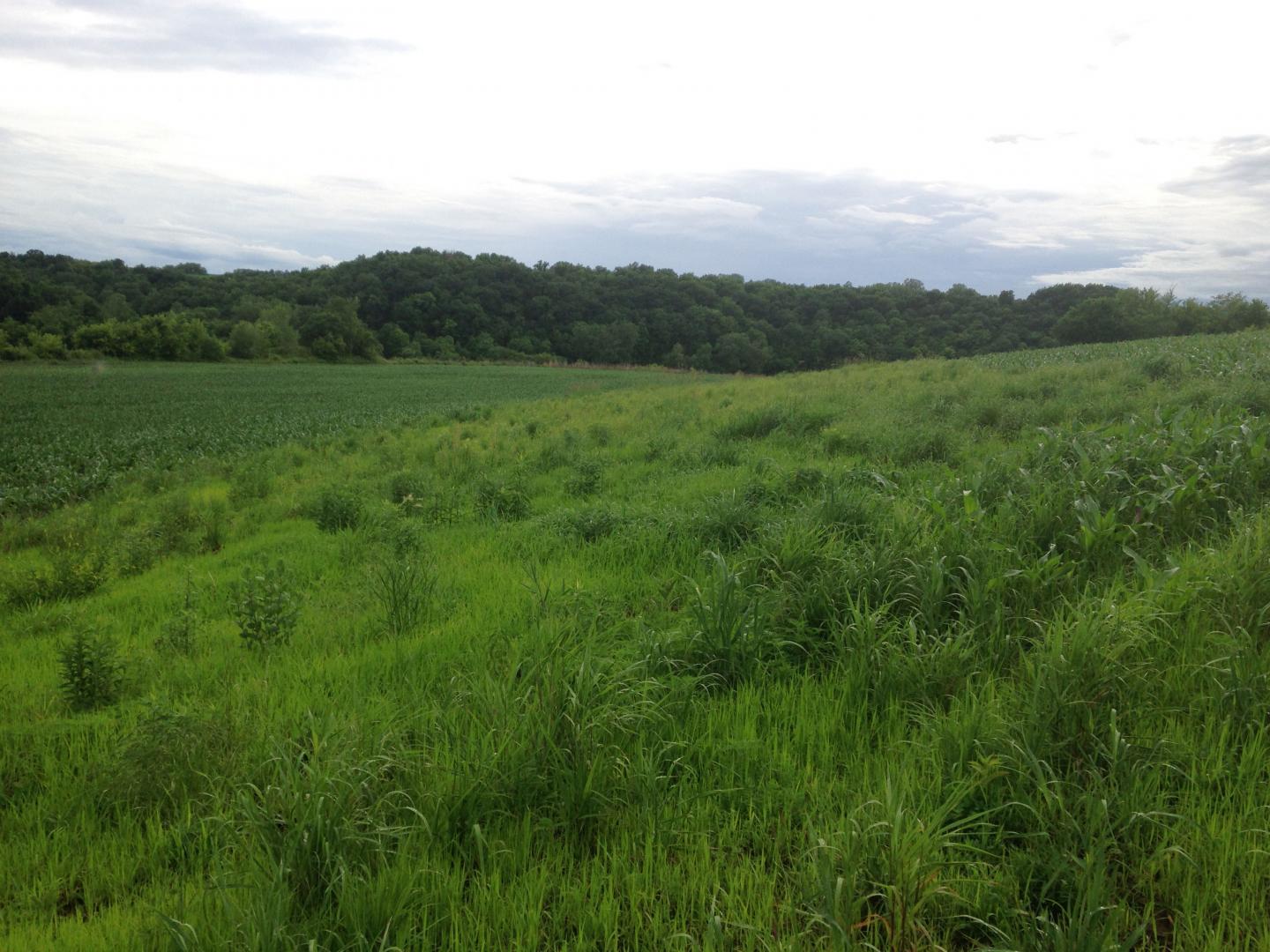
Credit: Lisa Schulte Moore
AMES, Iowa – Researchers at Iowa State University will test how the environmental benefits of planting strips of prairie among row crops change over time, filling in an unexplored gap in prairie strip research that stretches back over a decade.
Richard Cruse, a professor of agronomy, and his colleagues recently received a three-year, $746,000 grant from the Foundation for Food and Agriculture to conduct experiments to gauge how quickly soil health changes after the implementation of prairie strips. They’ll also examine how quickly soil health reverts to its previous state after strips are removed and the land converted back into crop production. The work will take into account factors such as erosion and surface hydrology, or how water moves through prairie strips and surrounding fields. The researchers also will conduct an economic analysis of prairie strips, which will consider new income streams strips may generate.
Cruse said previous research on prairie strips, a farmland conservation practice in which strategic locations in fields are seeded with prairie grasses and flowers, has documented how the strips slow erosion and provide habitat for wildlife, but questions remained about how long it takes for those benefits to manifest, and how quickly they disappear when the strips are converted back into row crops. The research team will attempt to answer those questions, he said.
“If farmers want to rotate the location of a strip, or terminate a longstanding prairie or establish a new one, we want to provide data on how that will affect soil health,” he said.
To find those answers, the ISU scientists will convert some existing prairie into row crops and measure several variables related to soil health over time. They’ll also convert some acres devoted to row crops into new prairie. The experiments will take place at the Neal Smith Wildlife Refuge near Prairie City, where ISU researchers have conducted previous strips-related research. Additional experimental sites will be located on land belonging to cooperating farmers in Iowa and Missouri.
The researchers will use tea bags to help measure biological activity in the soil, an important measure of soil health, Cruse said. Different tea varieties contain various proportions of nitrogen and carbon. Substances with high nitrogen content tend to decay more rapidly when buried in soil, while substances with high carbon decay slowly. The researchers will bury the tea bags in the soil of experimental sites and weigh the tea bags at determined intervals. Tea bags that exhibit rapid weight loss indicate high rates of biological activity in the soil, which is usually ideal for crop production.
In addition, the researchers will use modeling technology to create a statewide map of topsoil depth. They’ll then take core samples to measure the accuracy of their computer modeling methods. Cruse said the data will help researchers understand how prairie strips affect erosion on surrounding land.
The project also will examine the economic implications of prairie strips. For instance, converting land from row crops into prairie reduces the overall amount of grain a farmer harvests, but some sections of fields regularly produce yields that lag behind the surrounding acres. This can be due to soil considerations, topography or a range of other reasons, Cruse said. But these marginal acres often don’t produce enough grain to justify the necessary input costs, and planting prairie on those sections might make more financial sense.
Prairie strips might create new revenue streams, as well, Cruse said. For instance, the project’s economic analysis may look at the possibility of leasing land near prairie strips for hunting or its suitability as habitat for honeybees.
###
FFAR’s Seeding Solutions grant program is an open call for bold ideas that address pressing food and agriculture issues in one of the foundation’s Challenge Areas. The Foundation for Food and Agriculture Research, a 501 (c) (3) nonprofit organization originally established by bipartisan Congressional support in the 2014 Farm Bill, builds unique partnerships to support innovative and actionable science addressing today’s food and agriculture challenges.
Media Contact
Fred Love
[email protected]
Original Source
https:/