


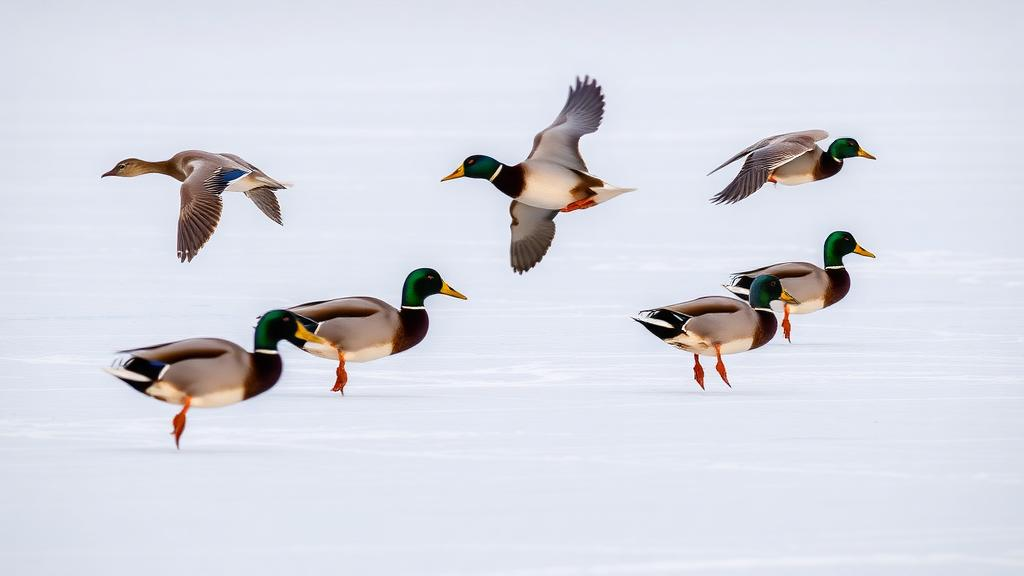
Six species of dabbling ducks that spend the winter side by side in South Korea do not travel north in the same way in spring. A new GPS tracking study of 95 individuals, published in BMC Zoology, shows that birds sharing the same wintering region adopt clearly divergent migration strategies, from the long, fast journeys of the Northern Pintail and Baikal Teal to the shorter, lower-intensity movements of the Mallard and Eastern Spot-billed Duck.
The research team, led by Hyung-Kyu Nam and colleagues, fitted trackers to Baikal Teal, Northern Pintail, Eurasian Teal, Mallard, Eurasian Wigeon and Eastern Spot-billed Duck, all wintering in South Korea. By following the birds during northward migration, the researchers compared total migration distance, mean migration speed, maximum daily distance, stopover behaviour and migratory connectivity across species.
To separate genuine species differences from year-to-year variation, the team used distribution-specific generalized linear mixed models, with species as a fixed effect and year as a random intercept. These models identified interspecific differences in total migration distance, mean migration speed, maximum daily distance, the maximum latitudinal shift between stopovers, the ratio of night movement, and both mean and maximum stopover duration. Migration duration, by contrast, did not differ significantly among the six species.
Some results were less clear-cut. Differences in the number of stopovers, the mean latitudinal shift between stopovers, and route straightness were weaker or sensitive to the choice of model, the authors report, suggesting that these aspects of migration behaviour are harder to pin down with the available tracking data.
The clearest contrasts emerged among species. Northern Pintail and Baikal Teal undertook the longest migrations of the tracked birds. Baikal Teal recorded the largest maximum daily movements, while Mallard and Eastern Spot-billed Duck made shorter journeys with lower movement intensity. Eurasian Wigeon stood out for the longest stopover durations, whereas Northern Pintail and Eurasian Teal showed high observed stopover counts. According to the authors, these patterns indicate species-specific combinations of movement and stopover use along a multidimensional time–energy trade-off continuum.
Mapping where the birds paused revealed a strongly patterned stopover network. Stopover sites were concentrated along the Yellow Sea coast, in northeastern China, and in the southern Russian Far East. This concentration underscores the importance of these regions as staging grounds for multiple duck species moving north from Korean wintering grounds.
Mantel correlations were small and non-significant in the tracked samples, although nearest-neighbour indices revealed differences in local spatial structure among the species. In other words, the tracked ducks did not show strong statistical evidence of coordinated connectivity, but finer-scale spatial patterns did differ between species.
The authors argue that their findings carry direct implications for conservation along the East Asian–Australasian Flyway. Because dabbling ducks sharing a single wintering region can adopt divergent migration strategies and use different stopover networks, they suggest that conservation planning should prioritize key staging areas, notably the Yellow Sea region, and should consider the connectivity and redundancy of species-specific stopover networks rather than treating the flyway’s ducks as a single unit.
Understanding how co-occurring migratory species differ in movement strategy, the study notes, is essential for predicting their responses to habitat change along flyways.
Subject of Research: Interspecific differences in spring migration strategies and stopover use among dabbling ducks wintering in South Korea
Article Title: Contrasting northward migration strategies and stopover use among sympatric dabbling ducks from a shared wintering region
Article References: Nam, H.-K., Choi, Y.-S., Lee, J.-Y., Oh, M.-R., Lee, H.-J., Cho, H., Hong, K.-S., Lee, H., & Kim, D.-W. (2026). Contrasting northward migration strategies and stopover use among sympatric dabbling ducks from a shared wintering region. BMC Zoology. https://doi.org/10.1186/s40850-026-00298-8
Image Credits: AI Generated
DOI: 10.1186/s40850-026-00298-8
Keywords: dabbling ducks, spring migration, GPS tracking, stopover ecology, South Korea, Yellow Sea, East Asian–Australasian Flyway, migratory connectivity, Baikal Teal, Northern Pintail, BMC Zoology, wetland conservation
News Source: Drew Townsend. (October 28, 2026). GPS tracking reveals six duck species sharing one wintering ground migrate in strikingly different ways. Scienmag.



