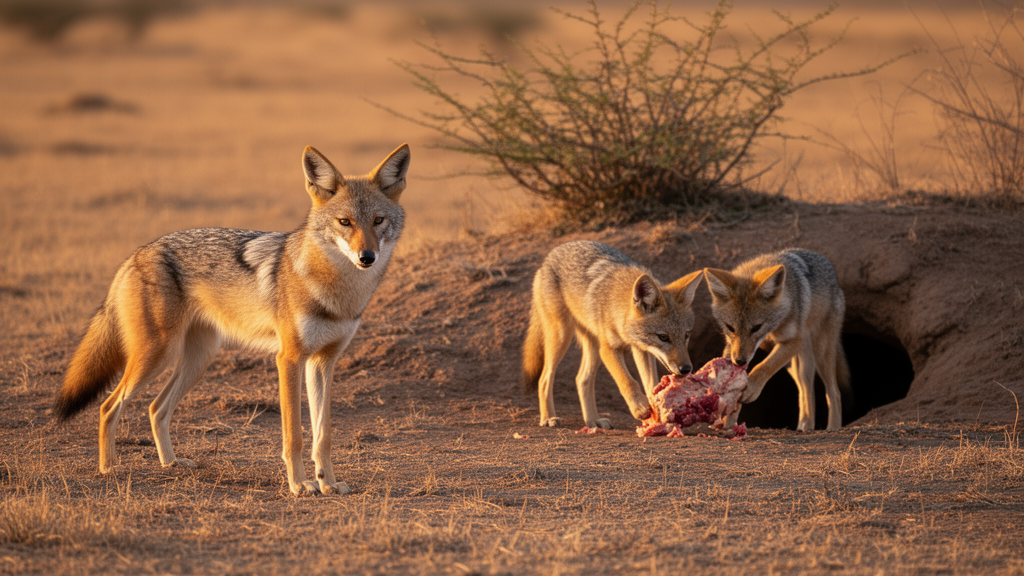
On the Bulgarian bank of the Danube River, a single non-breeding male Golden jackal has been documented stepping into the role of primary caregiver after the breeding pair of his family group disappeared, according to a longitudinal field study spanning two consecutive seasons. The finding offers a rare, finely detailed window into the cooperative breeding behaviour of a species whose European expansion has puzzled and impressed scientists in equal measure, and it suggests that helpers within jackal family groups may be a critical, previously underappreciated engine of the species’ demographic resilience.
The Golden jackal (Canis aureus) has been expanding remarkably from its traditional strongholds across Europe, a phenomenon attributed to a combination of environmental changes. Researchers have pointed to the decline of large carnivores such as the wolf, which may have released medium-sized predators from competitive pressure, alongside land-use change, deforestation, expanding road networks and the growing availability of food sources linked to human activity. The rewilding of abandoned agricultural land and the jackal’s considerable dispersal capacity add further momentum. Bulgaria stands out in this picture: the country hosts what is currently the largest jackal population in Europe, despite intense lethal management, and the animals not only recover from culling but continue to spread.
This resilience has prompted scientists to look inside the jackal’s social life for explanations. In canids, cooperative breeding is typically associated with socially monogamous mating systems, in which non-breeding individuals assist in raising young, for example by providing food. In Golden jackals, the core of the group is the breeding alpha pair, with females and males sharing pup-rearing duties roughly equally and usually remaining monogamous. Around this pair, the family group includes subordinate non-breeding adults that share in parenting. The new study documents just such alloparental care in the form of extended helping by a subordinate non-breeding adult, arguing that this behaviour is a critical mechanism for sustaining family groups under pronounced lethal control.
The research relied on an unusually long-term and immersive field approach. The team observed a resident jackal family group at its core territory for eight years, from 2017 to 2024, combining a manned camera-trap monitoring a bait-site with extensive in-field visual and audial observations. The present analysis drew on the last two seasons, 2023 and 2024, the period in which the researchers achieved sufficient certainty to unambiguously identify the breeding female, the breeding male and the non-breeding male as distinct individuals. The study site sits on the Danube bank, where dense thickets of Amorpha fruticosa interspersed with poplar, beech and willow form nearly impenetrable cover, bounded by a loess bluff whose soft soil allows badger setts that jackals can secondarily excavate.
The bait-site itself was designed to mimic the waste dumps found near villages and anglers’ camps along the Danube, which jackals actively exploit. Installed each year between April and May and removed by late August to mid-September, it targeted the denning and post-denning periods. The circular clearing of roughly six metres in diameter lay about thirty metres from the birthing den. Bait consisted of a minimum of two kilograms of soaked rolled oats, often enriched with fish, fish innards, bread and camp leftovers, reaching up to six kilograms. A camera trap, mounted on a poplar at 1.5 metres, recorded the site from 2018 onwards, later paired with a voice recorder and, from 2023, backed by a second camera. Footage was segmented into visits, each lasting from about a minute to a maximum of twenty minutes, with typical overnight rates of ten to twelve visits per night, ranging from zero to a maximum of twenty.
Identifying who was who among the visitors demanded a rigorous system of individualisation based on distinctive features, both exterior and behavioural. Exterior markers included ear shape, the hairy brush in the genital area of adult males, coat darkness, tail dimensions and markings, and muzzle breadth. Behavioural markers included the timing of visits, whether an individual appeared in association with lower-ranking family members, care-giving behaviour at the bait-site, wary versus confident posture, camera-related behaviour and chemical marking frequency. Care-giving itself was graded on a four-point scale: from chasing juniors away from food, through leaving food for waiting subordinates and eating nose-to-nose with them, to the highest grade of carrying food to the bait-site rim or towards the birthing den.
During the 2023 and 2024 seasons, the family consistently comprised three senior adults over four years old, four junior adults aged one to two-plus years, and, from late July, four cubs under one year old. The three senior adults, the breeding male, breeding female and non-breeding male, remained constant across both seasons, while losses and dispersal occurred among the junior cohorts. Senior adults visited the bait-site individually, whereas junior adults and cubs typically arrived in pairs or larger groups. Kernel density estimation, with bandwidths selected by the Sheather-Jones plug-in method, was used to visualise and compare visitation patterns across the day-night cycle, with curves scaled by each subject’s proportional contribution to total visitation and, in a second analysis, weighted by altruism scores.
The pivotal events unfolded in the 2024 season. The breeding male disappeared after the beginning of July, and the breeding female vanished later that month. Statistical models revealed a striking compensatory response from the non-breeding male: after the breeding male’s disappearance, he was 3.1 times more likely to display altruistic behaviour of any grade compared with the baseline period, with 95 percent confidence limits of 1.6 to 6.0 and p less than 0.001. Once the breeding female was also gone, this rose to 6.8 times more likely, with confidence limits of 4.4 to 10.6. The quality of his care-giving changed as well: with both primary caregivers absent, the likelihood of displaying a higher grade of care-giving was 6.3 times greater than during the base period, with confidence limits of 4.1 to 9.8. Notably, the increase in care-giving grade after the breeding male alone disappeared was not statistically significant.
The models also showed that the non-breeding male’s helping was not a static trait but a developing response to the family’s needs. The probability of altruistic behaviour was low at the start of the denning period, with an intercept of minus 2.5, and increased steadily by approximately two percent each day as the season progressed, with a confidence interval of 0.8 to 3.3 percent and p less than 0.001, indicating care adjusted to the developmental stage of the cubs. In 2023, the breeding female’s visiting and care-giving rates were roughly twice those of the breeding male, who showed minimal presence and low care-giving. The non-breeding male, by contrast, displayed very high values on both counts, particularly in 2024, and remained active at the bait-site well after solar midnight, long after the resource was exhausted and the breeding female’s presence had faded. Junior adults recorded the highest visitation of all, but their care-giving was low, mostly confined to sharing food among themselves and with the cubs and occasionally carrying food to the den, behaviour that could not be directly observed and was therefore scored at grade zero, a limitation the authors acknowledge alongside the fact that their altruism measure excludes den-level behaviours such as nursing or regurgitation.
The study’s primary conclusion is the dominant standing of a senior adult male as a care-giving performer, overturning the expectation that the breeding pair exercises the main protection of the young. Because the bait-site lay close to human habitation, the authors interpret the senior non-parental adult’s presence during the danger-prone first half of the night as an in-group strategy for deflecting anthropogenic threat, improving the protective capacity of the inexperienced juvenile cohort. Cubs, kept away from the resource in its prime state and peaking at the bait-site only after midnight, benefited overwhelmingly from the non-breeding male’s care. This social system, in which helpers rather than parents carry the main burden of upbringing and protection, appears to confer a high survival rate for the young and is likely to contribute critically to the demographic success of a population that continues to expand despite some of the heaviest extermination pressure in Europe.
Subject of Research: Alloparental care by a non-breeding male Golden jackal sustaining a family group under lethal control in Bulgaria
Article Title: Extended cubs’ care helping as a factor of reproductive success in a resident Golden jackal ( Canis aureus Linnaeus, 1758) family group
Article References: Konstantinov, Y., Konstantinov, B., Kamenova, S., Acosta-Pankov, I., & Spassov, N. (2026). Extended cubs’ care helping as a factor of reproductive success in a resident Golden jackal (Canis aureus Linnaeus, 1758) family group. Biodiversity Data Journal, 14, Article e191590. https://doi.org/10.3897/BDJ.14.e191590
Image Credits: AI Generated
Keywords: golden jackal, cooperative breeding, alloparental care, Bulgaria, camera traps, family group, canid behaviour, reproductive success, lethal control, Danube River, kernel density estimation, social organisation
News Source: Drew Townsend. (October 27, 2026). Golden Jackal Helpers Step Up When Breeders Vanish, Study Finds. Scienmag.